Top 5 Observability Predictions for 2026
The Observability Shift This traditional monitoring as this industry has understood it for decades, is effectively obsolete. Static dashboards, threshold-based alerts and siloed monitoring tools were born in a world of predictable infrastructure and fairly basic application architectures.
But in today’s digital environments, they find it hard to cope with the scale, speed and complexity of modern systems. Cloud-native platforms, distributed microservices and always on digital experiences have expanded the traditional monitoring model to a far larger extent.
Entering 2026, the organizations are entering an era of Intelligent Observability. Under this paradigm, systems don’t just report that something failed.
Rather, they help teams understand the motive behind it, how that spread across services, and what the next steps are to mitigate or even prevent impact.
Observability is no longer about how one reacts after failing; it is about continuous understanding and preemptive action. This shift is not incremental—it is fundamental.
Historically, monitoring only answered questions we knew were asked: “Is the server up?” Or, “Is CPU usage above a certain threshold?” However, with observability teams will be able to ask new questions that they did not anticipate before.
It imparts the depth and context necessary to think about and understand distributed systems that are complex in terms of how they work.
By 2026, that distinction will not be academic. It will provide a good delineation of which organizations can safely operate at scale and which continue to suffer from outages, performance issues, and increasing operating costs.
The nature of Observability.
The ultimate goal of observability is to identify the internal state that a system has based on the information it provides you, at the root of it being.
Instead of checking and passively giving static signals for the checks and outputs, observability empowers engineers and operators to view on-the-fly how a system behaves on the fly while operating, especially when new failure modes emerge.
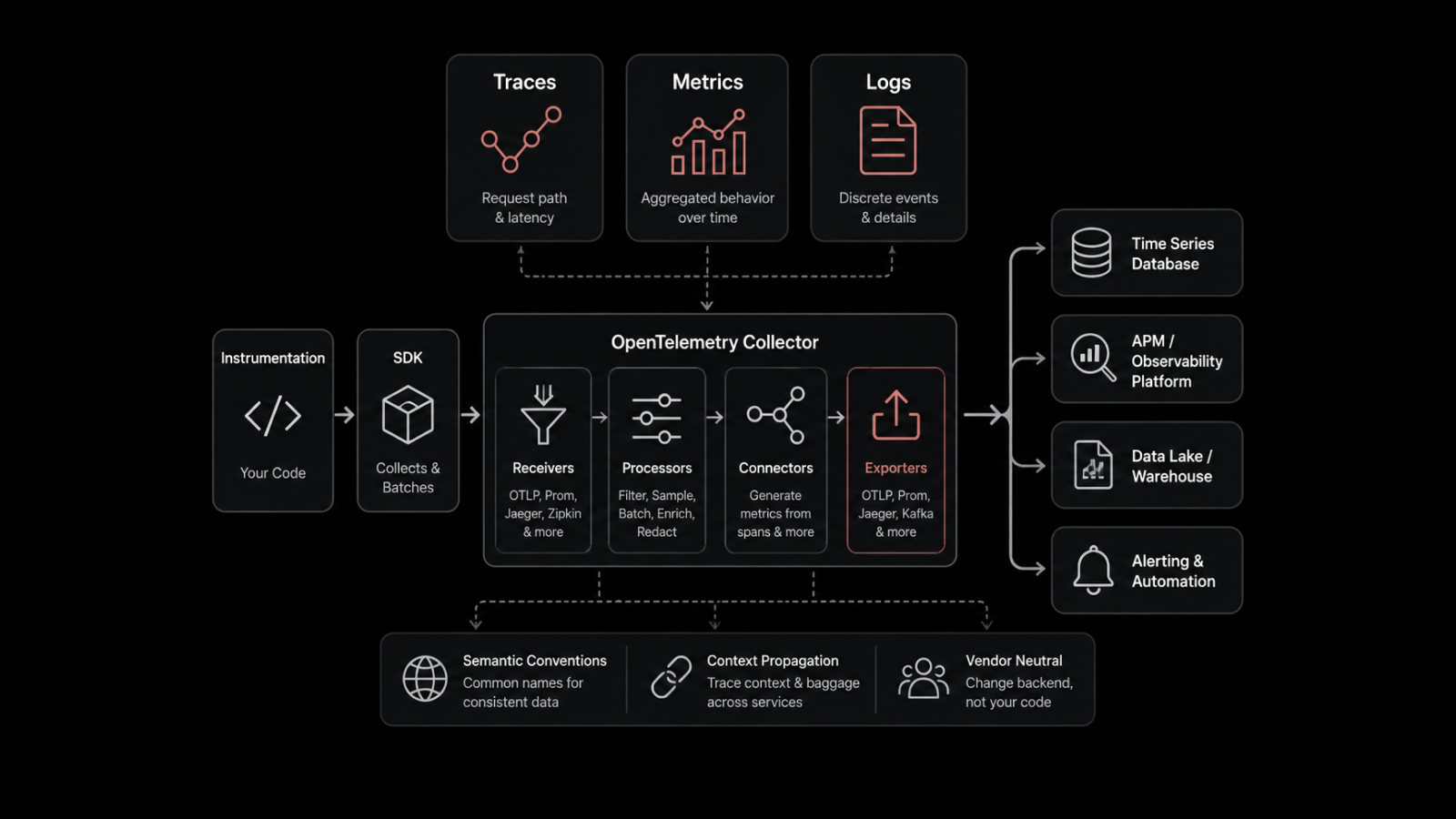
Classical understanding of observability data has been composed from three fundamental pillars:
Logs: A rich account of information and event-based information detailing the activity that occurred in an application or system at a given point in time.
Metrics: Aggregated numerical measurements over time to report trends, performance, and capacity.
Traces: Full picture view of requests as they move through a distributed system, exposing dependencies, latency and bottlenecks.
Though these pillars still help us, they are only the foundation of the foundation now. At the heart of modern environments are microservices, cloud-native architectures, Kubernetes, and increasingly generative AI and agentic systems.
They introduce such extremes of dynamism to these technologies. Services scale dynamically in a self-sustaining manner, dependencies are changing on an ongoing basis, deployments are happening at a rapid pace, and outages spread non-linearly across the board.
Observability has therefore shifted from being a diagnostic capability into a strategic one. Observability has turned into a bridge between both technical performance and user experience, business performance, financial efficiency, and regulation today. It has evolved to be an essential basis for digital trust and operational excellence.
The Five Major Predictions
We will be analyzing five major observability predictions for 2026 in this article.
1. AI is transformed from an ally copilot to an autonomous operational agent.
2. Intelligent telemetry filtering and data prioritization to achieve cost optimization.
3. OpenTelemetry becomes undisputed industry standard.
4. Observability spills over beyond engineering to business and compliance fields.
5. Resilience makes availability the new operational metric.
Prediction 1: AI Evolves from Copilot to Autonomous Agent.
Today, most observability platforms employ AI in limited, but important, ways. Anomaly detection helps us to discover unusual behaviour. Pattern recognition surfaces correlations across metrics and logs. Suggestions for root causes allow engineers to focus on potential problems.
These capabilities function as a copilot, helping human operators while still relying on them to investigate incidents and take corrective action.
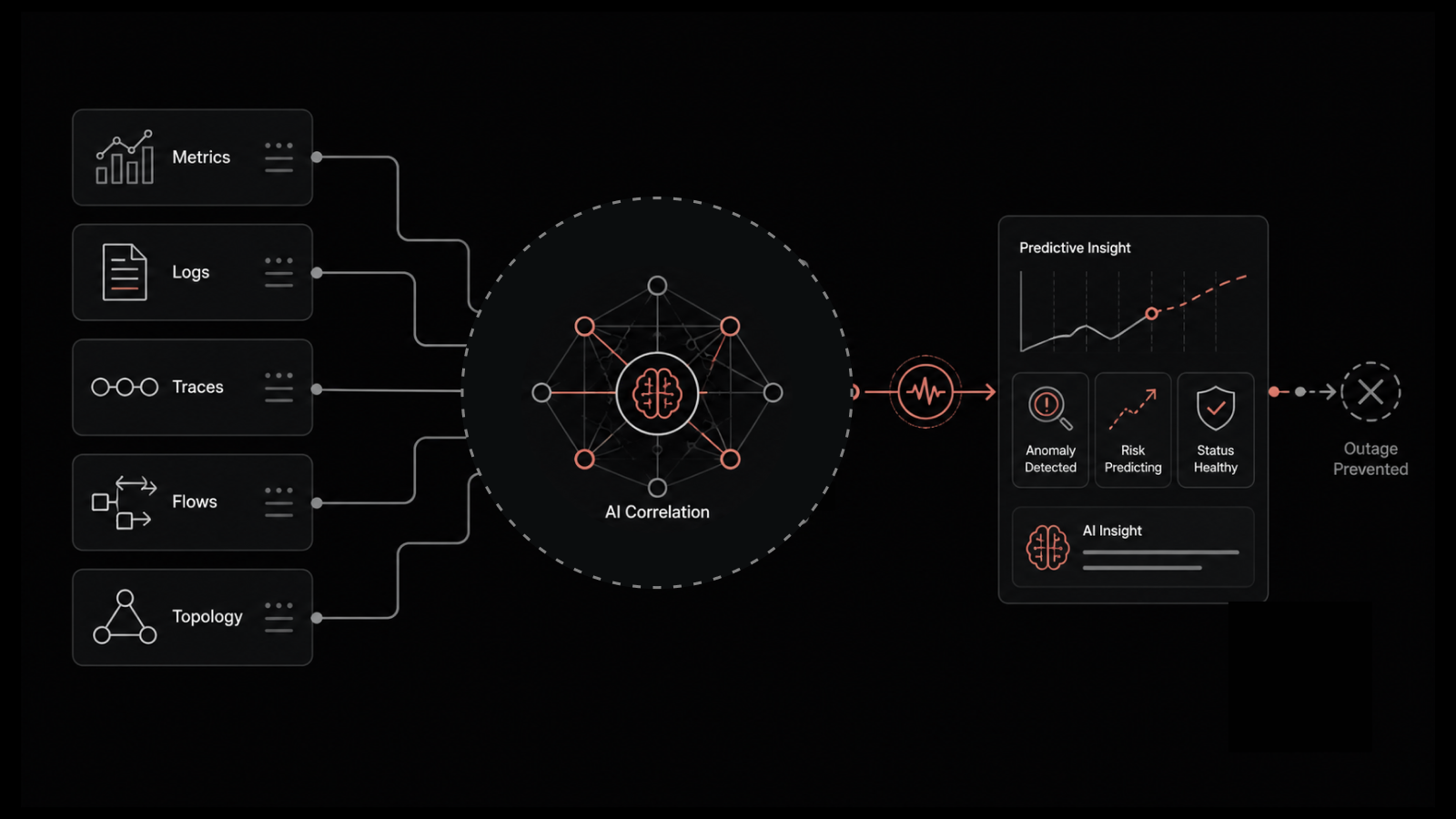
This model will be vastly developed in 2026. AI will change a copilot into an autonomous agent. These agents will monitor incidents and correlate signals from logs, metrics, traces, topology data, and change events, determining likely triggers with minimal human involvement.
More significantly, they will be able to automatically trigger prescribed remediation actions (restarting services, rolling back deployments, scaling resources, etc.). This adaptation is propelled by two key forces:
Increasingly complex modern systems, which increasingly exceed human cognitive limits.
The development in generative and agentic AI so that systems can reason, plan, and carry out multi-step actions autonomously by themselves.
Implication for Teams.
On engineering and operations teams, we will witness the profound effects:
Mean Time to Resolve (MTTR) will decrease significantly as incidents are resolved in real time.
Reduced on-call fatigue, as fewer alerts need human intervention.
SRE and DevOps operations will move from reactive firefighting to proactive reliability engineering. Rather than react to every alert, engineers will write guardrails, deploy policies, and define trust boundaries that ensure the operating behaviors of autonomous systems. Human expertise will drive the core expertise where it matters most: architecture design, resilience planning, and ongoing evolution.
Key Concept.
Autonomous Incident Response will become the default expectation rather than a competitive differentiator. Those organizations that do not adopt this model will fail to keep pace with those organizations.
Prediction 2: Cost Optimization Drives Intelligent Data Filtering.
Telemetry data volumes are growing at an unsustainable rate. Each microservice call, API request, AI inference, and background process produces logs, metrics, and traces.
Particularly agentic AI systems produce enormous quantities of high-cardinality telemetry that quickly overwhelms regular observability pipelines.
The long-standing practice of “collect everything and analyze later” is no longer reasonable. Storage, ingestion, and query costs keep climbing, often faster than infrastructure investment. Organizations will be faced in 2026 with the true cost of observability data at scale for the first time.
Industry will change its data value-oriented approach, focusing on data value rather than data volume. Rather than ingesting all telemetry indiscriminately, observability platforms will employ strategies such as Adaptive Telemetry which will include the following:
Intelligent sampling based on system health and business impact.
Pre-ingestion filtering to eliminate redundant and low-value data.
Dynamic routing of critical telemetry to high-performance storage and less critical data to lower-cost tiers.
It enables organizations to pay for insight, not noise, and investment in observability directly correlates with business priorities.
From a mere cost center, these observability platforms will become a profit enabler increasingly aligned with FinOps practices and cost-optimization methodologies.
Prediction 3: OpenTelemetry Becomes the Undisputed Standard.
This technology has evolved exponentially over the last few years. As companies transition from widespread adoption, by 2026 it will evolve from universal adoption to become the de facto required standard for telemetry instrumentation across clouds, vendors, and platforms.
With the rise of hybrid and multi-cloud strategies by organizations, proprietary instrumentation will be perceived as a liability. This will lead to flexibility, interoperability, and long-term sustainability, creating a need for standardization.
Implication for Vendors and Users.
OpenTelemetry provides users with:
True vendor independence and data portability.
Easier migration between observability platforms.
Consistent context propagation across services and tools.
For vendors, differentiation will move away from data collection into advanced analytics, automation, and intelligence based on a common telemetry infrastructure.
With a single telemetry pipeline, OpenTelemetry is the standard for delivering modern observability architectures.
Prediction 4: Observability Extends to Business and Compliance
Traditionally, observability was considered an engineering discipline that dealt merely with uptime and performance. By 2026, that boundary will dissolve. Telemetry data will increasingly be used to track business-aligned Service Level Objectives (SLOs):
Conversion latency.
Checkout success rates.
Search response times.
User abandonment thresholds.
Simultaneously, growing regulatory demands for AI governance, data privacy, and operational transparency will compel deeper observability into systems, pipelines, and models.
Implication for Leadership.
For senior executives and management, observability becomes a strategic decision-making asset that will guide:
Sprint prioritization and roadmap planning.
Infrastructure and platform investment decisions.
Budget allocation and cost justification.
Risk management and compliance reporting.
Observability data will also be key to AI model observability, auditability, and regulatory compliance.
Instead of measuring technical outcomes, reliability becomes a driver of business outcomes.
Prediction 5: Resilience Replaces Availability as the Top Metric.
In distributed, cloud-native systems, 100% availability is a myth. Dependencies fail, regions suffer outages, and third-party services introduce unavoidable risk. Availability is no longer the sole definition of operational excellence in this context.
By 2026, the best measure of success will be resilience — a system’s ability to withstand disruption, degrade gracefully, and recover quickly while ensuring good user experience.
Implication for Architecture. This shift will drive deeper investment in:
Chaos engineering and failure injection testing.
Strong failure domain isolation through advanced dependency mapping to understand blast radius and cascading failures.
Resilience-focused observability emphasizes how systems behave under stress, not only during normal operation.
Reliability, security (SecOps), and observability will converge into a single, unified operational requirement.
Final Takeaway
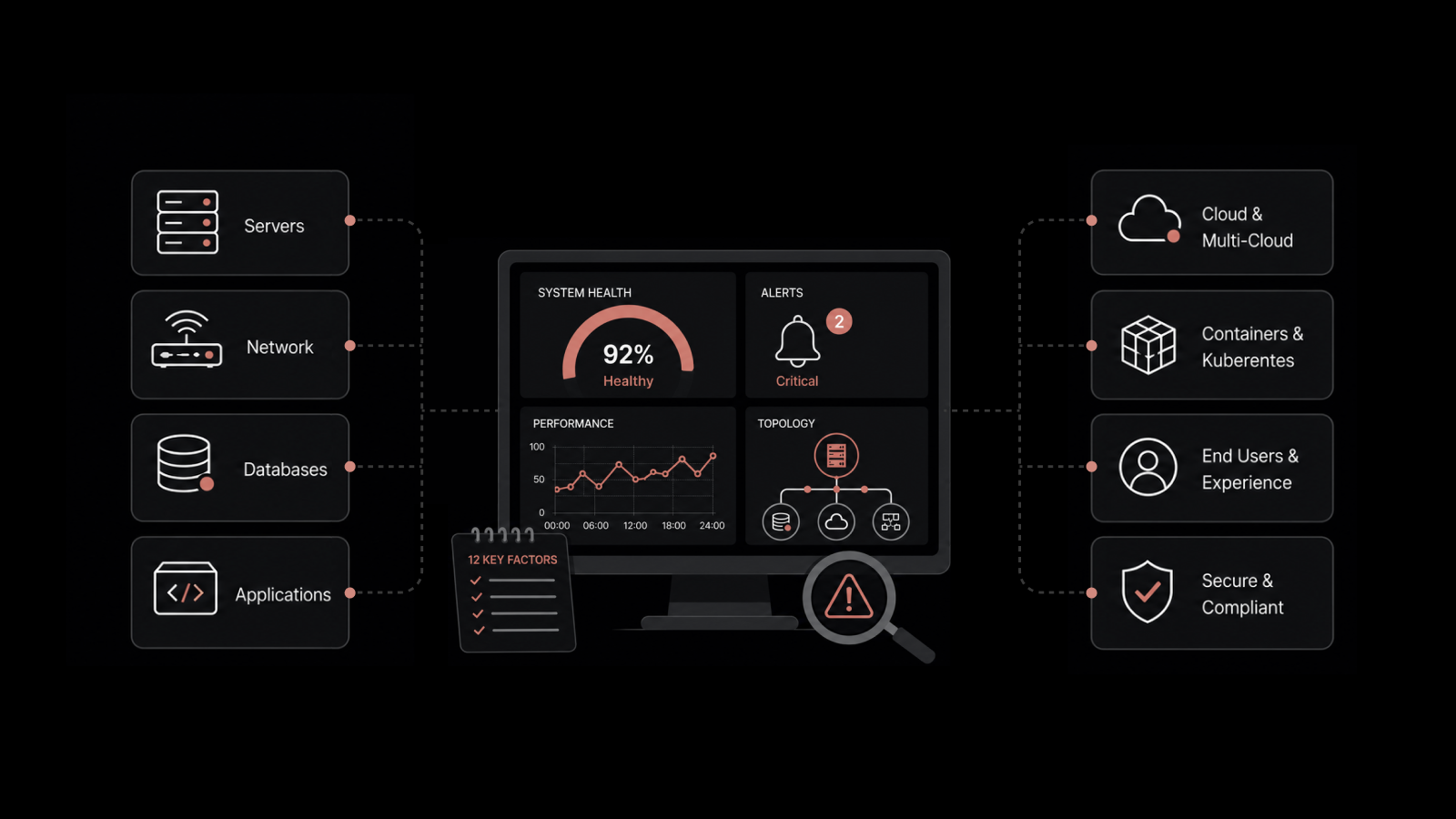
The future is in unified observability platforms that correlate data across the entire digital ecosystem and leverage AI to automate operations.
Companies that succeed will convert telemetry from raw data into actionable intelligence that helps the business operate properly and meet its business objectives.
FAQs
What is Intelligent Observability in 2026?
Intelligent Observability refers to the evolution of observability platforms that not only collect and correlate telemetry data but also apply AI-driven reasoning to predict failures, recommend actions, and automatically remediate incidents. In 2026, observability systems actively participate in operations rather than passively reporting issues.
How will AI change observability by 2026?
By 2026, AI in observability will transition from a decision-support copilot to an autonomous operational agent. These systems will correlate logs, metrics, traces, topology, and change data to identify root causes and execute remediation actions without human intervention.
Why is OpenTelemetry critical for modern observability?
OpenTelemetry provides a standardized, vendor-neutral framework for collecting telemetry data across distributed systems. As organizations adopt hybrid and multi-cloud architectures, OpenTelemetry becomes essential for portability, consistent context propagation, and long-term observability scalability.
How does observability help with cost optimization?
Modern observability platforms use intelligent telemetry filtering, adaptive sampling, and tiered storage to reduce unnecessary data ingestion. This ensures organizations pay for actionable insights instead of raw data volume, aligning observability investments with FinOps and business priorities.
Why is resilience more important than availability in 2026?
In complex distributed systems, failures are inevitable. Resilience measures how well a system withstands disruptions, limits blast radius, degrades gracefully, and recovers quickly. By 2026, resilience—not uptime alone—becomes the true indicator of operational excellence.
Prepare for the Future of Observability with AI-Driven Insights
Author
Arpit Sharma
Senior Content Marketer
Arpit Sharma is a Senior Content Marketer at Motadata with over 8 years of experience in content writing. Specializing in telecom, fintech, AIOps, and ServiceOps, Arpit crafts insightful and engaging content that resonates with industry professionals. Beyond his professional expertise, he is an avid reader, enjoys running, and loves exploring new places.