The Power Of AI In Network Monitoring
What Is AI-Driven Network Monitoring?
AI-driven network monitoring uses artificial intelligence and machine learning algorithms to continuously observe, analyze, and manage network infrastructure. Unlike traditional monitoring that relies on static rules and fixed thresholds, AI-driven monitoring learns what "normal" looks like for your specific environment, detects anomalies automatically, predicts problems before they occur, and can trigger automated remediation — all without requiring manual threshold configuration or constant human oversight.
Why Traditional Network Monitoring Isn't Enough Anymore
According to a Comcast Business survey, around 85% of IT leaders trust AI networking tools for meeting their organization's goals. That number reflects a shift that's been building for years: traditional network monitoring simply can't keep up with the complexity of modern infrastructure.
Networks today span on-premises data centers, multiple cloud providers, edge locations, and remote access points. The number of connected devices, virtual machines, containers, and microservices has exploded. Manual configuration of monitoring rules for every possible failure scenario isn't just impractical — it's impossible.
Traditional monitoring catches the problems you anticipated. AI-driven monitoring catches the problems you didn't. That's the fundamental difference, and it's why the shift is happening so fast.
Traditional vs. AI-Driven Network Monitoring
Understanding the differences helps clarify why organizations are making this transition:
Capability | Traditional Monitoring | AI-Driven Monitoring |
|---|---|---|
Alert Detection | Rule-based, static thresholds | ML algorithms with dynamic thresholds |
Configuration | Manual setup and tuning | Automated learning and adaptation |
Scalability | Limited by manual configuration capacity | Scales with automation |
Analysis | Historical, after-the-fact | Real-time and predictive |
Human Dependency | High — requires constant expert oversight | Reduced — AI handles routine analysis |
Threshold Management | Fixed values, manually adjusted | Dynamic, based on real-time behavioral patterns |
Automation | Limited to scheduled tasks | Automated diagnostics, remediation, and optimization |
Issue Resolution | Entirely human-driven | Automated for known patterns, human oversight for complex issues |
The shift isn't about replacing human expertise. It's about applying human expertise where it matters most — architecture, planning, and complex problem-solving — while AI handles the pattern recognition, correlation, and routine analysis that overwhelms manual approaches at scale.
Five Benefits of AI in Network Monitoring
1. Deeper Infrastructure Visibility
Modern networks are dense, virtualized, and distributed. Traditional monitoring tools often provide fragmented views — one tool for physical devices, another for virtual machines, another for cloud resources.
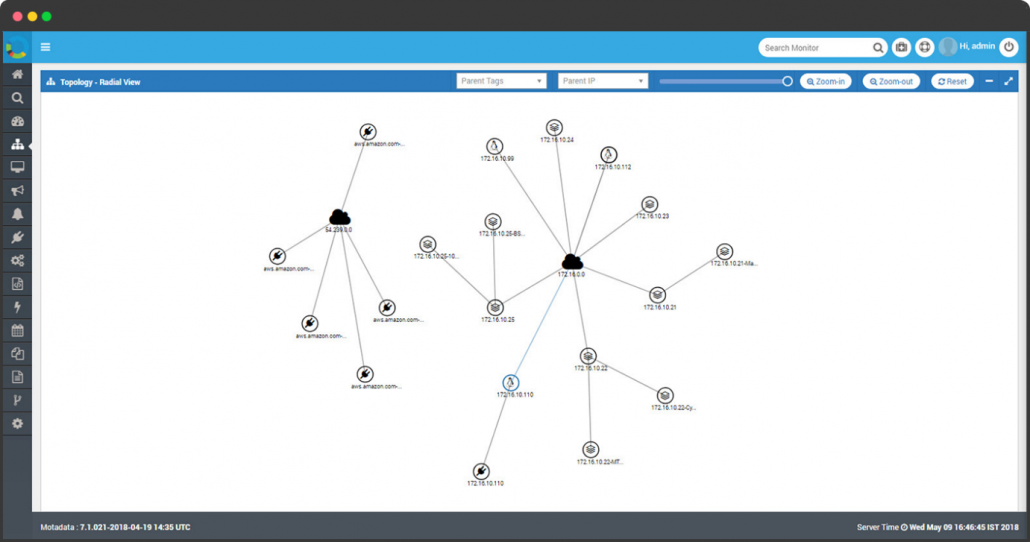
AI monitoring consolidates this visibility. It correlates data across infrastructure layers, identifies dependencies between systems, and provides a unified view of how all components interact. This means:
Clear visibility into physical, virtual, and cloud infrastructure from a single platform
Automatic dependency mapping that shows how component failures cascade
Improved root cause analysis that looks across systems rather than within silos
When you can see everything in context, troubleshooting becomes faster and more accurate.
2. Stronger Security Posture
AI network monitoring identifies potential security threats by detecting behavioral anomalies that signature-based tools miss. It recognizes unusual traffic patterns, unauthorized access attempts, lateral movement, and data exfiltration attempts — often before they trigger traditional security alerts.
Equally important, AI reduces false positive alerts that overwhelm security analysts. By understanding what normal behavior looks like, it filters out the noise and surfaces the alerts that actually matter. This improves both detection accuracy and response speed.
3. Automated Problem Resolution
AI doesn't just detect problems — it can resolve many of them automatically. As AI models observe and learn from network behavior, they develop the ability to:
Identify recurring issues and apply proven fixes automatically
Restart failed services or processes without human intervention
Reroute traffic around congested or degraded paths
Adjust resource allocation based on real-time demand
Over time, the system accumulates enough context to make informed decisions about common scenarios, reducing MTTR for routine issues to near-zero.
4. Pre-Emptive Issue Detection That Reduces Support Volume
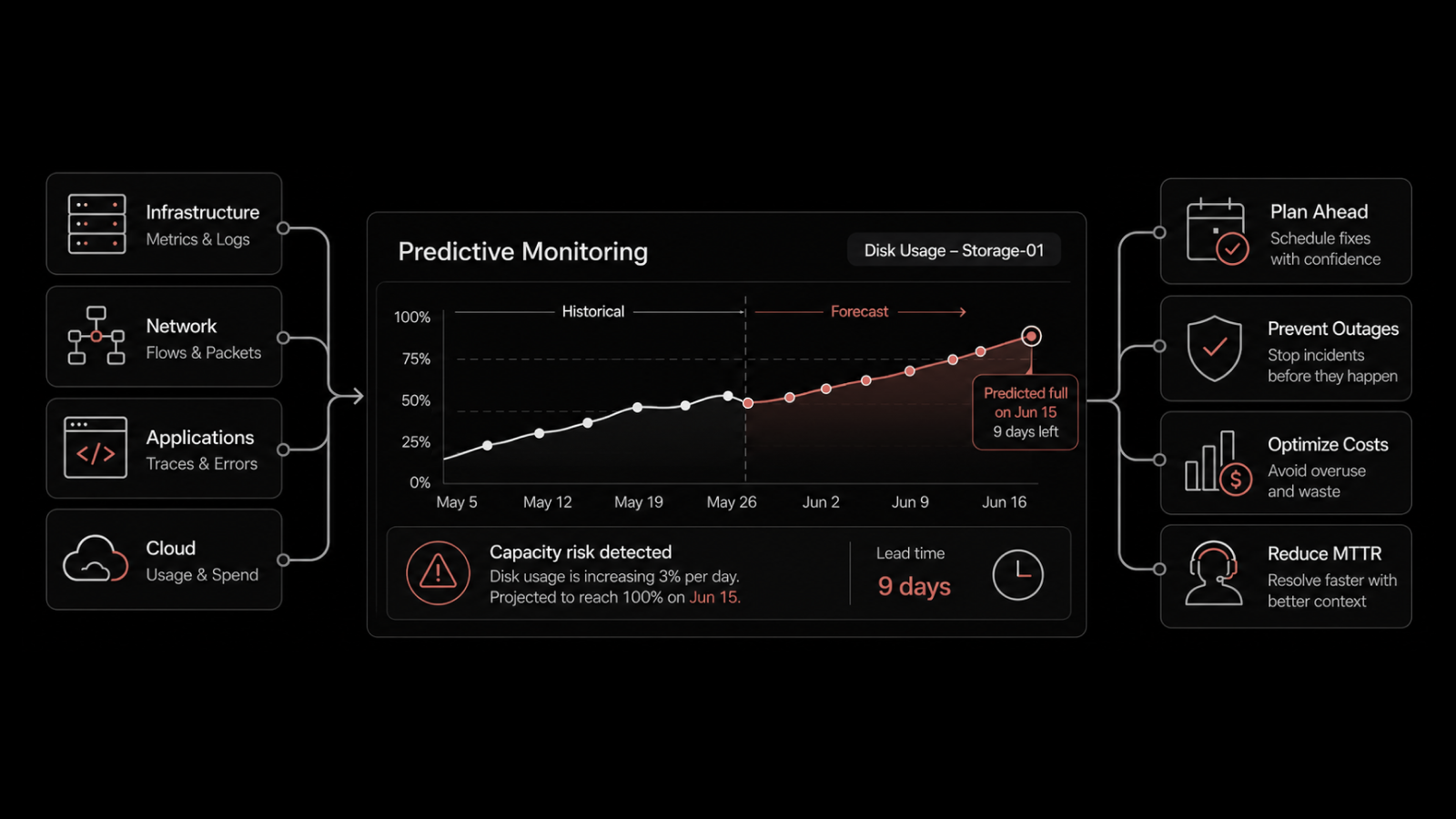
IT teams drowning in support tickets is a widespread problem. When AI monitoring detects early signs of performance degradation — a gradually increasing error rate, a memory leak building over days, a link approaching capacity — it alerts teams or triggers remediation before users experience any impact.
This pre-emptive approach means:
Users don't experience the problem, so they don't file tickets
IT teams spend less time on reactive firefighting
Resources are freed for planning, improvement, and strategic work
Service quality perception improves because problems are invisible to end users
5. Optimized Network Performance
AI-powered monitoring tracks traffic patterns and detects anomalies in real time, giving network managers the ability to address bottlenecks before they affect performance.
Beyond detection, AI can dynamically adjust:
Routing — directing traffic through optimal paths based on real-time conditions
Bandwidth allocation — increasing capacity for high-priority applications during peak periods
Quality of Service (QoS) — adjusting service parameters to maintain user experience quality
This results in better resource utilization and improved Quality of Experience (QoE) across the network.
Top 3 Challenges of AI in Network Monitoring
1. Data Quality and Completeness
AI models produce outputs that reflect their inputs. If your network data is incomplete, inconsistent, or poorly structured, AI will generate inaccurate results — flagging false problems and missing real ones.
Before implementing AI monitoring, invest in:
Comprehensive data collection across all network components
Data normalization and deduplication processes
Validation checks to ensure data integrity
Gap analysis to identify monitoring blind spots
Clean data isn't glamorous, but it's the foundation everything else depends on.
2. Integration With Existing Systems
Integrating AI monitoring tools with existing infrastructure — ITSM platforms, SIEM systems, configuration management databases, ticketing systems — requires careful planning. Common integration challenges include:
Incompatible APIs and data formats
Workflow misalignment between AI-generated insights and existing processes
Security requirements that limit data sharing between systems
Organizational resistance to changing established monitoring workflows
Plan integration architecture before selecting tools. The most capable AI monitoring platform delivers limited value if its insights don't flow into the workflows where action happens.
3. Governance and Ethical Considerations
AI-driven network monitoring raises legitimate governance questions:
Decision transparency — Can you explain why the AI flagged a specific alert or took an automated action?
Oversight boundaries — Which actions should AI take autonomously vs. which require human approval?
Data privacy — How is network traffic data collected, stored, and used by AI models?
Accountability — When an AI-driven action causes a problem, who is responsible?
Establish clear policies for AI governance before deployment. Define the boundaries of autonomous action, maintain audit trails, and ensure human oversight for high-impact decisions.
How to Implement AI for Network Monitoring
Step 1: Collect and Prepare Your Data
Gather network data from all sources: devices, logs, performance metrics, traffic flows, configuration databases, and event logs. Pre-process the data to remove noise, normalize formats, and ensure consistency. This is the most time-consuming step — and the most important.
Step 2: Develop and Train AI Models
Use historical network data to train models that recognize patterns, anomalies, and performance degradation signatures. Select algorithms based on your monitoring requirements:
Anomaly detection models for identifying unusual behavior
Predictive models for forecasting capacity constraints and potential failures
Classification models for categorizing alerts by severity and type
tart with supervised learning on well-labeled historical data, then expand to unsupervised learning for discovering unknown patterns, an approach commonly used by any AI Agent Development Company building production-grade models. Organizations should also focus on strategies to humanize AI by ensuring transparency, explainability, and human oversight in decision-making processes, especially when AI-driven actions directly impact network operations.
Step 3: Deploy Real-Time Analysis
Once models are trained, deploy them against live network data. Monitor performance, traffic patterns, and security events continuously. Use the models to identify bottlenecks, predict potential issues, and surface actionable insights in real time.
Step 4: Configure Intelligent Alerting and Response
Set up AI-powered alerting that generates notifications based on anomaly detection rather than just fixed thresholds. Configure automated response actions for well-understood scenarios — service restarts, traffic rerouting, capacity scaling — while maintaining human oversight for complex or novel situations.
Step 5: Continuously Refine and Improve
AI models aren't static. Feed them new data continuously, incorporate feedback from operations teams, and refine algorithms based on real-world performance. Track key effectiveness metrics:
False positive rate (should decrease over time)
Detection accuracy (should increase)
MTTR for AI-detected issues vs. manually detected issues
Support ticket volume trend
AI has moved from an optional enhancement to a practical necessity for network monitoring. The combination of anomaly detection, predictive analytics, automated remediation, and intelligent alerting addresses the scale and complexity challenges that traditional monitoring can't solve.
The organizations getting the most value from AI in network monitoring are the ones that approach it methodically: clean their data first, start with well-defined use cases, integrate with existing workflows, and continuously refine their models based on real-world results.
AI doesn't replace network engineering expertise — it amplifies it. It handles the pattern recognition and routine analysis at machine scale, freeing your team to focus on the architecture, planning, and strategic decisions that AI can't make on its own.
See AI-Driven Network Monitoring in Action With Motadata
Motadata's AI-native network monitoring platform delivers complete visibility across your network infrastructure — physical devices, virtual machines, cloud resources, and applications — from a unified console. The built-in AI engine uses machine learning for anomaly detection, predictive analytics, automated root cause analysis, and intelligent alerting, helping your team detect and resolve issues before they impact users. With auto-discovery, dependency mapping, and support for 10,000+ device types, Motadata scales with your infrastructure. Start a 30-day free trial or schedule a demo to experience AI-driven monitoring firsthand.
FAQs
Is AI necessary for network monitoring?
AI isn't strictly necessary for basic network monitoring, but it's increasingly necessary for modern, complex environments. Networks with thousands of devices, hybrid cloud infrastructure, and dynamic workloads produce more data than rule-based systems can effectively analyze. AI handles that scale.
How does AI reduce alert fatigue in network monitoring?
AI learns normal behavior patterns and uses dynamic thresholds instead of static ones. This means it only alerts on genuine anomalies rather than every time a metric crosses a fixed value. The result is fewer, more meaningful alerts that operations teams can actually act on.
What's the ROI of implementing AI in network monitoring?
ROI typically comes from reduced MTTR, fewer outages, lower support ticket volume, and more efficient use of engineering time. Organizations often see 30-50% reduction in MTTR and significant decreases in noise-related alert volume within the first 6-12 months.
Can AI completely replace human network engineers?
No. AI handles pattern recognition, correlation, routine analysis, and automated remediation at a scale humans can't match. But architecture decisions, complex troubleshooting, strategic planning, and governance require human judgment. AI makes engineers more effective — it doesn't make them unnecessary.
Author
Bhavyadeep Sinh Rathod
Senior Content Writer
Bhavyadeep Sinh Rathod is a Senior Content Writer at Motadata with 5+ years of content marketing expertise. He's passionate about crafting tech-focused content that captivates audiences and drives results. Apart from content, he has a deep interest in a variety of subjects like comedy, philosophy, geopolitics, sports, science, and spirituality.