Impact of Network Downtime on Enterprise Productivity: The Full Cost Breakdown
Network downtime impact in short: Network downtime costs enterprises $5,600+ per minute on average. But the real damage is the cascading effect on employee productivity, customer trust, and brand reputation that extends well beyond the outage window.
A logistics company's core network went down for 47 minutes on a Wednesday afternoon. The direct cost was roughly $260,000 in delayed shipments. The hidden cost was worse -- 1,200 employees sat idle, three customer SLAs were breached, and a key enterprise prospect pulled out of a deal because "if your own systems can't stay up, how can we trust your platform?"
Forty-seven minutes. One incident. Months of damage.
The Three Layers of Downtime Cost
Layer 1: Direct Financial Losses (The Immediate Hit)
When connectivity fails, revenue-generating processes stop instantly. Transactions can't complete, customer orders freeze, and service workflows stall. Industries reliant on high-volume digital activity -- retail, e-commerce, logistics, financial services -- feel this impact within minutes.
Recovery adds cost on top: staff overtime, emergency vendor assistance, rapid hardware procurement. SLA penalties stack up when uptime commitments are breached. These combined pressures show how tightly network performance and business productivity are intertwined.
Layer 2: Operational Productivity Drain (The Internal Fallout)
While financial losses dominate attention, internal productivity costs are often equally damaging. When ERP, CRM, email, cloud apps, and communication tools become unreachable, employees are effectively immobilized. Businesses pay full salaries for zero output.
Downtime also disrupts timelines for major initiatives -- delaying product launches, customer onboarding, and internal projects. Even after the network is restored, teams face "productivity debt": the accumulated backlog, rework, and lost coordination time that extend the outage's impact well beyond the incident window.
Layer 3: Reputation and Compliance Damage (The Long Tail)
Beyond immediate disruptions, downtime creates long-term ripple effects. Customers expect seamless digital interactions. Any prolonged interruption erodes trust and increases churn risk. Public-facing outages escalate into negative press, executive scrutiny, and viral criticism on social platforms.
Downtime scenarios often force IT teams to implement temporary fixes -- unintentionally opening the door to compliance issues or new security vulnerabilities. These intangible consequences reveal why network outage prevention must be a strategic priority, not a reactive effort.
How Network Monitoring Transforms the Downtime Equation
Modern enterprises can't rely on reactive troubleshooting. As networks grow more complex and distributed, proactive monitoring becomes essential for shifting IT teams from break/fix cycles to prevention-focused operations.
Real-Time Visibility Across the Entire Network
Continuous monitoring of every device, interface, link, and service provides the baseline visibility needed to detect degradation. You can't fix what you can't see -- and most enterprises have significant blind spots in their network visibility.
AI/ML-Powered Anomaly Detection
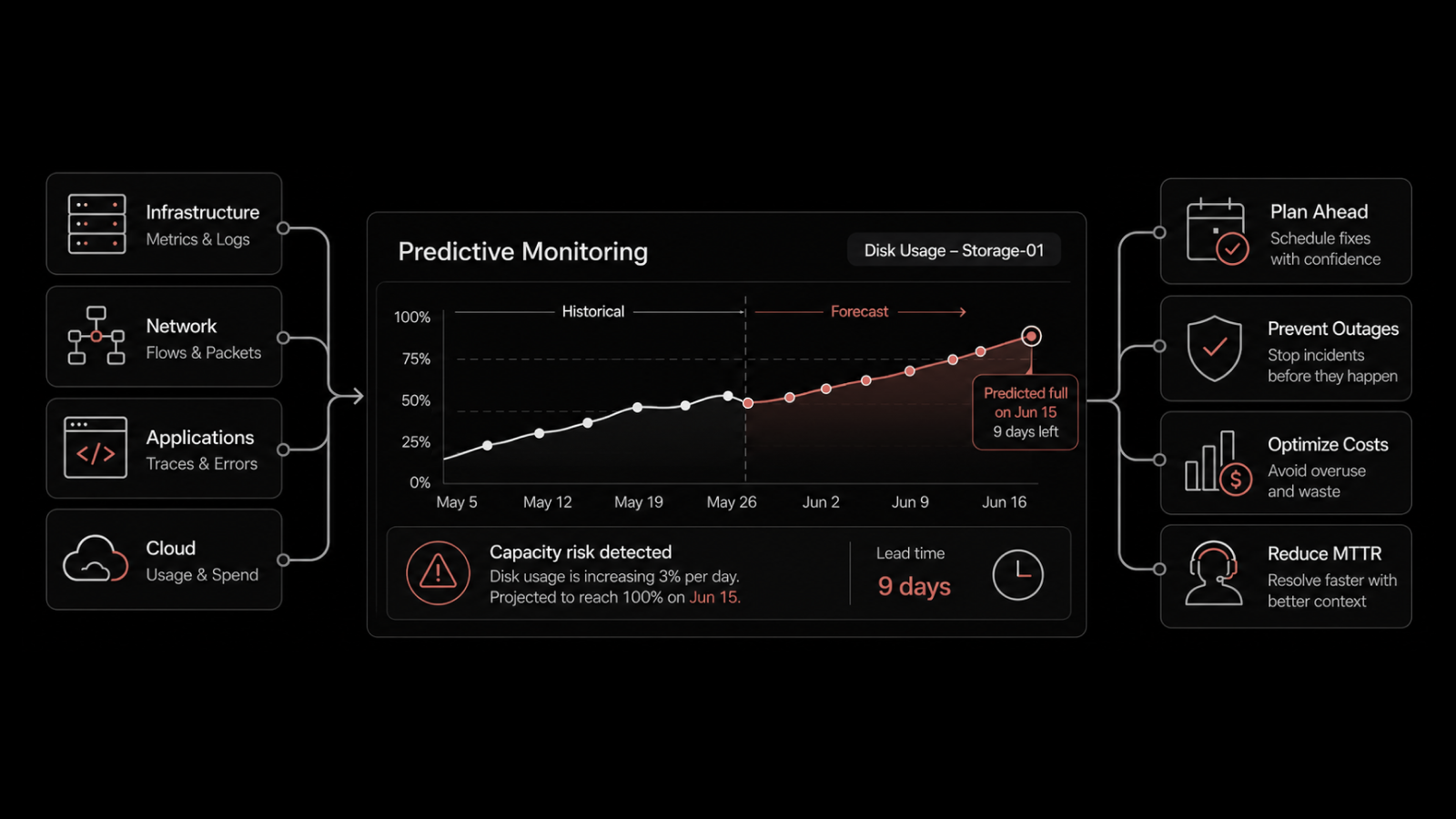
Static thresholds miss slow degradation. ML-based anomaly detection learns your network's normal behavior patterns and flags deviations before they breach thresholds. A gradual increase in interface errors on a core switch gets flagged weeks before it causes a failure.
Predictive Analytics for Capacity Planning
Predictive analytics identifies trends that indicate future problems. Bandwidth utilization trending toward 85%? Storage filling at 2% per week? Latency increasing 5ms per month on a specific path? These trends are invisible without monitoring but obvious with it.
Intelligent Alerting and Event Correlation
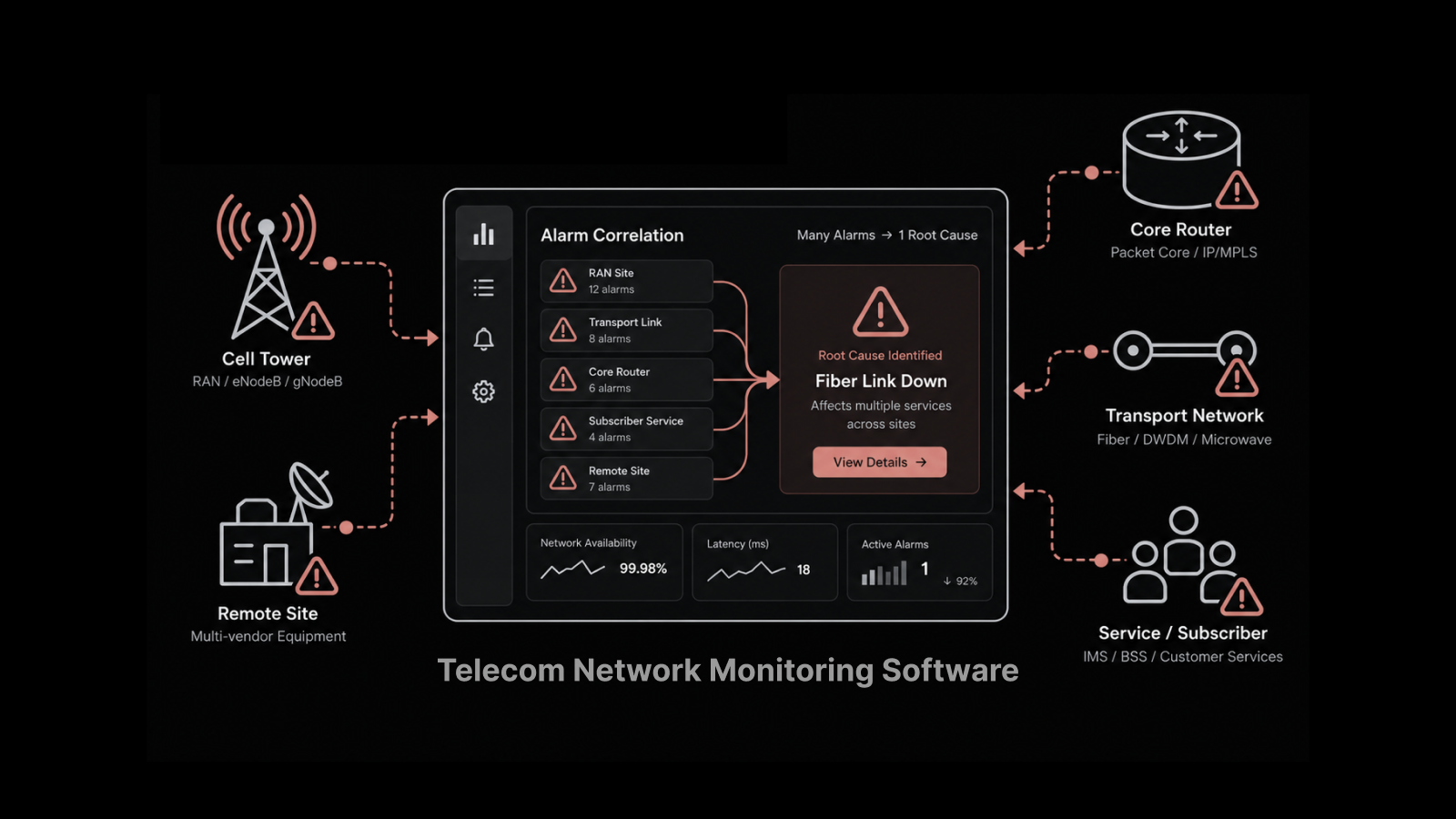
Raw alerts create noise. Intelligent alerting correlates related events, suppresses duplicates, and surfaces actionable incidents. Your team sees "core switch degradation affecting 15 downstream services" instead of 200 individual alerts.
Topology-Aware Root Cause Identification
When an issue occurs, topology-aware analysis traces it to the source. Is the latency spike caused by the application, the network, or the infrastructure? Dynamic topology mapping with auto-discovery answers this in minutes instead of hours.
Calculating Your Organization's Downtime Cost
Use this framework to quantify your specific exposure:
Cost Component | Formula |
|---|---|
Revenue loss | Revenue per hour x hours of downtime |
Employee productivity loss | Avg hourly cost x affected employees x hours |
SLA penalties | Per-breach penalty x number of breaches |
Recovery costs | Overtime + vendor fees + hardware replacement |
Customer churn | Estimated lost customers x lifetime value |
Example: Mid-size enterprise, 2-hour outage
Revenue loss: $200K/hour x 2 = $400K
Employee cost: $50/hour x 800 employees x 2 hours = $80K
SLA penalties: 3 breaches x $25K = $75K
Recovery: $20K
Total direct cost: $575K for a single 2-hour outage
Now multiply by the number of outages per year. Most enterprises experience 5-15 unplanned outages annually.
What IT Leaders Should Also Understand
How do you justify network monitoring investment to the board?
Frame it as insurance with measurable ROI. Calculate your annual downtime cost (use the framework above), then show that preventing even 50% of outages delivers value that typically exceeds monitoring platform cost by 5-10x.
What's the difference between reactive and proactive monitoring?
Reactive monitoring tells you something broke after users complain. Proactive monitoring uses anomaly detection and predictive analytics to identify degradation patterns before they become outages. The difference is minutes of prevention vs. hours of firefighting.
Which network metrics should we monitor to prevent downtime?
Bandwidth utilization, latency, packet loss, jitter, interface errors, CPU/memory on network devices, and application response times. Track trends over time, not just point-in-time thresholds.
Does network downtime affect remote workers differently?
Yes -- remote workers have no fallback when the VPN or cloud services go down. They can't walk to a colleague's desk or use an alternative office network. Remote workforce downtime is total downtime.
How Motadata AIOps Prevents Network Downtime
Motadata AIOps provides the proactive visibility enterprises need to prevent downtime before it impacts productivity. The platform monitors network devices, traffic flows, and application performance from a single console with AI/ML-powered anomaly detection that catches degradation patterns human operators miss.
Dynamic topology mapping shows service dependencies in real-time, so when an issue emerges, your team knows exactly what's affected and where to focus. Automated event correlation reduces alert noise by 90%+, letting engineers work on real problems instead of chasing false positives.
If network downtime is costing your organization more than your monitoring budget, request a demo to see how Motadata changes that equation.
FAQs
How much does network downtime cost per minute?
Industry estimates average $5,600 per minute, but this varies widely. Financial services and e-commerce can exceed $10,000/minute. Calculate your specific cost using revenue per hour, employee costs, and SLA penalty exposure.
What causes most enterprise network downtime?
Human error (configuration changes, failed updates) causes 40-50% of outages. Hardware failures account for 20-30%. Software bugs, security incidents, and external factors (ISP issues, power outages) make up the remainder.
How does AIOps help prevent network downtime?
AIOps applies machine learning to network telemetry data -- learning normal behavior patterns, detecting anomalies before they cascade, correlating events across infrastructure layers, and triggering automated remediation for known issue patterns. It shifts teams from reactive to predictive.
What's the ROI of network monitoring?
If your organization experiences 10 hours of unplanned downtime per year at $100K/hour cost, that's $1M in annual downtime losses. A monitoring platform that prevents even 50% of those outages delivers $500K in value -- typically 5-10x the platform cost.
Author
Arpit Sharma
Senior Content Marketer
Arpit Sharma is a Senior Content Marketer at Motadata with over 8 years of experience in content writing. Specializing in telecom, fintech, AIOps, and ServiceOps, Arpit crafts insightful and engaging content that resonates with industry professionals. Beyond his professional expertise, he is an avid reader, enjoys running, and loves exploring new places.