Observability Maturity Model: Levels, Stages & Roadmap
One doesn’t need to be a rocket scientist to understand that the modern digital systems are more dynamic and distributed than ever before. Now to prevent the conundrum, organizations must rely on the observability maturity model as it provides a structured way to monitor and improve system behavior.
Researches have shown that Mature/expert organizations are 78% effective at identifying root causes, compared to just 35% for early-stage teams. Despite pouring in money for monitoring tools, organizations still face the same questions about the overall performance, reliability, and user experience of the system.
To overcome the knowledge gap, businesses must understand that observability is about maturity and not just acquiring the tools. A matured observability model helps the IT teams transition better to predictive and autonomous operations by setting clear stages of alignment, execution and capability.
Here, we will understand the details of observability maturity levels and its importance, key pillars, common mistakes in observability roadmap and many more.
What Is an Observability Maturity Model?
An Observability Maturity Model is a structured framework that defines progressive levels of observability capability within an organization. It allows teams to assess their current state, identify gaps, and plan a realistic path toward advanced observability.
Enterprise observability models maintains a fine line between true observability maturity and tool adoption. Model observability is only achieved when signals are contextualized and correlated. They must be used derive information across the business and engineering teams. While on the other hand, many organizations are still believer of the fact that maturity is tracing tools, deploying metrics dashboards and log aggregations.
Observability maturity assessment provides a shared language to organizations for better roadmap for scaling while keeping the system complexity under check.
How Does an Observability Maturity Model Work?
An observability maturity model works by guiding organizations through a structured, stage-wise evolution of their observability capabilities. It helps teams understand their current maturity level, identify operational and visibility gaps, and progress toward a more contextual, intelligent, and scalable observability ecosystem.
Assessing the Current Observability State
The process begins with an observability maturity assessment where teams evaluate how effectively logs, metrics, and traces are being used across systems. Rather than measuring tool deployment, the model focuses on how well insights are correlated, shared across teams, and used to support decision-making and incident response.
Moving Beyond Tools to Contextual Observability
The model emphasizes the difference between monitoring tools and true model observability. Maturity is achieved when signals are unified, contextualized, and correlated to deliver meaningful insights for both engineering and business teams, rather than relying on isolated dashboards or fragmented data views.
Progressing Through Stage-Wise Improvement
As organizations move through maturity stages, they gradually improve visibility, automation, and root-cause analysis capabilities. Each stage strengthens reliability and operational resilience, helping teams transition from reactive troubleshooting to proactive and predictive observability practices.
Building Scalable and Future-Ready Systems
By following a structured observability maturity roadmap, organizations can control complexity, improve collaboration, and build systems that are adaptive and scalable for future growth. This ensures observability evolves alongside the business — not just with tool expansion, but with measurable operational maturity.
Why Observability Maturity Matters?
When something impacts business outcomes and technical performances directly, it demands a serious look in. Observability maturity levels has the same result and thus it becomes necessary to understand the different aspects that makes it impactful
Faster Incident Detection and Resolution
Early anomaly detection before distortion hampers user experience, sounds cool, right? Teams at a higher stage of observability maturity models do the same along with reducing mean time to detect (MTTD) and mean time to resolve (MTTR).
Improved Reliability and Uptime
Proactive reliability engineering is one of the main pillars of mature observability model. Through this, it enables teams to be resilient under constantly changing workloads and maintain the health of the server. It not only improves the uptime, but enhances the overall reliability of the system.
Increased Engineering Productivity
By employing the best observability practices, engineering teams have more time on their hands to deliver impactful features they spend less in troubleshooting. Engineers spend less time troubleshooting and more time delivering features when they can quickly understand system behavior.
Better Business and Customer Experience
Through observability, teams can prioritize and solve the issues that become hurdles in user experience. Thus, not only does application output becomes better through observability best practices, it enhances the overall brand-recalling as well.
These outcomes align closely with Site Reliability Engineering (SRE) practices, error budgets, and the Golden Signals. Observability maturity is necessary for effective reliability engineering and catching errors, saturation and latency at a nascent stage.
Key Pillars of Observability Maturity
Observability maturity doesn’t work in insolation as being in siloes, it cannot produce the right results. Thus, it becomes imperative to understand the key pillars of observability maturity models so that implementation becomes easier:
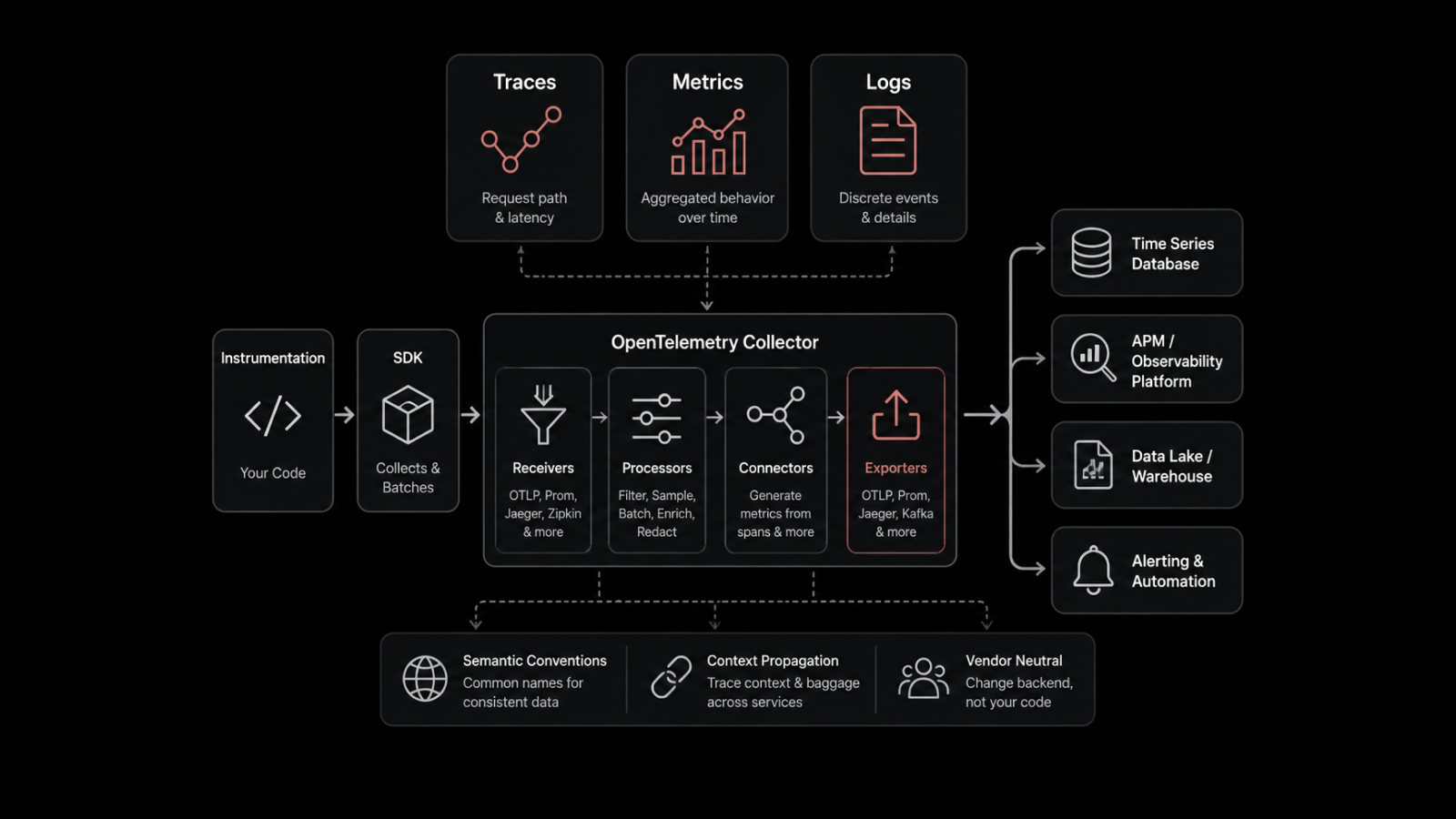
Logs: Every event that happens in the system is being recorded as log. It dives deep into system behavior and churn out the insights that helps the teams to find the root cause easily incase of any mishap. In addition, through better log monitoring, detecting problems beforehand also becomes easier.
Metrics: Metrics provide a quantitative view of system performance by tracking key indicators such as latency, throughput, resource utilization, and error rates. They help teams identify patterns, detect anomalies, and understand long-term trends in system behavior. With well-designed metrics and dashboards, organizations can proactively monitor thresholds, optimize performance, and quickly recognize when systems deviate from expected service levels.
Traces: Traces offer end-to-end visibility into how a request travels across distributed services and microservices. They help teams understand execution paths, identify performance bottlenecks, and pinpoint where latency or failures occur within a transaction flow. By visualizing service dependencies and request lifecycles, tracing makes it easier to diagnose complex incidents and improve user experience.
Context and Correlation: Context and correlation bring together logs, metrics, and traces into a unified view. This process allows the tech team to relate apps, business transactions and infrastructure together. Context anf correlation together sees a bigger picture that accelerates collaboration between the tech teams and improves root cause analysis.
Automation and Intelligence: Automation and intelligence directly detects anomalies, triggering remedies while keeping the other hazards at bay. Through this observability becomes faster and more scalable, fousing more on system optimization rather than just firefighting.
Maturity is achieved when these pillars operate as a unified system rather than fragmented data sources.
Observability Maturity Levels Explained
Along with understanding what is observability, we are here explaining these levels of observability maturity model in a chronological way to understand basic monitoring, intelligence and autonomous operations. Each stage is essential as it tells the story about how business organizations use observability as a tool to derive reliability, digital experience and better performance.
Level 1 – Reactive Monitoring
At this level, observability is not unified, it is fragmented, reactive and event driven. This is a stage where teams operate with isolated monitoring tools and overly rely on manual troubleshooting.
Characteristics include:
Tools that are distributed across teams and does work in tandem
Dashboards provide a static image that does show the entire picture
Larger Alert fatigue due to too many notifications and a fickle threshold
Visibility is more focused on singular components
Here, majorly all the incidents are detected only after performance degradation or service disruption is felt at the user end.
Root cause analysis depends heavily on individual expertise rather than shared system intelligence — resulting in inconsistent outcomes, higher MTTR, and unpredictable reliability.
This level answers only one question:
“What failed?” — not “Why did it fail?”
Level 2 – Proactive Monitoring
As we now get to level 2, teams experience proactive risk awareness consistency and structure.
Organizations here begin:
Implementing alert definition across systems along with metrics
Have threshold-based alerting in reducing noise of notifications
Early implementation of Application Performance Monitoring (APM)
Basic cross-infrastructure and application correlation
Teams move from incident reaction to early warning detection, allowing faster response when degradation patterns emerge.
However, challenges remain:
Manual intervention is still required in root cause analysis
The context of data that exists is limited
Observability is not service-centric but customer centric
The shift here is from availability visibility to performance understanding.
Organizations start asking:
“Where is the problem forming — and how soon will it impact users?”
Level 3 – Unified Observability
The information of monitoring data to operational insights is analyzed in a concrete manner at level 3.
Here are some of the key characteristics that are easier to understand:
Tool sprawl is replaced by centralized (unified) observability
Metrics, traces and logs, all are correlated
Golden Signals and SLOs become core reliability measures
User experience visibility improves via Digital Experience Monitoring (DEM)
Observability evolves into a shared organizational capability spanning:
Development
IT Operations
Platform engineering
SRE teams
Instead of troubleshooting events in isolation, teams gain:
end-to-end service context
dependency mapping
environment-wide behavioral understanding
At this stage, observability becomes a decision-support system, improving:
incident response accuracy
release confidence
operational accountability
Organizations shift from monitoring systems to observing service health and customer impact.
Level 4 – Predictive & Intelligent Observability
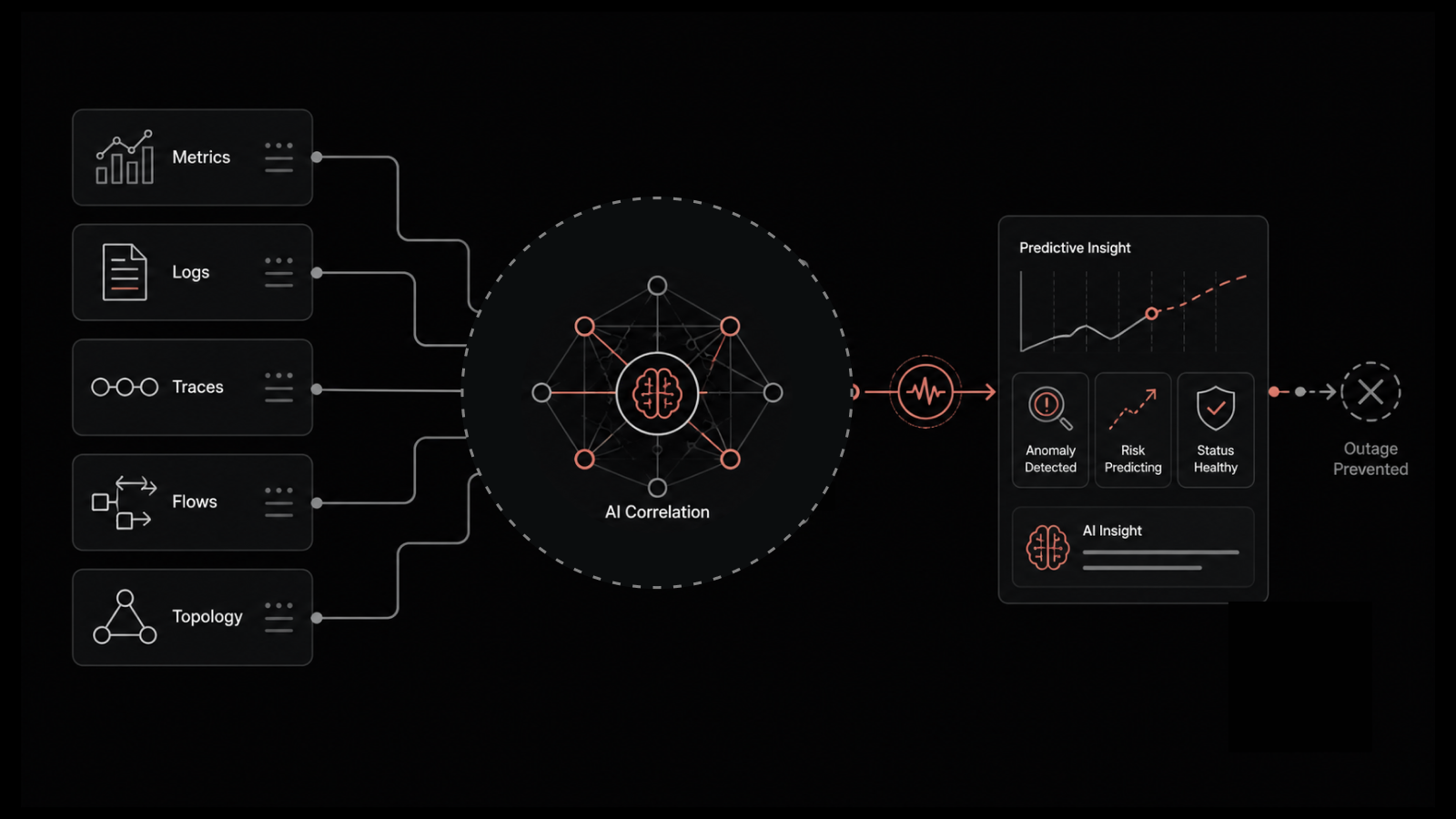
Level 4 introduces AI-driven analytics, predictive modeling, and automated event correlation.
Key capabilities include:
Error budgets tracked and enforced across services
Root cause analysis accelerated through automated correlation
Teams receive predictive insights instead of reactive alert storms
Instead of solving incidents after failure, organizations begin preventing failures before they occur.
Observability now supports:
capacity optimization
performance risk forecasting
proactive reliability planning
incident trend elimination
Operations move from response-driven workflows to prevention-focused reliability engineering.
Level 5 – Autonomous Observability
Level 5 represents the highest stage of observability maturity
Capabilities include:
Automated remediation for recurring and known failure patterns
Continuous optimization of performance and cloud cost
Observability integrated into DevOps and SRE delivery pipelines
Systems dynamically adjust to workload, traffic, and failure conditions
Observability transitions from a diagnostic function into a strategic enabler of innovation and agility.
At this level, organizations achieve:
faster release velocity
resilient architectures
sustainable reliability culture
This is where observability stops being “monitoring plus analytics” and becomes a foundational pillar of digital operations.
Observability Maturity Roadmap
A structured observability maturity roadmap enables sustainable and incremental progress over a long period of time. Here are the steps that will help businesses to implement observability maturity model in a systematic manner
Short-Term (Foundational)
Standardize the metrics, logging, and alerting practices keeping business goals in mind
Reduce data fragmentation and tool sprawl
Mid-Term (Optimization)
Implement correlation and service-level context keeping business interests in mind
Adopt Golden Signals and SLO-driven observability
Long-Term (Advanced)
Introduce AI-driven analytics and predictive modeling
Enable autonomous remediation and self-healing patterns
This roadmap ensures maturity scales with organizational capability, culture, and technical readiness.
Common Mistakes in Observability Maturity Journeys
Fragmented execution and misaligned priorities often become the biggest hurdle for companies to stop their observability maturity journey. These challenges compound over time after seeming feeble at the beginning and prevent the evolution of overall observability capability. Common mistakes include:
1. Deploying tools without strategy
If the teams does not have an adoption roadmap or no shared objectives, even if they invest in various tools, it shows no result. On the other hand, there are too many disconnected insights and tool sprawl as there is no meaning-full decision making process that supports the business.
2. Ignoring the user experience
Businesses must not implement observability with a system centric mindset. The modern day environment is dynamic and reason why it is so is the changing needs of the customers. Thus, it is always advised to have a organizational context and operational or strategic value to enhance user experience and garner the most from the observability maturity model.
3. Treating observability as an operations-only responsibility
Observability becomes incident focused when it is only limited to the tech (Ops, NOC) teams. True maturity whose end goal is better reliability and performance always lies in shared ownership across different teams.
Ultimately, true observability maturity requires a shift towards outcome-driven observability. And this will only happen when insights improve system resilience while supporting business objectives directly.
Best Practices for Advancing Observability Maturity
Organizations must follow a value-aligned approach if they want to get the best out of observability maturity model. They should focus on collaboration and insight quality instead of just scaling the tools.
To accelerate maturity progress:
1. Observability with Business Goals
Define success metrics first up that are directly related to to SLOs, service resilience, customer experience and cost efficiency. The metrics must establish a connection between observability and measurable outcomes, rather than merely providing isolated technical visibility.
2. SRE, Operations and Development Team must Work in Tandem
Observability must form a core of incident workflows, design and deployment. This shared ownership improves reliability in the entire engineering culture and reduces dependencies on siloed expertise.
3. Continuously evolve standards, instrumentation, and operating models
Telemetry models and automation strategies must evolve when the architecture expands. Regular observability reviews ensure instrumentation remains relevant, scalable, and aligned with service risk.
These observability best practices ensure maturity growth is sustainable, value-driven, and directly aligned with customer experience and organizational outcomes.
Conclusion
Observability maturity is a continuous and evolving journey that is shaped with changing business expectations and system complexity. If your team has a structured observability maturity model, it will help the business organizations to build shared alignments, measure improvement across teams and build clarity.
Organizations strengthen through autonomous, intelligent operations digressing from reactive monitoring. They do this by:
Service reliability and uptime
Digital experience quality for the end users
Operational resilience throughout the system
Release confidence and engineering agility
By adopting a stage-wise observability maturity roadmap, teams can enable sustainable long-term growth, build adaptive systems, and ensure their IT environments are future-ready for scale.
FAQs
What is an Observability Maturity Model and why do organizations need it?
The Observability Maturity Model is a structured framework that defines progressive observability maturity levels, helping organizations assess capability gaps, improve reliability, reduce MTTR, and build a roadmap toward unified and predictive observability.
What are the main observability maturity levels in an organization?
The key observability maturity levels include Reactive Monitoring, Proactive Monitoring, Unified Observability, Predictive & Intelligent Observability, and Autonomous Observability — each improving reliability, performance, and decision-making.
How does unified observability improve reliability and user experience?
Unified observability correlates logs, metrics, traces, and context into a single platform, enabling faster root-cause analysis, SLO tracking, dependency visibility, and better alignment across Dev, Ops, and SRE teams.
What role does AI play in predictive observability maturity?
At higher maturity levels, predictive observability uses AI-driven anomaly detection, automated correlation, and error-budget intelligence to detect risks early, prevent outages, and support proactive reliability engineering.
How do organizations progress through the observability maturity roadmap?
Organizations advance through the observability maturity roadmap by standardizing telemetry, reducing tool sprawl, adopting Golden Signals and SLOs, implementing correlation, and gradually enabling automation and self-healing capabilities.
Author
Arpit Sharma
Senior Content Marketer
Arpit Sharma is a Senior Content Marketer at Motadata with over 8 years of experience in content writing. Specializing in telecom, fintech, AIOps, and ServiceOps, Arpit crafts insightful and engaging content that resonates with industry professionals. Beyond his professional expertise, he is an avid reader, enjoys running, and loves exploring new places.