More IT Spend, Better Returns: The Hidden ROI of IT Asset Management
Introduction
As organizations continue increasing their investments in technology, the challenge isn’t just spending more, it’s making sure every dollar delivers measurable value. With the rapid adoption of cloud services, SaaS subscriptions, remote-work devices, and growing security needs, IT environments have become more complex and costlier than ever. Many teams struggle with limited visibility, scattered assets, and rising operational overheads, which leads to overspending and lower returns.
This is where IT Asset Management (ITAM) becomes a powerful strategic enabler. A strong ITAM practice helps organizations understand exactly what assets they own, how those assets are used, and where costs can be optimized.
By centralizing visibility, improving control, and providing data-driven insights, ITAM transforms rising IT spend into meaningful business value. When done right, it reduces waste, strengthens security, and helps teams make smarter investment decisions, ultimately boosting both operational efficiency and overall ROI.
Why IT Spending Is Increasing Across Organizations
IT spending is rising across most organizations as technology continues to evolve and expand. To understand the growing importance of IT Asset Management (ITAM) and effective control of the IT asset lifecycle, it’s essential to examine what is driving these higher costs.
Growth of Cloud, SaaS, and Subscription Models
The shift from traditional one-time software purchases to SaaS and cloud-based subscription models is one of the biggest contributors to increased IT spend. These models offer scalability, flexibility, and rapid deployment—but they also introduce recurring costs that can grow quickly without oversight.
Key factors pushing spend upward:
Multiple SaaS tools adopted independently by different teams
Auto-renewing subscriptions without usage checks
Cloud consumption charges that fluctuate monthly
Rising Security and Compliance Costs
Cybersecurity threats are more sophisticated than ever, pushing companies to invest heavily in advanced security solutions, endpoint protection, monitoring tools, and compliance frameworks. Regulatory requirements such as data privacy laws further elevate expenses. Effective ITAM ensures these security assets are properly tracked, compliant, and updated—maximizing value and reducing risk.
Distributed Workforce and Device Proliferation
Remote and hybrid work models have dramatically increased the number of endpoints organizations must manage.
Primary drivers include:
More laptops, desktops, and mobile devices in circulation
Growing reliance on cloud apps for remote collaboration
Expansion of remote access infrastructure
Lack of Visibility Leading to Overspending
Many organizations still lack centralized visibility into their IT environment, resulting in overspending.
Common issues include:
Shadow IT and unauthorized tools
Duplicate or unused software licenses
Hardware assets that go untracked or underutilized
What Is IT Asset Management and Why It Matters Today
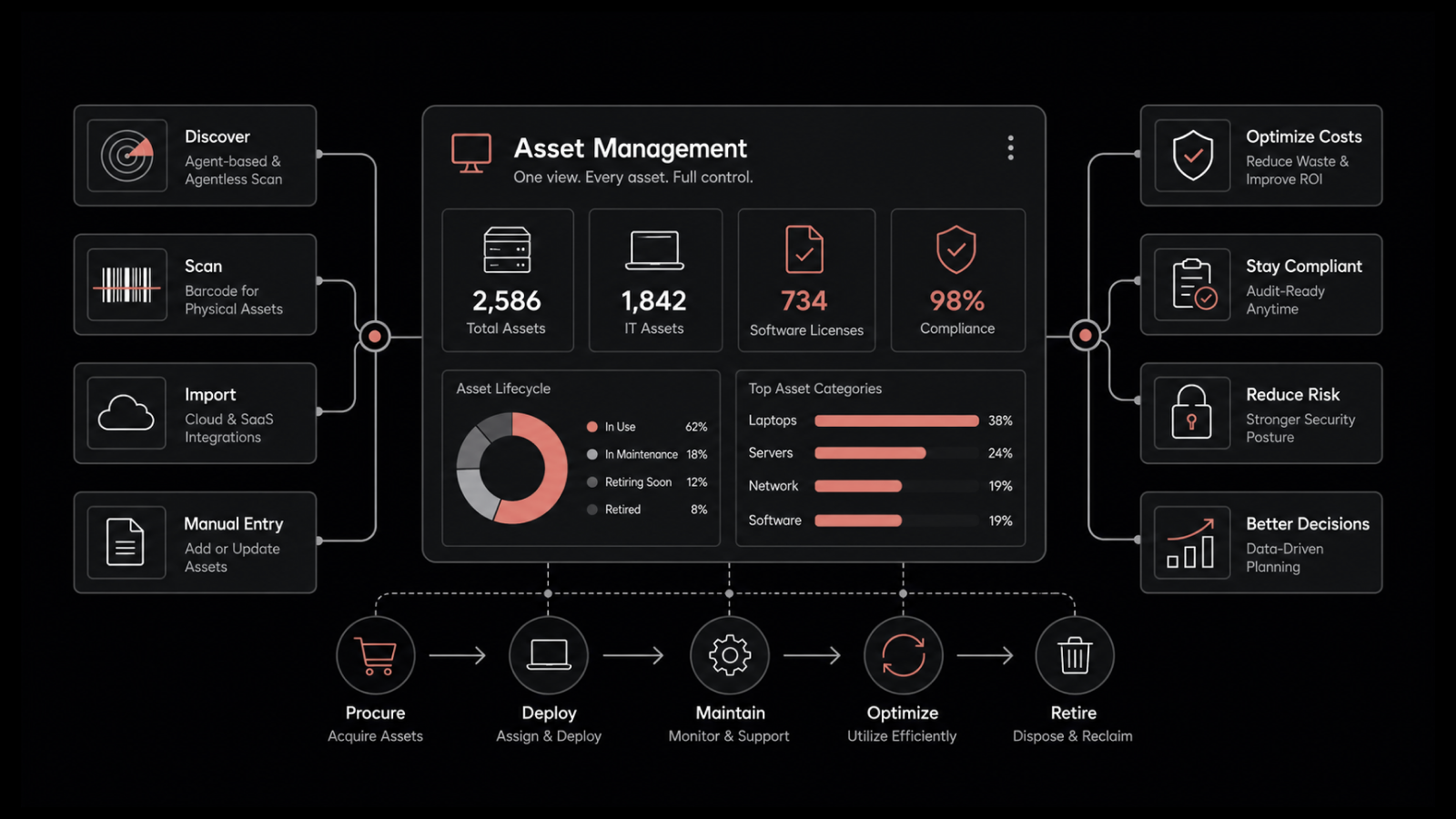
As modern IT environments continue to expand across cloud platforms, SaaS tools, devices, and distributed networks, organizations need a structured way to understand what technology they own, how it’s being used, and where costs or risks may be hiding. This is where IT Asset Management (ITAM) becomes essential. ITAM provides the visibility and intelligence needed to manage the entire IT asset lifecycle efficiently—from acquisition to retirement—ensuring every investment delivers maximum value.
Understanding IT Asset Management (ITAM)
ITAM is a comprehensive practice focused on tracking, managing, and optimizing IT assets throughout their lifecycle. Rather than treating assets as static inventory items, ITAM looks at their usage, cost, performance, compliance, and relationship to business outcomes. By maintaining accurate, real-time asset data, organizations can make smarter decisions, reduce waste, and strengthen governance across the IT ecosystem.
Types of IT Assets Managed by ITAM
ITAM covers a wide range of digital and physical assets, including:
Hardware (desktops, laptops, mobile devices, servers)
Software and SaaS applications
Cloud infrastructure and subscription services
Network devices and connectivity equipment
Virtual machines, storage, and other virtualized resources
Licenses, warranties, contracts, and vendor documentation
ITAM vs. Basic Asset Tracking
Basic asset tracking focuses on simple records—such as who owns a device and where it is located. In contrast, ITAM delivers deep operational intelligence, supporting lifecycle planning, cost optimization, compliance management, and performance analysis. ITAM is proactive, strategic, and data-driven, offering insights far beyond what traditional tracking tools provide.
Importance of IT Asset Management
Effective ITAM empowers organizations to:
Eliminate unnecessary or duplicate assets
Strengthen their overall security posture
Improve software and regulatory compliance
Reduce ongoing operational and licensing costs
Maximize ROI by optimizing technology investments
How IT Asset Management Boosts ROI When IT Spending Goes Up
As IT investments continue to rise, organizations need clear strategies to ensure these costs translate into measurable business value. IT Asset Management (ITAM) provides the visibility, control, and automation required to optimize the entire IT asset lifecycle, helping companies improve ROI even as technology expenses increase.
Maximizing Asset Utilization
ITAM enables IT teams to see exactly which hardware, software, and cloud resources are actively used versus sitting idle. By reallocating underutilized assets before purchasing new ones, companies avoid unnecessary spend and ensure existing investments deliver full value.
Reducing IT Waste and Redundant Purchases
Untracked assets often lead to duplicate buying or maintaining tools that deliver little value. ITAM uncovers unused licenses, legacy hardware, and overlapping solutions, allowing organizations to retire or repurpose what’s no longer needed—significantly reducing waste.
Controlling Software Licensing and Preventing Over-Provisioning
Licensing is one of the costliest areas of IT. ITAM provides real-time visibility into license allocation, usage, and compliance. This helps prevent overspending on user seats, cloud subscriptions, and vendor renewals while reducing the risk of financial penalties.
Enhancing Security and Compliance
Accurate asset inventories ensure that IT teams know what exists in the environment and whether those assets are patched, updated, and aligned with regulatory requirements. This reduces vulnerabilities, strengthens compliance, and lowers audit-related risks.
Improving Budget Forecasting
With historical usage data and lifecycle intelligence, ITAM supports more accurate budget planning. IT leaders can anticipate refresh cycles, renewal costs, and resource needs instead of relying on guesswork.
Extending Asset Lifecycles Through Proactive Maintenance
Scheduled maintenance, warranty tracking, and automated alerts help extend asset life and reduce downtime. This delays expensive hardware replacements and optimizes total cost of ownership.
Automating Manual Work and Reducing Operational Overheads
Automation in discovery, updates, reconciliation, and reporting eliminates time-consuming manual tasks. This allows IT teams to focus on strategic initiatives rather than routine administration.
Improving IT Service Delivery Efficiency
When service teams have access to reliable asset data, they can troubleshoot faster, resolve incidents more accurately, and enhance the overall user experience.
ITAM ROI Benefits Overview
| ITAM Benefit | Impact on ROI |
|---|---|
| Maximized asset utilization | Reduces unnecessary purchases and improves resource efficiency |
| Reduced IT waste | Eliminates redundant tools and unused assets |
| Software license control | Prevents overspending and costly compliance violations |
| Strengthened security & compliance | Lowers risk, downtime, and audit exposure |
| Improved budgeting accuracy | Supports predictable, data-driven financial planning |
| Extended asset lifecycles | Reduces replacement costs and improves long-term value |
| Automated workflows & processes | Cuts labor hours and operational overhead |
| Enhanced IT service delivery | Boosts productivity and user satisfaction |
Key Features to Look for in an IT Asset Management Solution
A strong IT Asset Management (ITAM) solution should offer deep visibility, automation, and control across the full IT asset lifecycle. The right platform not only tracks assets but also optimizes performance, cost, and compliance for modern, distributed environments.
1. Automated Asset Discovery
Automated discovery detects all IT assets—both known and unknown—across on-premises, cloud, and remote networks. This ensures complete visibility and eliminates blind spots.
2. Software License Management
Effective ITAM tools monitor software usage, compliance status, and license allocation to help organizations avoid over-provisioning and uncover optimization opportunities.
3. Hardware Lifecycle Tracking
Tracking hardware from procurement through disposal helps manage depreciation, plan refresh cycles, and extend asset lifespans.
4. Contract and Vendor Management
Centralized management of warranties, renewals, SLAs, and vendor agreements reduces risk and ensures timely actions across the IT asset lifecycle.
5. CMDB Integration
Integrating ITAM with a CMDB creates a unified view of assets, services, dependencies, and configurations—critical for troubleshooting and impact analysis.
6. Remote Device Management
With hybrid and distributed workforces, remote device control is essential for managing endpoints securely and efficiently.
7. Reporting and Cost Analytics
Advanced analytics provide insights into asset utilization, consumption trends, and cost-saving opportunities, supporting data-driven IT decision-making.
How Motadata ServiceOps ITAM Helps You Boost ROI
Motadata ServiceOps ITAM is designed to help organizations maximize the value of their IT investments by delivering complete visibility, automation, and intelligence across the IT asset lifecycle. By unifying asset data and streamlining operations, Motadata enables IT teams to reduce waste, improve compliance, strengthen security, and make smarter cost decisions—directly boosting ROI.
Unified View of All IT Assets
Motadata ServiceOps provides a centralized dashboard that consolidates hardware, software, cloud, and network assets into a single, unified view. This holistic visibility helps IT teams quickly identify underutilized resources, eliminate redundancies, and maintain accurate asset records.
Agent-Based and Agentless Discovery
Its dual discovery capabilities ensure that no asset goes undetected—whether it’s on-prem, cloud-based, remote, or part of a distributed workforce. This reduces blind spots and enables precise tracking and reporting.
Integrated ITAM, ITSM, and CMDB Ecosystem
Motadata seamlessly integrates ITAM with ITSM and CMDB, creating a synchronized ecosystem where incidents, changes, and configurations are mapped to the correct assets. This integration improves service delivery, accelerates troubleshooting, and enhances governance.
Automated Workflows and Alerts
With built-in automation, Motadata eliminates repetitive manual tasks such as updates, approvals, and lifecycle reminders. Automated alerts ensure timely actions related to maintenance, renewals, or compliance, reducing operational overhead and risk.
Smart Dashboards, Insights, and Cost Reports
Real-time analytics help IT leaders monitor asset usage, identify cost-saving opportunities, and visualize ROI improvements. These insights support data-driven decisions, allowing teams to optimize spend and forecast more accurately.
Conclusion
As IT investments continue to rise, organizations must ensure every technology decision delivers measurable business value. IT Asset Management (ITAM) is no longer just a cost-control practice—it’s a strategic driver of ROI, security, operational efficiency, and long-term digital resilience. With growing complexity across devices, cloud services, and software ecosystems, ITAM provides the visibility and governance needed to stay in control.
Solutions like Motadata ServiceOps ITAM equip businesses with automated discovery, intelligent insights, and unified asset visibility—turning increased IT spend into meaningful operational and financial returns.
FAQs
How does ITAM reduce overall IT spending?
ITAM identifies unused assets, monitors software usage, prevents redundant purchases, and ensures license compliance—resulting in significant cost savings.
Can ITAM improve ROI for small or mid-sized organizations?
Absolutely. Even smaller teams benefit from eliminating waste, prolonging asset lifecycles, and improving service efficiency.
What is the difference between ITAM and CMDB?
ITAM focuses on asset lifecycle and cost optimization, whereas a CMDB maps relationships and configurations across IT services. Combined, they offer deeper operational insights.
How does ITAM help with budget planning?
By providing accurate lifecycle data, usage trends, and spending patterns, ITAM helps forecast future needs more precisely.
Does ServiceOps support automated asset discovery?
Yes, Motadata ServiceOps offers both agent-based and agentless automated discovery.
How does ITAM support compliance requirements?
ITAM ensures correct license usage, tracks audit-ready records, and identifies non-compliant or unpatched assets quickly.
Author
Arpit Sharma
Senior Content Marketer
Arpit Sharma is a Senior Content Marketer at Motadata with over 8 years of experience in content writing. Specializing in telecom, fintech, AIOps, and ServiceOps, Arpit crafts insightful and engaging content that resonates with industry professionals. Beyond his professional expertise, he is an avid reader, enjoys running, and loves exploring new places.