How NIST Compliance Turns Observability Data Into Audit Evidence
Can you prove, on demand, which production systems were under continuous monitoring last quarter? Buyers, auditors, and insurers all ask a version of that question, and the answer decides contracts as often as audit findings.
NIST compliance means aligning security controls and operations with standards from the National Institute of Standards and Technology, then holding evidence that the alignment stayed continuous. The frameworks are precise about outcomes and quiet about mechanics. They say networks must be monitored and incidents declared against defined criteria, without naming the signal that proves either one.
That translation falls to IT operations. Policy belongs to the compliance function, while the evidence for the Detect and Respond functions comes from telemetry your team already collects for uptime. Teams building a wider cybersecurity compliance program usually find this out late.
In this blog, you will see what NIST compliance means in practice, what it returns commercially, what changed in CSF 2.0, how to map the Detect and Respond functions to signals you already have, and how to build a checklist that survives an audit.
What does NIST Compliance Mean in Practice?
NIST compliance means aligning an organization's security controls, monitoring practices, and incident procedures with the standards published by the National Institute of Standards and Technology, then holding evidence that the alignment is continuous. The word covers several documents rather than one, which is why two organizations can both claim NIST compliance and mean different things.
Three publications carry most of the weight in commercial and federal contracting:
NIST Cybersecurity Framework 2.0: A voluntary outcome-based framework organizing security into six functions, twenty-two categories, and one hundred and six subcategories
NIST SP 800-53: A detailed control catalog used by federal agencies under FISMA and adopted widely by enterprises that want prescriptive control language
NIST SP 800-171: The control set that protects Controlled Unclassified Information held by non-federal organizations, and the technical baseline underneath CMMC
CSF describes what good looks like. SP 800-53 and SP 800-171 describe the controls that get you there. Most enterprise conversations that begin with NIST compliance requirements end up touching at least two of the three.
Who Has to Comply and Who Chooses To
Compliance is mandatory in some contexts and commercially unavoidable in others. Three groups face it for different reasons:
Federal agencies: Bound by FISMA, which points at SP 800-53 as the control catalog
Defense contractors: Carrying NIST 800-171 compliance obligations for Controlled Unclassified Information through DFARS clause 252.204-7012, now assessed through the Cybersecurity Maturity Model Certification program
Everyone else: Adopting NIST voluntarily, then finding that enterprise customers write CSF alignment into vendor agreements and cyber insurers ask about detection coverage and incident response maturity before quoting
Regional privacy regimes such as CCPA compliance raise similar operational questions from a different direction. The evidence work overlaps heavily, which is worth knowing before running two programs in parallel.
What does NIST Compliance Deliver Beyond Passing an Audit?
NIST compliance delivers three commercial outcomes that matter well above the IT floor: contract eligibility, better insurance terms, and a shared vocabulary for reporting cyber risk to a board. Each one carries a cost when the program is weak, which is why compliance budgets tend to survive cuts that reach other IT projects.
Consider a mid-market manufacturer bidding for its first large enterprise customer. The security addendum requires CSF alignment and evidence of continuous monitoring across production systems. The controls are in place, but assembling the evidence takes eleven weeks, and the bid closes in six.
That situation repeats across sectors, and it reads as a revenue problem long before it reads as a technical one. Three things change when the evidence is standing rather than assembled on request:
Sales cycles shorten: Security questionnaires and vendor assessments get answered from exports instead of from scratch
Insurance and financing improve: Underwriters price detection and response maturity directly, and the framework gives them something specific to price
Board conversations get concrete: Implementation tiers turn "are we secure" into a position on a scale with a target beside it
Organizations that treat IT risk management as a reporting exercise rather than an operating one usually pay the difference back at contract renewal.
What Happens When NIST Compliance Slips?
NIST CSF carries no statutory penalty of its own, because the framework is voluntary. Exposure arrives instead through the contracts and regulations that reference it:
Contract loss: Award eligibility withdrawn or an existing contract terminated where CMMC status or an SPRS score no longer holds
False Claims Act liability: Civil action where a contractor certified a security posture it could not evidence, with settlements reaching into the millions
Suspension and debarment: Removal from future federal work, which reaches well past the contract that triggered it
Insurance disputes: Claims contested where detection and response controls were represented as operating
The pattern is consistent across all four. Penalties attach to the representation rather than to the underlying gap, which is why evidence that stays current matters more than a strong position at a single moment.
Why do Most NIST Programs Stall at the Detect and Respond Functions?
Most NIST programs stall at the Detect and Respond functions because neither one can be satisfied with documents. Govern, Identify, and Protect produce artifacts a compliance team can write, review, and file: policies, asset registers, access matrices, configuration standards. Detect and Respond produce artifacts that only a running system can generate.
An assessor reviewing Protect can read your configuration standard. An assessor reviewing Detect asks four questions instead, and every answer carries a timestamp:
Scope: What the platform was watching across the assessment period
Interval: How often each source was polled or collected
Retention: How long the resulting data was held, and where
Outcome: What happened after a threshold broke
That evidence either exists or it does not, and it cannot be produced after the fact.
The operational cost of getting this wrong shows up in breach data. IBM research in the Cost of a Data Breach Report 2026 puts the mean time to identify and contain a breach at 247 days, the first increase after five consecutive years of improvement. The same research found that breaches discovered by internal security teams were contained roughly five weeks faster than the global average, which is a detection capability outcome rather than a policy outcome.
What Changed in NIST CSF 2.0 for IT Operations?
NIST CSF 2.0, released by NIST in February 2024, added a sixth function called Govern and expanded the NIST Cybersecurity Framework beyond critical infrastructure to organizations of any size or sector. A large share of published guidance still describes the older five-function model, so it is worth being precise about the current structure before mapping anything to it.
CSF 2.0 function | What it asks for | Where the evidence lives |
Govern (GV) | Strategy, roles, policy, oversight, supply chain risk | Governance and risk documentation |
Identify (ID) | Asset, data, and risk understanding | Asset inventory and CMDB |
Protect (PR) | Access control, configuration baselines, patching | Configuration and patch systems |
Detect (DE) | Continuous monitoring and adverse event analysis | Observability and log platform |
Respond (RS) | Incident management, analysis, communication, mitigation | Service management platform |
Recover (RC) | Restoration and recovery communication | Backup and restoration records |
What Happened to the Five NIST Functions?
The five-function model belongs to CSF 1.1 and was superseded in February 2024. Identify, Protect, Detect, Respond, and Recover all remain, and Govern joins them as a sixth function covering strategy, roles, policy, oversight, and supply chain risk. Guidance still describing five standards or five pillars is working from the previous version.
Four implementation tiers describe how consistently these outcomes are achieved:
Tier 1, Partial: Risk handled case by case, with limited awareness across the organization
Tier 2, Risk Informed: Practices approved by management, without organization-wide policy behind them
Tier 3, Repeatable: Formal policy in place and updated as risk and business needs change
Tier 4, Adaptive: Practices adjusted continuously from lessons learned and predictive indicators
Tiers work as maturity vocabulary for the conversation between IT and the board, with no certification attached. The Detect and Respond functions are usually where an organization's tier gets decided.
How does the NIST Detect Function Map to Telemetry You Already Collect?
The NIST Detect function maps almost entirely onto data a full-stack observability platform already holds. Detect contains two categories: Continuous Monitoring, coded DE.CM, and Adverse Event Analysis, coded DE.AE. Between them, they describe an observability architecture in outcome language.
The mapping below is the part most NIST compliance guides skip. It names the subcategory, the signal that satisfies it, and the artifact you hand over when asked.
Subcategory | What it asks for | Signal that proves it | Evidence artifact |
DE.CM-01 | Networks and network services monitored | SNMP polling, flow records, interface and latency metrics | Coverage report matched against the asset register |
DE.CM-03 | Personnel activity and technology usage monitored | Authentication events, session records, administrative actions | Audit trail export covering the retention window |
DE.CM-06 | External providers and services monitored | Cloud service metrics, URL and port checks, certificate checks | Service check history per provider |
DE.CM-09 | Hardware, software, and runtime environments monitored | Agent metrics, process availability, application and system logs | Per-host metric continuity report |
DE.AE-02 | Potentially adverse events analyzed | Anomaly detection against learned baselines | Anomaly records with analyst disposition |
DE.AE-03 | Information correlated from multiple sources | Metrics, logs, flows, and traps held in one backend | Correlated alert showing contributing signals |
DE.AE-04 | Impact and scope determined | Topology and dependency relationships | Dependency view attached to the incident record |
DE.AE-06 | Adverse event information routed to staff and tools | Alert policies with notification and integration actions | Notification log linked to the ticket |
DE.AE-08 | Incidents declared against defined criteria | Severity classification rules | Policy configuration export and declared incident list |
Three observations follow from reading the framework this way.
Correlation is a stated requirement: DE.AE-03 asks for information correlated from multiple sources, which is difficult to evidence when metrics, logs, and flows live in separate tools with separate retention policies
Scope determination is a control: DE.AE-04 turns dependency mapping from a troubleshooting convenience into an auditable outcome
Declaration criteria must be written down: DE.AE-08 requires defined thresholds for when an event becomes an incident, and assessors read the configuration itself
Organizations running a SIEM alongside infrastructure observability should decide which platform owns which subcategory before the assessment, because split ownership tends to produce two versions of the same timeline.
Motadata ObserveOps covers the Detect mapping from one platform:
Single backend: Metrics, logs, flows, traces, and topology held together, which is what makes DE.AE-03 and DE.AE-04 evidence-producing rather than aspirational
One alert history: Anomaly detection and dynamic baselines run as machine learning policies beside fixed-threshold policies, and both write to the same record
Configuration over procurement: Teams already using flow analytics and log management for performance work usually find the Detect mapping needs setup rather than a new purchase
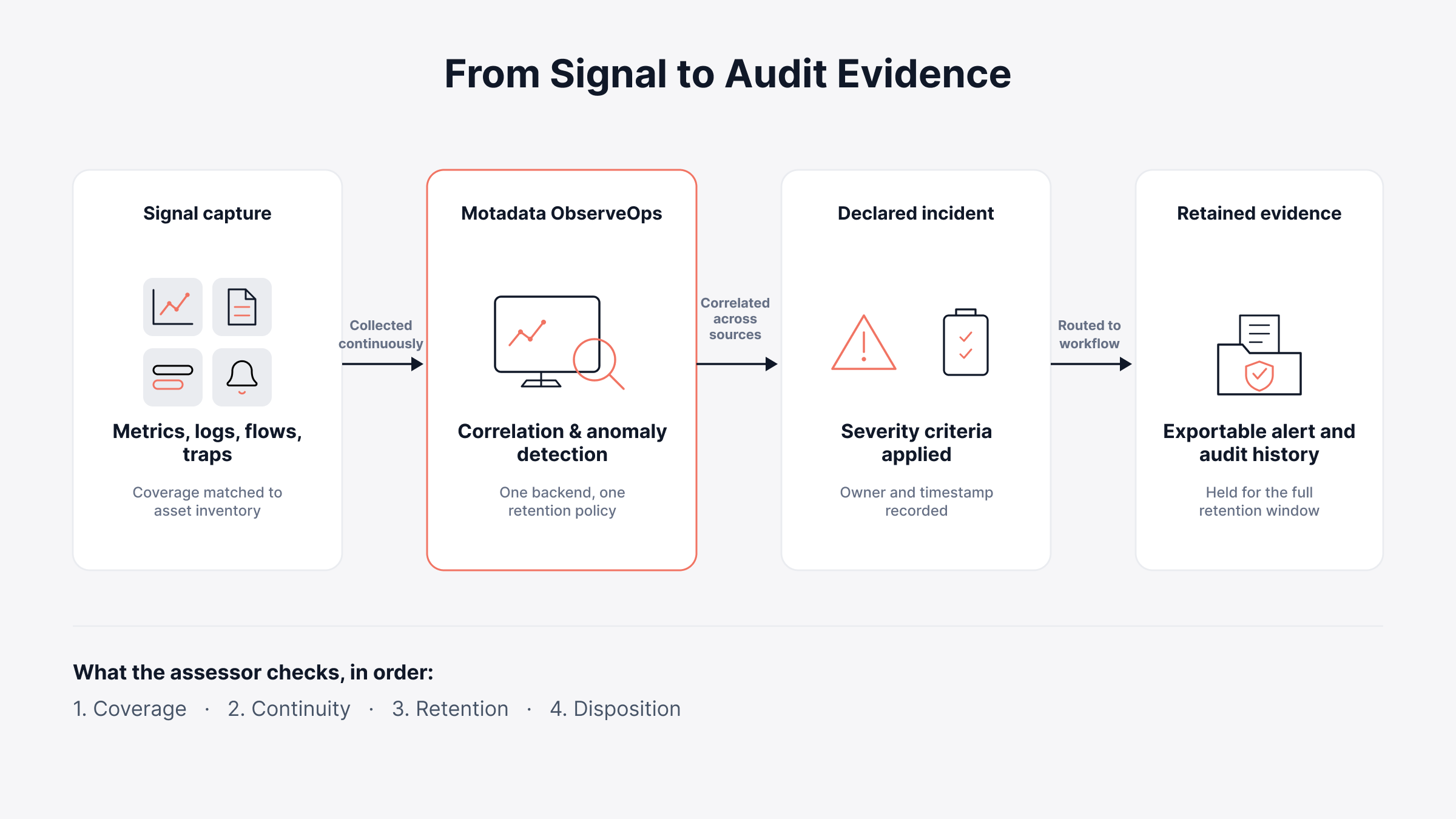
NIST CSF continuous monitoring evidence moves through a pipeline, and every stage has to stand up on its own when exported. The following traces how a raw signal becomes something an assessor accepts.
What Evidence do Assessors Expect for NIST Continuous Monitoring?
Assessors expect four things from a NIST continuous monitoring claim, and they check them in roughly this order. Getting these ready in advance is most of the difference between a two-week assessment and a two-month one.
Coverage: The list of monitored systems reconciled against the authoritative asset inventory, with documented reasons for anything excluded
Continuity: Proof that collection ran without unexplained gaps, which means polling records and agent connectivity history
Retention: Log and metric retention windows that meet or exceed the period the control requires, with the retention setting itself exportable
Disposition: Evidence that alerts led somewhere, whether to a ticket, a documented dismissal, or an automated action
Coverage and continuity are where most programs lose points, and both fail quietly. These are the failures that surface at assessment time:
Coverage drift: Inventory and monitored objects separating over time, answered by scheduled reconciliation against asset management records
Silent collection loss: Polling that stops without raising an alarm, answered by agent connectivity history, polling records, and detection time trends a board can read
A migration adds twelve virtual machines, the CMDB records all twelve, and the discovery profile never picks them up because it was scoped to the old subnet. Nothing breaks and the dashboard stays green, so the gap surfaces nine months later in a coverage report with nothing to explain it.
How does the Respond Function Depend on Operational Workflow?
The Respond function depends on service management workflow because every one of its outcomes is a recorded action with an owner and a timestamp. Respond contains four categories: Incident Management, Incident Analysis, Incident Response Reporting and Communication, and Incident Mitigation. All four describe things a ticketing and workflow system records natively.
The practical mapping looks like this:
Incident Management (RS.MA): Response plan execution, triage, categorization, and formal incident closure, evidenced by ticket lifecycle records
Incident Analysis (RS.AN): Investigation notes, root cause findings, and preserved data integrity, evidenced by linked artifacts on the incident record
Incident Response Reporting (RS.CO): Internal and external notification against defined criteria, evidenced by communication logs and approval steps
Incident Mitigation (RS.MI): Containment and eradication actions, evidenced by change records and automated action history
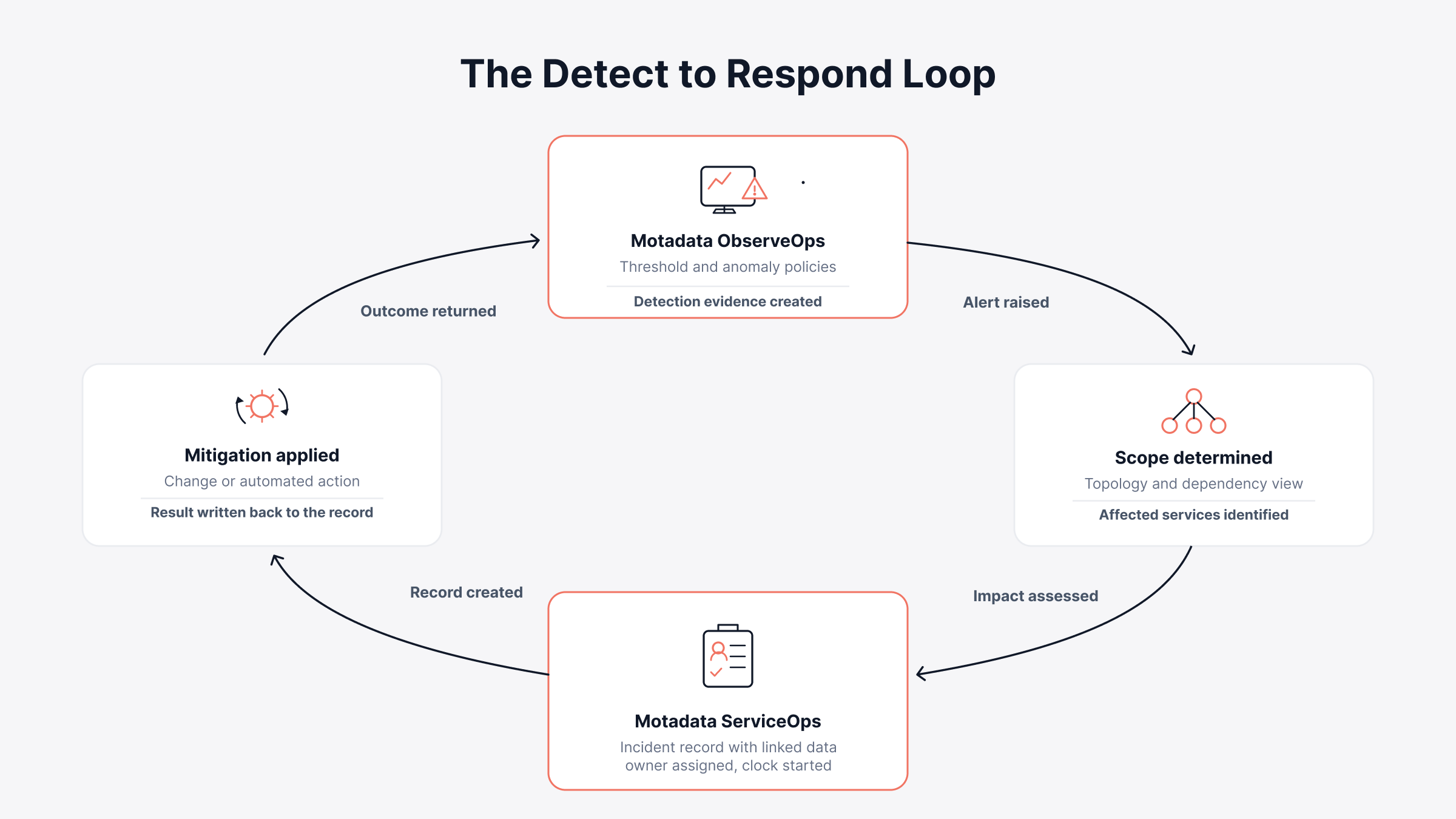
The dependency that matters is the handoff. A correlated alert in the observability platform has to become an incident record with an owner, carrying the detection evidence with it. When that link is manual, the response clock starts late and the audit trail has a hole in the middle of it.
Motadata ServiceOps carries the Respond side:
Workflow practices: Incident, problem, and change running on a unified CMDB
Alert-to-record integration: ObserveOps policies raising records directly, which is what makes closed-loop incident management auditable rather than described
Existing service desks: The same integration path available where a third-party tool is already in place
The handoff between detection and response is where audit trails usually break, and it is also where response time is quietly lost. The following traces the loop that keeps detection evidence attached to the incident record.
Where does Configuration Compliance Fit into NIST CSF?
Configuration compliance spans the Protect and Detect functions, and it is the control area where network teams carry the most direct NIST exposure. PR.PS covers platform security and configuration management, while DE.CM-09 covers monitoring of hardware, software, and runtime environments for potentially adverse events, which includes unauthorized configuration change.
Drift becomes a compliance problem before it becomes a performance problem, and a policy document detects none of it:
Unapproved rule change: A firewall rule added outside the change process
Stale credentials: A switch still running an SNMP community string that should have been rotated
Bad restore: A router brought back from an out-of-date configuration backup
Continuous network configuration capture with version tracking turns each of those into an alert. ObserveOps handles this through network compliance management, capturing configurations automatically, tracking versions, detecting change through syslog or scheduled comparison, and assessing against compliance standards. The documented standards for policy-based assessment are CIS, GDPR, HIPAA, and SOX, and bulk configuration execution handles the correction side across multi-vendor environments.
How to Build a NIST Compliance Checklist That Survives an Audit
A NIST compliance checklist survives an audit when every line names an artifact rather than an intention. Checklists that read as activities produce assessment findings; checklists that read as artifacts produce evidence packages. The difference is a single column.
Work through these five steps in order:
Establish the authoritative inventory: Reconcile discovery output against the CMDB, tag every asset with a business service owner, and record the exclusion rationale for anything unmonitored
Select the applicable publication: Decide whether CSF 2.0 alone applies, or whether SP 800-53 or NIST 800-171 compliance obligations apply on top, since the evidence bar differs
Map subcategories to signals: Use the Detect and Respond mappings above, and mark any subcategory with no signal behind it as a gap rather than a plan
Set retention against the longest requirement: Align log, metric, and audit trail retention to whichever control demands the longest window, then export the retention configuration as evidence
Schedule the reconciliation: Run coverage and continuity checks monthly, because the gap that appears in month two is the one an annual review misses
Two supporting practices carry more weight than their effort suggests. Patch compliance reporting answers a large share of Protect questions with data the patch platform already produces. On the ServiceOps side, compliance in ITAM practices cover the asset and software integrity subcategories that otherwise get answered from memory.
What Should a NIST Compliance Tool Cover?
A NIST compliance tool should cover evidence generation as well as control mapping. Plenty of NIST compliance software presents a control matrix and a completion percentage, which helps the compliance team and does nothing for the assessor asking what the infrastructure recorded. Evaluate against what the platform can produce on demand.
Unified signal storage: Metrics, logs, flows, and traces in one backend, so correlation evidence comes from one system with one retention policy
Coverage reconciliation: The ability to compare monitored objects against the asset inventory and export the difference
Configurable retention: Per-source retention settings that can be exported as configuration evidence
Policy-based configuration assessment: Scheduled evaluation of device configurations with drift alerting and rollback
Alert-to-record integration: Native or API-based creation of incident records carrying the originating detection data
Exportable audit log: User and administrative action history covering the full retention window
Deployment control: On-premises or private cloud options where data residency forms part of the control set
These criteria separate the field faster than a feature matrix does, and they apply to NIST compliance solutions of every shape. They matter even more when you assess NIST 800 171 compliance solutions specifically, since CUI boundary requirements often rule out shared-tenant collection.
Anyone evaluating the best NIST compliance platform for a hybrid environment should test coverage reconciliation first, because it is the capability most commonly assumed and least commonly present. Pair the shortlist with a review of network security monitoring practice, since tool selection rarely fixes a process gap on its own.
Make the NIST Detect and Respond Functions Provable with Motadata
NIST compliance work fails at the same place for most organizations: the moment an assessor asks for operational evidence and the answer has to be assembled from four tools with four retention policies. The governance documents are ready. The infrastructure record is not.
One concession is worth stating plainly. No platform makes an organization NIST compliant on its own, because Govern, risk acceptance, and control selection stay with people. What a platform removes is the evidence problem across the other five functions.
Motadata ObserveOps holds metrics, logs, flows, traces, and topology in one backend, correlates across them, and assesses network device configurations in the same platform. Motadata ServiceOps carries the Respond side through incident, problem, and change practices on a unified CMDB, with alert-to-ticket integration linking detection to action. Together they make both functions something your infrastructure records continuously.
FAQs
What is NIST compliance?
NIST compliance means aligning security controls, monitoring, and incident practices with standards published by the National Institute of Standards and Technology and keeping evidence that the alignment holds continuously. It most often refers to the Cybersecurity Framework 2.0, SP 800-53, or SP 800-171 depending on the organization's obligations.
Is NIST compliance mandatory?
It is mandatory for US federal agencies under FISMA and for defense contractors handling Controlled Unclassified Information through DFARS and CMMC. For everyone else, it is voluntary in law and increasingly required in practice by enterprise customers, cyber insurers, and supply chain agreements.
Which is better, ISO 27001 or NIST CSF?
They answer different questions. ISO 27001 is a certifiable management system standard with an accredited audit path, while NIST CSF is an outcome framework with no certification attached. Organizations needing a certificate for procurement choose ISO 27001, and many run CSF alongside it to organize technical work.
How does monitoring support NIST compliance?
Monitoring supplies the evidence behind Detect and much of Respond, including coverage records, correlated event analysis, and the alert history showing what happened after a threshold broke. Platforms such as Motadata ObserveOps hold metrics, logs, and flows in one backend, so correlation and retention evidence come from a single source.
What should a NIST compliance checklist include?
Every line should name a retrievable artifact rather than an activity, covering asset reconciliation, coverage and continuity, retention settings, configuration assessment results, and incident records with linked detection data. Teams running Motadata ObserveOps and ServiceOps together can export most of those artifacts directly, and scheduling the reconciliation monthly keeps the checklist accurate between assessments.
Author
Poonam Lalani
Content Strategist
Poonam Lalani is a B2B content strategist and writer with a background in computer engineering and experience across enterprise technology domains, including AI, cloud, DevOps, data engineering, and IT operations. She specializes in creating research-driven content that simplifies complex ideas and supports product education, thought leadership, and business growth.