What Is Cybersecurity Compliance? Frameworks and Requirements
Most IT teams are asked to meet more than one security framework at once. Almost nobody gets more budget or more people to do it.
That is the real shape of cybersecurity compliance. A sales deal needs SOC 2, a hospital contract drags in HIPAA, and card payments put PCI DSS on top of both. Each one arrives with its own auditor, its own vocabulary, and a deadline somebody set without asking you.
So the same controls get built three times over.
Teams keep three sets of records and answer one question three ways. The overlap between these regulatory compliance regimes is enormous, and hardly anyone maps it.
We have watched teams budget for a new framework as a fresh project when most of the work was compliance they had already done, sitting there in somebody else's vocabulary.
In this guide, you will learn:
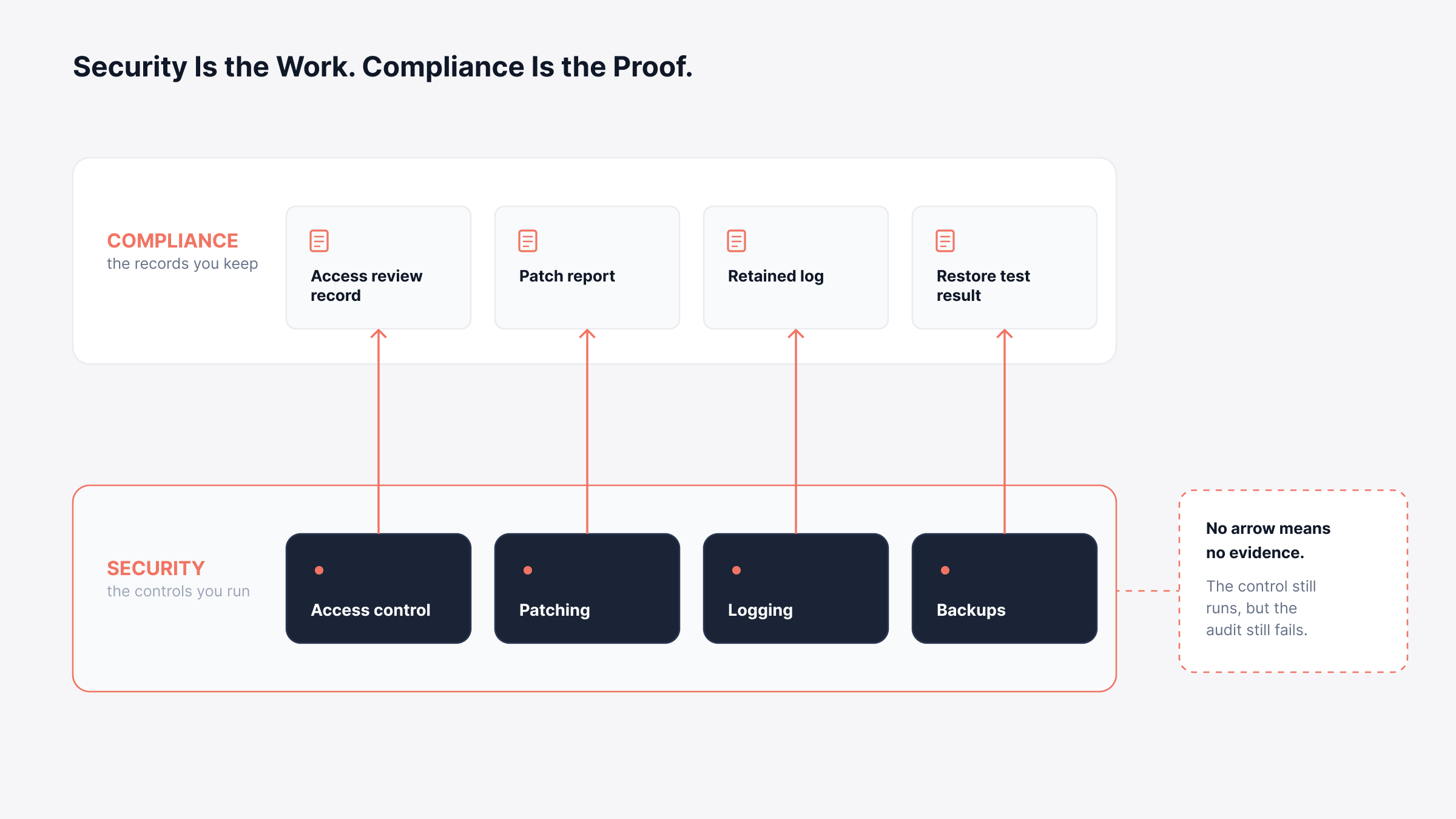
Compliance is the evidence layer: Security is the work. Compliance is the proof you can hand to someone else.
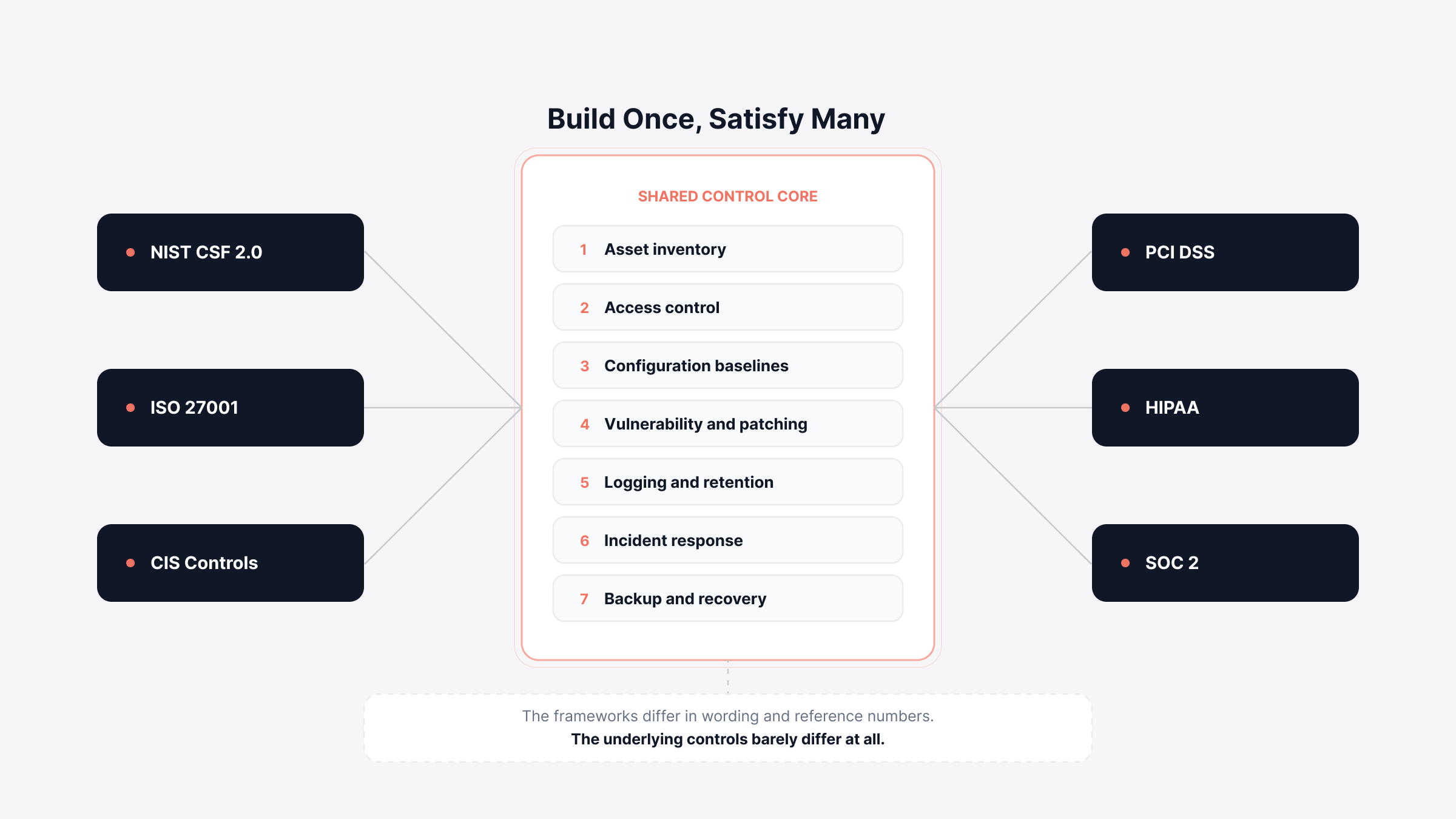
Seven controls carry most frameworks: Asset inventory, access control, configuration baselines, patching, logging, incident response, and recovery.
NIST CSF now has six functions: Govern joined the original five in version 2.0, and a surprising number of published guides still say five.
The penalties differ in kind: Some frameworks fine you. Others stop you bidding at all.
Auditors want records, not intentions: A policy with nothing behind it fails.
By the end you will know which frameworks apply to you, which controls satisfy several of them at once, and what evidence each one expects.
What Is Cybersecurity Compliance?
Cybersecurity compliance means meeting the security rules that apply to your organization and being able to prove it. Those rules come from laws, industry standards, and contracts, and each one sets out controls you have to run plus records you have to keep.
The proof matters as much as the controls. Auditors and customers cannot see your network. They see what your records show, which makes evidence the working currency of every framework below.
Three kinds of rule get grouped under the same term, and they behave nothing alike.
Laws and regulations: Binding whether you agree or not. HIPAA, GDPR, and SOX sit here, and a regulator enforces them.
Industry standards: Binding through contract rather than statute. PCI DSS is the clearest case, because the card brands enforce it and no government does.
Voluntary frameworks: Adopted by choice. NIST CSF, ISO 27001, and the CIS Controls all work this way.
That last group causes the most confusion, and a voluntary framework stops feeling voluntary the second an enterprise buyer writes it into a contract.
The word certification causes its own trouble. ISO 27001 certifies you, and an accredited body issues the certificate. SOC 2 works differently, because what you get is an opinion from a CPA firm.
NIST CSF and the CIS Controls hand out nothing at all. You assess yourself against those, which is why we are so often asked to help teams prove an alignment no external body will ever stamp.
What Is the Difference Between Cybersecurity and Compliance?
Cybersecurity is the work of protecting systems. Compliance is the work of proving that protection meets an agreed standard. You can do one well and still fail the other.
It fails in both directions, and that is why the distinction earns its keep.
Situation | What It Looks Like | Why It Happens |
Secure but not compliant | Strong controls, failed audit | The controls work, but nothing records that they worked |
Compliant but not secure | Clean audit, then a breach | Controls were built to pass a checklist, not to stop an attacker |
Neither | Findings and incidents together | Security treated as a project with an end date |
The middle row is the one that wrecks reputations. Passing an audit says a sample of controls met a standard on a given date. It has never once said you are safe.
Row one is more common, and far easier to fix. In our experience the controls are already there and running fine. What went missing was the log, the ticket, or the approval that would have shown an auditor as much.
So we push back when compliance gets handed to one person with a spreadsheet (which, more often than anyone admits, is exactly how it starts). Evidence has to come from the systems doing the work. It cannot come from someone walking the floor asking colleagues what they did last quarter.
Keeping both layers running takes real effort, so it is worth being clear about what that effort buys you.
What Are the Benefits of Cybersecurity Compliance?
Cybersecurity compliance is important because it decides which contracts you can bid on, how fast you close enterprise deals, and what your cyber insurance costs. The security gains are real. The commercial ones tend to arrive first.
Five come up again and again in the teams we work with.
Contract eligibility: Some frameworks are a gate, not a preference. A defense contractor without CMMC certification cannot win the work at all, however good its security is.
Shorter sales cycles: Security questionnaires get answered from records you already hold.
Insurance terms: Insurers increasingly want evidence of named controls before they will quote, and your answers move the premium.
Lower breach risk: The shared controls below are genuine security measures, so meeting them cuts real exposure.
Cheaper audits: Evidence gathered continuously costs a fraction of evidence reconstructed the week before an auditor lands.
That last one compounds. Teams who automate evidence collection spend their audit week reviewing findings, and teams who do not spend it hunting screenshots.
One caution belongs on the list too. Compliance wins you the right to compete, and nothing more, so treat it as a floor rather than a selling point.
Which Cybersecurity Compliance Frameworks Apply to You?
Which cybersecurity compliance frameworks apply to you depends on three things: your industry, the data you hold, and who you sell to. Most organizations land under several at once.
The table below covers the ones that come up most in US organizations, and what pulls you into each.
Framework | Who It Applies To | Binding How |
NIST CSF 2.0 | Any organization, and expected across federal supply chains | Voluntary, often contractual |
ISO/IEC 27001 | Any organization, common where buyers are international | Voluntary, certifiable |
CIS Controls | Any organization wanting a prioritized starting point | Voluntary |
SOC 2 | Service providers holding customer data | Contractual, via customer demand |
PCI DSS | Anyone storing, processing, or transmitting card data | Contractual, via card brands |
HIPAA | Healthcare providers, insurers, and their business associates | Federal law |
GDPR | Anyone processing personal data of people in the EU | EU law, extraterritorial |
CMMC and DFARS | Defense contractors handling federal contract information | Federal contract requirement |
SOX | US publicly traded companies | Federal law |
GLBA | Financial institutions and many lenders | Federal law |
SEC cyber disclosure | SEC registrants | Federal rule |
Two entries there get misread constantly.
NIST CSF has six functions, not five: Version 2.0 added Govern in February 2024, alongside Identify, Protect, Detect, Respond, and Recover. Plenty of published guides still say five. Govern covers roles, policy, and risk strategy, and it is increasingly where an auditor opens.
CIS Controls are not a regime: The CIS Controls are a prioritized list that maps cleanly onto the others. That makes them the cheapest place to start when nothing has been mandated yet.
Operate outside the US and regional privacy law adds a layer. India's DPDPA and South Africa's POPIA both impose security and breach-reporting duties that will look familiar if you already meet GDPR.
Most teams we speak to are subject to three or four of these at once. That sounds worse than it is. The frameworks overlap far more than their documentation lets on.
What Are the Cybersecurity Compliance Requirements?
The cybersecurity compliance requirements that repeat across almost every framework come down to seven controls. Build them once, keep the records, and you have covered most of what any of these auditors will ask for.
The mapping below shows where each one surfaces. Reference numbers shift between framework versions, so treat them as pointers and not as quotations.
Control | CIS v8 | NIST CSF 2.0 | ISO 27001:2022 | PCI DSS v4.0 | SOC 2 |
Asset inventory | 1, 2 | ID.AM | A.5.9 | 12.5.1 | CC6.1 |
Access control | 5, 6 | PR.AA | A.5.15 | 7, 8 | CC6.1 to CC6.3 |
Configuration baselines | 4 | PR.PS | A.8.9 | 2 | CC7.1 |
Vulnerability and patching | 7 | ID.RA | A.8.8 | 6, 11 | CC7.1 |
Logging and retention | 8 | DE.CM | A.8.15 | 10 | CC7.2 |
Incident response | 17 | RS, RC | A.5.24 | 12.10 | CC7.3 to CC7.5 |
Backup and recovery | 11 | RC.RP | A.8.13 | Not specified | A1.2 |
That table is not exhaustive, and no mapping removes the need to read the framework text that actually binds you.
What it does show is where effort compounds. Every control below earns its place in several columns at once, so we take them one at a time and note the evidence each one throws off.
1. Asset Inventory
Asset inventory means a current, complete record of the hardware and software you run. Every framework starts here, because you cannot protect or report on a thing you do not know exists.
Auditors test it by sampling. They pull devices off your network and check whether your inventory knew about them, which is a test hand-maintained spreadsheets fail inside ten minutes. That is why automated asset discovery is the first thing we would fix.
Shadow IT is where the control really breaks. A forgotten test server holding real customer data counts as a security gap and an audit finding at the same time.
Cloud makes it worse. We keep finding estates where the on-premises inventory is immaculate and the cloud side is two years stale, for the dull reason that nothing was ever pointed at it.
2. Access Control
Access control means people reach only the systems their job requires, and you can show who approved it. Joiners, movers, and leavers are what frameworks care about most.
The evidence comes in three parts: how access was granted, how it was reviewed, and how fast it went away. Role-based access control makes all three easier to prove, because permissions hang off a role rather than a person.
Departed employees with live accounts are still the most common finding we run into. The control exists. Offboarding is the step that gets skipped.
Service accounts need watching separately, since they belong to no one, survive every offboarding process ever written, and quietly hold more privilege than most of the humans do.
3. Configuration Baselines
A configuration baseline is a documented, secure setting for each class of system, plus a way to spot drift away from it. PCI DSS Requirement 2 and CIS Control 4 both go after default settings that ship insecure.
Network devices are the hard part. Someone changes a config by hand at two in the morning to clear an incident, the incident clears, and the change never gets reverted. That is the whole argument for putting network compliance checks on a schedule instead of in a project plan.
Version history turns all that into usable evidence. Show the baseline, the change, who made it, and when it was corrected. We have yet to meet an auditor who wanted more than that.
4. Vulnerability and Patch Management
This control pairs finding weaknesses with fixing them inside a defined window. Auditors check both halves. The second half is where programs fall down.
Scanning proves you looked. Patch records prove you acted. Knowing how to ensure patch compliance across a mixed estate of Windows, Linux, and whatever the last acquisition dragged in is what turns a scan report into something an auditor accepts.
Set the remediation window before you need it. A policy saying critical patches ship within fourteen days can be tested against reality. A policy that just says promptly gives an auditor nothing to test.
Log your exceptions as well. Some systems genuinely cannot be patched on schedule, and we would rather see the reason and the compensating control written down than watch the gap sit there unexplained.
5. Logging and Retention
Logging means recording security-relevant events and keeping them long enough to investigate. PCI DSS wants a year of history with three months immediately available, and other frameworks set their own periods.
Retention is what teams underestimate. An audit log that rolled over last month cannot answer a question about last quarter. Breaches get discovered months after they start, so those two facts compound into one very bad afternoon.
Logs have to be protected from the people they record. An administrator who can edit the log of their own actions has left you with a log that proves nothing.
Then there is coverage. We keep meeting teams with excellent server logging and almost nothing on the network gear, and that gap surfaces at the worst imaginable moment, which is always halfway through an investigation.
6. Incident Response
Incident response means a documented plan, named owners, and a record of what actually happened during real incidents. Frameworks want the plan and the proof you followed it.
Notification deadlines are the sharp edge. GDPR gives you 72 hours from becoming aware of a breach, and the SEC wants a material incident disclosed within four business days of the moment you decided it was material.
Both clocks start at detection, not at resolution, which quietly turns your logging and your timestamps into incident response evidence.
Tabletop exercises are the cheapest evidence you will find here. Run one a year, keep the notes, and several frameworks are satisfied at once. They also surface gaps that no amount of document review ever would.
7. Backup and Recovery
Backup and recovery covers protected copies of your data plus proof that restoring them works. Auditors focus on the proof, because untested backups fail at a rate that would surprise you.
Run restore tests on a schedule and keep the results. One dated restore test satisfies several frameworks and costs you an afternoon.
Ransomware moved the goalposts here. Auditors now want to know whether a backup copy is genuinely offline or immutable, and a backup an attacker can reach was never a recovery plan to begin with.
What Evidence Do Auditors Ask For?
Auditors ask for records showing a control operated over a period, not documents saying it should. Most first-time audits fail in the gap between those two things.
That period is why retention settings matter so much. A SOC 2 Type 2 review can cover twelve months, and a log holding thirty days will not support it however well the control itself runs.
Here is the artifact normally requested against each control.
Control | Evidence Usually Requested | Where It Normally Lives |
Asset inventory | Current asset register with discovery dates | Asset management or CMDB |
Access control | Access review sign-offs and deprovisioning tickets | Identity system and service desk |
Configuration baselines | Baseline documents and drift or change reports | Configuration management |
Vulnerability and patching | Scan results plus patch deployment reports | Patch management |
Logging and retention | Retained logs and proof of retention settings | Log management |
Incident response | Incident tickets with detection and closure times | Service desk |
Backup and recovery | Backup job history and dated restore test results | Backup platform |
Read down the right column and the pattern jumps out. Almost none of that evidence comes from a compliance product. It comes from operational tools your team already runs every day.
Which is the practical case for treating compliance as an IT operations problem rather than a paperwork one. The records exist. What goes missing is retention, consistency, and any sane way to export them when somebody asks.
Cybersecurity Compliance Checklist: 10 Steps
This checklist takes you from no formal program to an auditable one. Order matters here, because each step produces something the next one needs.
List what applies to you: Work through your industry, your data types, your contracts, and the regions you operate in. Write the frameworks down where everyone can see them.
Name an owner: One person, accountable. Shared ownership is how deadlines quietly slip.
Define your scope: Decide which systems, sites, and data are in. Scope creep drives audit cost more than anything else.
Build the asset inventory: Everything downstream depends on knowing what you run.
Run a gap analysis: Compare your current controls against the frameworks you just listed. Rank every gap by risk, not by how easy it looks to close.
Write the policies: Document what you will do, with real numbers in them. Patch windows and retention periods, not adjectives.
Implement the seven controls: Start with the ones serving several frameworks at once.
Automate evidence collection: Make records a by-product of running the controls rather than a separate job somebody has to remember.
Test before the auditor does: Run an internal review and fix findings while they are still cheap.
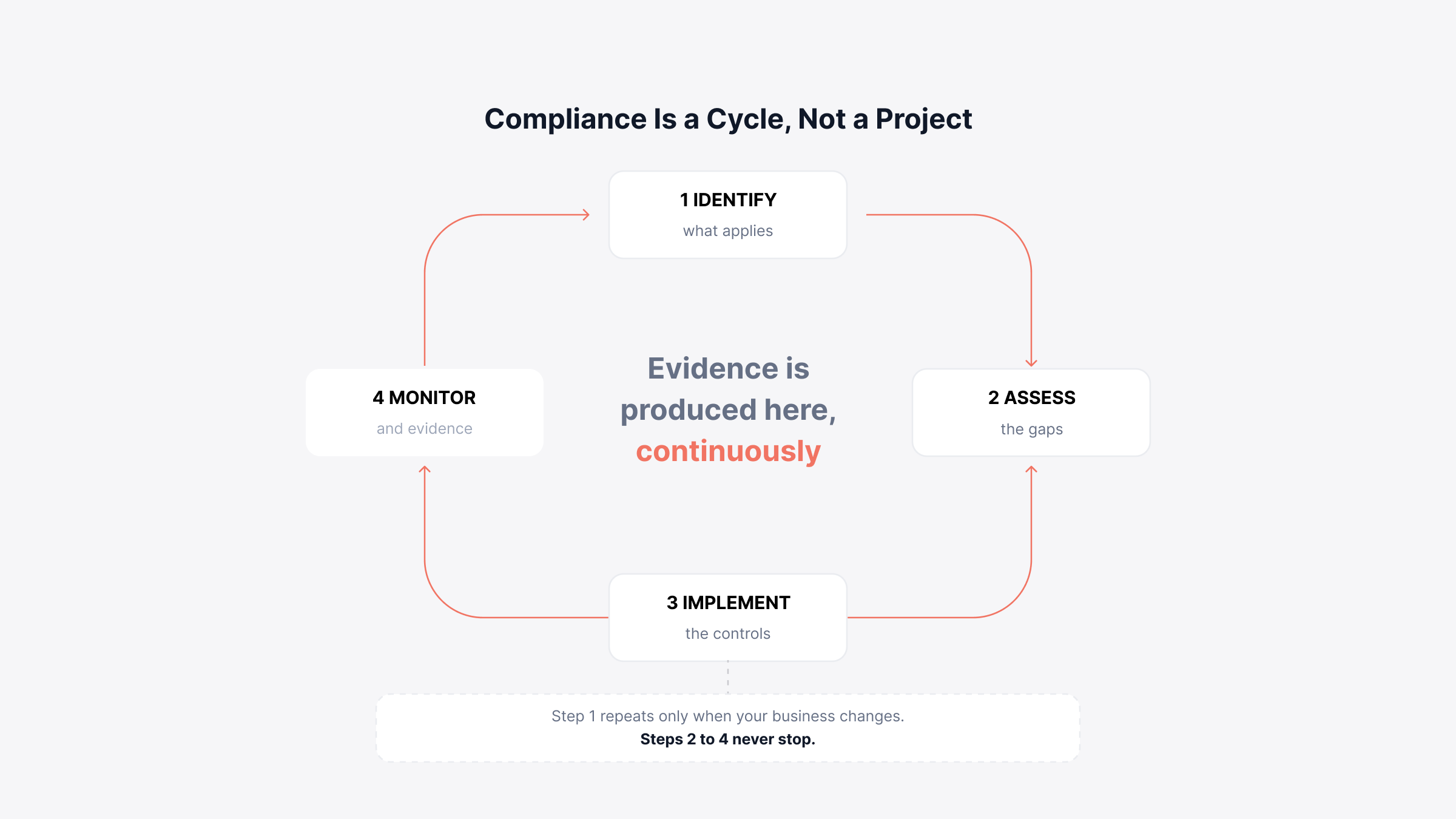
Monitor continuously: Schedule the reviews, drift checks, and restore tests so the program survives between audits.
Step eight decides whether any of this becomes sustainable. You will still pass your first audit if you skip it, but future audits can be really challenging.
Steps one and three repay extra care. Scope gets drawn too wide on a first attempt more often than not, dragging development and test systems into an audit that never needed to touch them. Nobody notices until the auditor starts sampling.
That last step turns the list into a loop rather than a sequence, as the diagram shows.
Running that loop is straightforward on paper. Keeping it running while the business changes around you is where programs struggle.
What Are the Challenges of Cybersecurity Compliance?
The challenges of cybersecurity compliance are operational far more than technical. The controls themselves are well understood. Keeping them running while everything around them changes is the hard part.
Five turn up in nearly every program, each with a practice that answers it.
Challenge | What Goes Wrong | What Helps |
Overlapping frameworks | The same control gets built and evidenced several times | Map controls to frameworks once, then evidence each control a single time |
Point-in-time thinking | Controls decay between audits, then get rebuilt under pressure | Schedule reviews and drift checks instead of running audit sprints |
Manual evidence collection | Screenshots and spreadsheets consume weeks and go stale | Generate evidence from the tools that run the controls |
Scope drift | New cloud accounts and devices appear outside the program | Automated discovery feeding the asset inventory |
Third-party risk | Your vendors hold your data and your frameworks still hold you responsible | Collect vendor attestations on a schedule and record the review |
Manual evidence collection carries the highest cost and the clearest fix. It is also where budgets go wrong, because the recurring staff time dwarfs the auditor's fee and nobody put it in the spreadsheet.
Scope drift is the quietest of the five. Get the role of asset management in compliance right and a program stops going stale behind your back.
Honestly, a sixth belongs on that list: staff turnover. We have seen it wreck more programs than any technical gap.
When the person who understood the evidence walks out, the next audit starts from nothing unless somebody wrote the process down.
What Are the Penalties for Non-Compliance?
The penalties for non-compliance vary by framework, and they differ in kind as much as in size. Some cost money. Others cost you the ability to do business at all.
Framework | What Happens |
GDPR | Up to 20 million euros or 4 percent of global annual turnover, whichever is higher |
HIPAA | Four tiers of civil penalty based on culpability, with annual caps set by HHS |
PCI DSS | Card brand fines passed on by your bank, and potential loss of card processing |
CMMC and DFARS | Loss of eligibility to bid, and False Claims Act exposure for misrepresentation |
SOX | Officer certification liability, including criminal penalties for knowing false certification |
SEC cyber disclosure | Enforcement action against the company and its officers |
The CMMC row is the one to look at twice. A fine is survivable. Losing the right to bid on defense work deletes a revenue line.
Most of the cost lands long before a regulator does anything. Breach notification, forensics, and the customers who quietly stop renewing will dwarf the fine. Regional laws such as POPIA then stack their own penalties on top in the markets they cover.
Regulators weigh how you behaved, too. Show that controls were running, that you caught the problem yourself, and that you reported it on time. In our experience that record counts for a great deal when the penalty gets set.
How Do You Get Started With Cybersecurity Compliance?
Start by writing down which frameworks apply to you and building an accurate asset inventory. Those two unblock everything else, and neither needs budget approval to begin.
After that, we would work in order of overlap rather than framework by framework. Find the control appearing in the most frameworks you are actually subject to, and close that gap first.
Three things are worth doing in month one.
Check your retention settings: Confirm the logs are held long enough for the longest requirement you face. Do it before you need them, not after.
Run one restore test: Record the date and the result. Cheapest audit evidence you will ever produce.
Review access for leavers: Pull the list of departed staff and check for live accounts. You will find some.
None of that needs a compliance platform. It needs you to know which records you already generate, and to make sure they survive long enough to be worth something.
On tooling, our advice is to buy last. Work out what evidence you cannot produce today, then go looking for what would produce it. Most teams already own more of the answer than they think.
Build Compliance Into How You Already Work
Cybersecurity compliance gets easier the moment you stop treating each framework as a separate project. Those seven controls carry most of the load across all of them.
Teams who find this manageable are rarely the ones with the biggest budgets. They are the ones whose evidence falls out of daily operations, rather than getting assembled the week an auditor books a date.
It is also why the second framework costs a fraction of the first. Once your asset inventory, access reviews, and log retention run properly, a new standard is mostly met before you start. What changes is the mapping, not the work underneath it.
So pick one control this week. Make its records automatic, complete, and retained long enough to matter, then go and do the next one.
FAQs
Is NIST 800-53 a compliance standard?
NIST 800-53 is a control catalog rather than a compliance standard. Federal agencies must use it under FISMA, and private organizations adopt it voluntarily or through contract. It supplies the controls that other frameworks reference.
What are the four types of cybersecurity controls?
Controls are usually grouped as preventive, detective, corrective, and deterrent, based on what they do. A separate grouping splits them into administrative, technical, and physical, based on how they are implemented. Auditors use both.
How long does cybersecurity compliance take?
A first framework typically takes six to twelve months from gap analysis to audit, depending on scope and starting maturity. Adding a second framework takes far less time, because most of the controls already exist and only the evidence mapping changes.
Do small businesses need cybersecurity compliance?
Yes, whenever a law, a card brand, or a customer contract applies to them. Small size does not exempt you from HIPAA, PCI DSS, or GDPR. The CIS Controls are a practical starting point when nothing specific is mandated yet.
Can you be compliant and still get breached?
Yes, and it happens regularly. Compliance confirms that controls met a standard when they were tested, which is not the same as being safe. Attackers do not limit themselves to the gaps a framework happens to cover.
Author
Ramya Shah
Technical Writer
Ramya Shah is a technical content writer with a computer engineering background and roots in automotive journalism. He covers IT Service Management, observability, IT operations, and AI-driven automation. An early adopter of AI-assisted writing workflows, he turns complex IT processes into clear, engaging content optimized for search and answer engines (AEO), lifting content output and organic visibility.