ISO 20000 in ITSM: What the Standard Actually Requires From Your Service Desk
Certification against ISO 20000 puts your service desk under audit. That audit runs on what your team wrote down at the time.
The standard does not care how your team describes its process. It does not care which ITIL 4 practices you adopted. It cares what your records show, so auditors spend their time in your tickets, approvals, and review minutes.
In this blog, you will:
See what each of the seven auditable clauses demands.
Trace Clause 8 down to the practices your service desk runs daily.
Learn what the 2024 climate amendment added to Clause 4.
Compare the standard against ITIL 4 and ISO 27001.
You will finish knowing which of your records would survive an audit.
What Is ISO 20000?
ISO 20000 is the international standard for IT service management, formally ISO/IEC 20000. You certify against Part 1, published as ISO/IEC 20000-1:2018.
Part 1 sets the rules for a service management system, or SMS. Your SMS covers everything you use to plan, deliver, and improve IT services. Policies sit inside it. So do processes, roles, and the records that prove the work happened.
The standard has grown into a wide family. Only Part 1 carries a certificate. The rest offers guidance, and some of it repays reading before you start.
Part | What it covers | Certifiable |
ISO/IEC 20000-1:2018 | Service management system requirements | Yes |
ISO/IEC 20000-2:2019 | Guidance on applying an SMS | No |
ISO/IEC 20000-3:2019 | Guidance on scope definition | No |
ISO/IEC TS 20000-5:2022 | Implementation guidance | No |
ISO/IEC 20000-6:2017 | Rules for bodies that audit an SMS | No |
ISO/IEC 20000-10:2018 | Concepts and vocabulary | No |
ISO/IEC TS 20000-11:2021 | How the standard maps to ITIL 4 | No |
ISO/IEC TS 20000-15:2024 | Agile and DevOps inside an SMS | No |
Anyone who has worked through ISO 27001 or ISO 9001 will know the shape of the 2018 edition. It follows Annex SL, the harmonized structure ISO applies across its management system standards. Clauses 4 through 10 carry the same headings in every one.
Take-up has climbed steadily since the standard entered ISO's certification survey. According to ISO's analysis of the ISO Survey, ISO/IEC 20000-1 went from 2,778 certificates in 2015 to 11,769 in 2021.
What Does ISO/IEC 20000-1 Require? The Seven Auditable Clauses
Clauses 4 through 10 hold every requirement you can be audited against. The first three cover scope, references, and definitions. No auditor raises a finding there.
The table gives each auditable clause and what it asks you to produce.
Clause | Title | What it asks of you |
4 | Context of the Organization | Identify who your services affect, set the SMS scope, and record why the boundary sits where it does. |
5 | Leadership | Show that top management owns the SMS. A signed policy and named roles are the floor. |
6 | Planning | Record the risks and opportunities you found, and the service management objectives set against them. |
7 | Support of the SMS | Prove you have the people, the skills, the awareness, the communication, and the documented information. |
8 | Operation of the SMS | Run the service management practices themselves, from the service catalog through to change and release. |
9 | Performance Evaluation | Monitor, measure, audit internally, report on services, and hold management reviews. |
10 | Improvement | Handle nonconformities, take corrective action, and improve the SMS continually. |
Clauses 4 to 7 and 9 to 10 look familiar to anyone holding another ISO certificate. Clause 8 is where ISO 20000 stops resembling its siblings. It reaches your service desk floor.
What Clause 8 Asks of Your Service Desk
Clause 8 breaks into five groups of service management practices. Each group leaves evidence inside your ITSM tool. The clause runs longer than any other, because it covers the daily running of services instead of the governance around them.
We have watched auditors work these groups the same way every time. They sample instead of reading everything. They pick a handful of tickets, changes, and reviews, then follow each one end to end.
1. Relationship and Agreement
This group covers business relationship management, service level management, and supplier management. You need a named contact for each customer. You also need a documented way of gathering what they want.
Every service in scope needs a service level agreement with targets you actually measure. Agreeing a target and never reporting against it draws a finding here more often than anything else.
Suppliers get the same treatment. Where an outside party delivers part of your service, expect to show a signed agreement. You also need evidence that you track their performance against it.
2. Service Design, Build, and Transition
Three practices sit in this group: change management, service design and transition, and release and deployment management. All three circle one question an auditor keeps asking. How do you stop an untested change reaching production?
Your change management records have to show the request, the assessment, the approval, and the outcome. A change closed with no recorded approval draws a finding, even when the change itself went fine.
New and changed services need design and transition records too. We see teams clear this one by dating acceptance criteria before go-live. Written afterwards, those criteria prove nothing.
3. Service Portfolio
The service catalog anchors this group, because it defines what you get audited on. A scope error here spreads everywhere else. Service delivery, service planning, asset management, and configuration management all sit alongside it.
Configuration management carries the heaviest evidence load. Your CMDB has to hold configuration items and the links between them. It also needs a record of how often you check the data.
Accuracy trips teams up more than completeness does. A CMDB nobody has reconciled in eighteen months will not pass, however good it looked on build day.
4. Supply and Demand
Budgeting and accounting for services, demand management, and capacity management make up this group. Each one ties service delivery to numbers.
Capacity management needs forecast data and evidence you acted on it. Demand management needs a record of how you predict and absorb changes in volume.
Budgeting and accounting catches internal IT teams most often. The standard expects you to cost your services, and many in-house desks have never been asked to. We watch this one stall projects for a quarter.
5. Service Assurance
Three assurance practices close out Clause 8, and availability comes first. It needs targets, measurement, and a record of what you did when you missed them.
Continuity comes next, and it needs documented plans plus evidence that you test them. An untested continuity plan proves nothing at audit.
Information security management links ISO 20000 to ISO 27001. The requirement here runs lighter than a full ISMS. It still asks for policy, controls, and incident handling.
What the 2024 Climate Amendment Added to Clauses 4.1 and 4.2
ISO amended the 2018 edition in February 2024, and the change is small enough to miss. Amendment 1:2024 adds climate change to the context analysis you already run under Clause 4.
Two pieces of text went in, and the table gives both.
Clause | What the clause covers | What Amendment 1:2024 added |
4.1 | Understanding the organization and its context | You shall determine whether climate change is a relevant issue. |
4.2 | Understanding the needs and expectations of interested parties | A note that interested parties can have requirements related to climate change. |
The amendment landed across ISO's certifiable management system standards on the same day. ISO 9001 and ISO/IEC 27001 were among them. According to the joint ISO and IAF communiqué, the amended text took effect on publication.
The audit impact lands narrower than it sounds:
What you must show: that climate change was weighed when you assessed your context, plus the conclusion you reached.
What you do not need: a carbon program, an emissions baseline, or an environmental target of any kind.
What passes: a short entry recording that the topic was assessed and found not relevant. The assessment has to have genuinely happened.
Auditors began checking the amended clauses from 2024 onward, and existing certificates stayed valid throughout.
ISO 20000 vs ITIL 4: What Each One Does
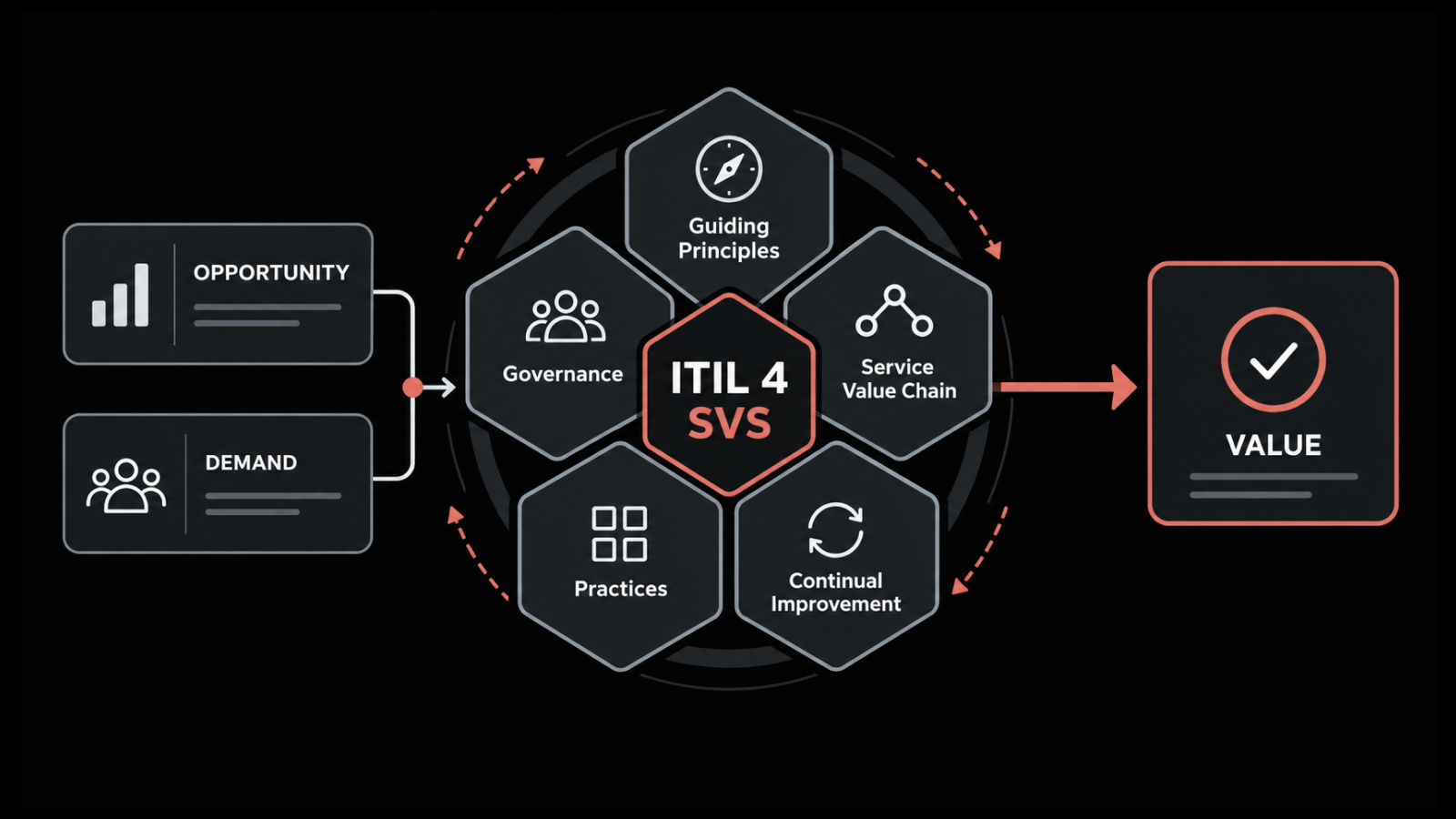
ISO 20000 tells you what must be achieved. ITIL 4 suggests how to achieve it. One gets audited. The other never does.
Here is how the two compare on the points that decide where you spend effort.
ISO/IEC 20000-1 | ITIL 4 | |
Type | Certifiable standard | Best practice framework |
Written as | Requirements | Guidance |
Audited | Yes, by an accredited body | No |
Prescribes methods | No | Yes |
Published by | ISO and IEC | PeopleCert |
The two were built to work together. ISO published ISO/IEC TS 20000-11 for exactly this reason. It maps the standard against ITIL 4 practices, so teams can see where existing work already counts.
An ITIL 4 rollout does not make you compliant on its own. We have seen teams run ITIL 4 practices well and still fail an audit, because the standard wants records ITIL never told them to keep.
ISO 20000 vs ISO 27001: Where They Overlap
ISO 20000 governs how you deliver services. ISO 27001 governs how you protect information. They share a clause structure and one practice. The rest sits apart.
Information security management is the one shared practice. It lives inside Clause 8 of ISO 20000-1 as part of service assurance. ISO 27001 builds a whole management system around the same subject.
Both follow Annex SL, so Clauses 4 through 10 line up heading for heading. That split decides what is finished and what is still ahead.
Already done if you hold ISO 27001 | Still to build for ISO 20000 |
Context analysis and scope (Clause 4) | Service catalog with named owners |
Leadership commitment and policy (Clause 5) | SLA targets and performance reporting |
Documented information controls (Clause 7.5) | Change approval and release records |
Internal audit program (Clause 9.2) | CMDB with verified configuration items |
Management review cadence (Clause 9.3) | Capacity and demand forecasts |
Information security management | Availability and continuity evidence |
Everything in the right column sits inside Clause 8, on ground ISO 27001 never covered. Teams building a wider cybersecurity compliance program often run the two standards together for that reason.
Which Records Your Service Desk Has to Produce
Every clause above resolves into a record. An auditor cannot assess a process they cannot see. So the useful question is which artifacts your service desk produces without anyone remembering to produce them.
The table maps the busiest requirements to the evidence an auditor samples.
Requirement | Record the auditor samples |
Service level management | SLA definitions, target performance reports, records of breaches and what followed |
Change management | Change request, impact assessment, approval, implementation outcome |
Configuration management | CI records, CI relationships, verification and audit history |
Incident and service request | Ticket history with classification, priority, timestamps, and resolution |
Service catalog management | Current catalog with owners, and the change history behind it |
Internal audit and management review | Audit plans, findings, minutes, and corrective actions with owners |
Manual record-keeping fails audits for one predictable reason. The evidence exists while somebody maintains a spreadsheet.
It stops existing the week that person goes on leave. An auditor asking for six change records from last March will find the three that were logged and the three that nobody wrote down.
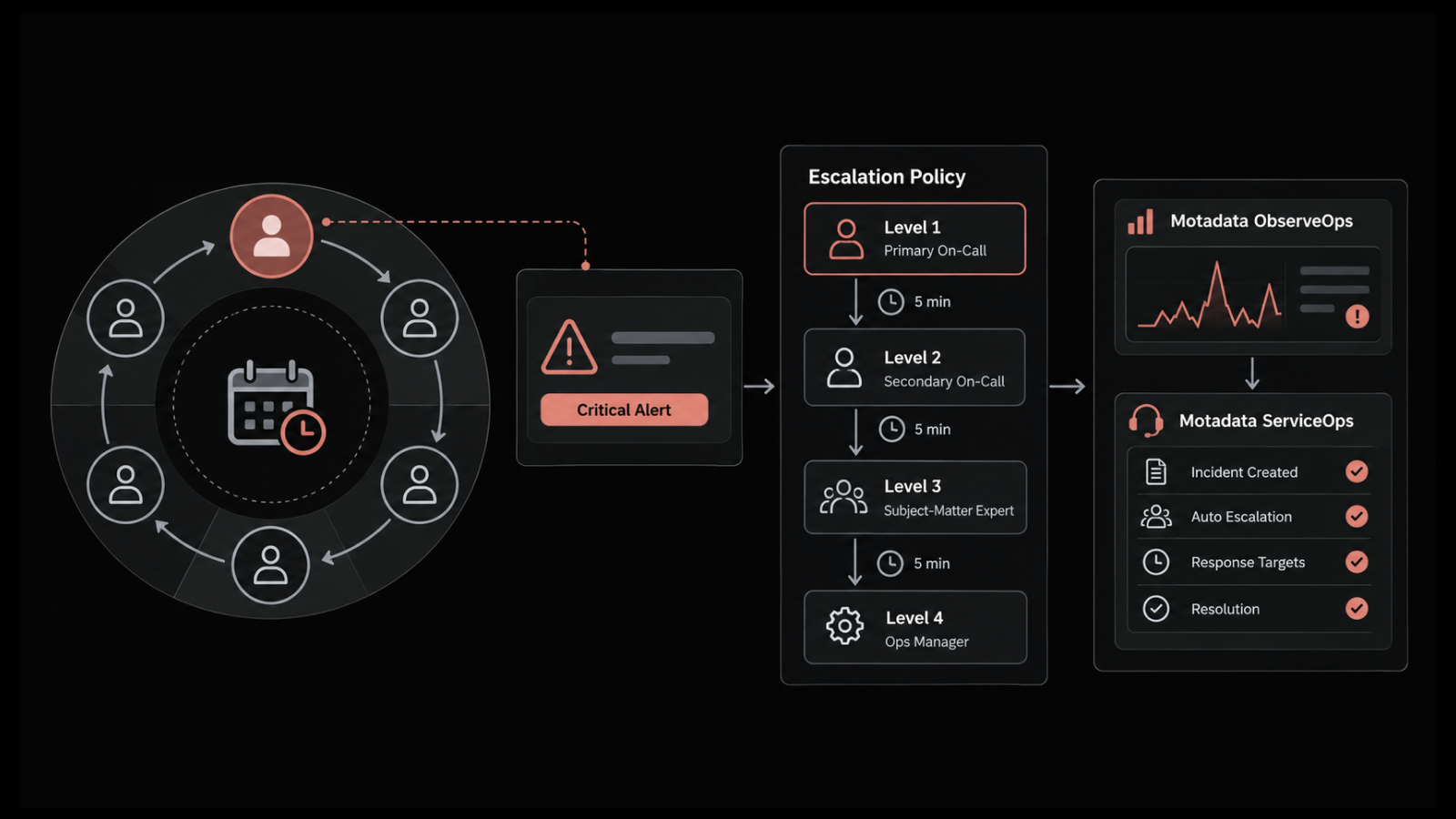
Motadata ServiceOps generates these records inside the modules that create the work. Incident, problem, change, release, and knowledge modules run on ITIL 4 aligned workflows.
Audit trails and change tracking sit inside each one. SLA tracking covers response and resolution times, then reports on them with no separate export step.
Configuration data sits in a unified CMDB shared with asset management. CI links stay tied to the assets they describe.
Availability and capacity evidence needs live infrastructure data behind it. We build both halves as a unified ITSM and observability platform, so the service records and the monitoring data sit in one place.
Where ISO 20000 Programs Usually Strain
Four problems account for most of the difficulty we see teams hit. None of them involve understanding the clauses.
1. Scope Gets Drawn Too Wide
Teams often scope the SMS across every service they run. Then they find that Clause 8 applies to all of it. A narrower scope covering two or three services is easier to defend and easier to keep accurate.
ISO published Part 3 to help with scope definition. It is the part most teams skip.
2. Clause 9 Evidence Gets Built Retrospectively
Monitoring, internal audit, service reporting, and management review all need a rhythm. Reports assembled the week before an audit show it, because the dates cluster.
Tooling helps most here. A platform that reports continuously builds the history on its own.
3. The Certificate Says Less Than People Assume
An ISO 20000 certificate confirms that your SMS meets the rules and that you run it. It says nothing about whether your services are good.
A team with poor availability and honest records about it can hold the certificate. A team with excellent services and no records cannot.
4. Adoption Is Concentrated in a Way That Affects Its Value
That same ISO analysis puts ISO/IEC 20000-1 eighth among accredited management system certifications in 2021. China accounted for just over 78% of the certificates that year. The United States held 265.
That distribution is worth knowing before you build a business case. In some markets the certificate is a routine procurement ask. In others your customers will never have heard of it. Check whether your buyers request it.
How Certification Works, in Short
Conformance and certification are separate things. You can meet every requirement in ISO/IEC 20000-1 and never commission an audit. Plenty of internal IT teams do exactly that.
For teams that do pursue it, the shape stays consistent:
An accredited certification body audits you in two stages.
Stage 1 reviews your documented SMS.
Stage 2 tests whether you genuinely run it.
From the day it is issued, the ISO 20000 certification process runs on a three-year cycle with annual checks in between.
Build ISO 20000 Into How Your Service Desk Already Works
ISO 20000 rewards teams whose evidence falls out of the work instead of a project running beside it. Every clause resolves into something an auditor can sample. The teams that pass are the ones whose tooling already keeps it.
Clause 9 stays the hard part. Monitoring, internal audit, service reporting, and management review demand a rhythm most service desks have never held. No platform supplies that discipline for you.
Start by mapping your current service desk best practices onto Clauses 4 through 10. Mark which ones already leave a record. The gaps you find are the real scope of the work, and they usually run smaller than the standard looks from outside.
FAQs
What is the latest version of ISO 20000?
ISO/IEC 20000-1:2018 is the current certifiable edition. Amendment 1:2024 added climate change to Clause 4. No full revision has replaced it, so guidance written against the 2011 edition is out of date.
What is the difference between ISO 20000-1 and ISO 20000-2?
Part 1 holds the requirements you get audited against. Part 2 explains how to apply them and carries no requirements of its own. You certify against Part 1 only, and read Part 2 while implementing.
Can you comply with ISO 20000 without getting certified?
Yes, because conformance and certification are separate things. Many internal IT teams run an SMS that meets ISO/IEC 20000-1 and never commission an audit. You lose the certificate, not the operational benefit.
Does ISO 20000 apply to companies that are not IT service providers?
Yes, the requirements are generic and cover any organization delivering services through an SMS. Internal IT departments, cloud providers, and business process outsourcers all certify against it.
Does ISO 20000 require a specific ITSM tool?
No, the standard names no product and mandates no software. It does ask for documented information and traceable records. Those are easier to hold in an ITIL 4 aligned platform such as Motadata ServiceOps than in spreadsheets.
Author
Ramya Shah
Technical Writer
Ramya Shah is a technical content writer with a computer engineering background and roots in automotive journalism. He covers IT Service Management, observability, IT operations, and AI-driven automation. An early adopter of AI-assisted writing workflows, he turns complex IT processes into clear, engaging content optimized for search and answer engines (AEO), lifting content output and organic visibility.