IT Service Continuity Management: How to Build an ITSCM Plan
Most IT teams have a recovery plan somewhere. It was written for a disruption that has not happened yet, and tested less often than anyone admits.
The gap rarely sits in the technology. Nobody agreed which services come back first, or how fast. There was time to settle that calmly, and it went unused.
IT service continuity management is the ITIL practice that settles those questions in advance.
In this blog, you will:
Separate ITSCM from disaster recovery and business continuity, which get used as synonyms and are not the same.
Set RTO, RPO and the targets the business actually signs off on.
Build a continuity plan from a business impact analysis rather than a guess.
Test it on a schedule that proves something, without shutting the business down.
By the end you will know what belongs in an ITSCM plan and who has to agree to it.
What Is IT Service Continuity Management (ITSCM)?
IT service continuity management, shortened to ITSCM, keeps IT services recoverable after a major disruption. It sets the level each service returns to and the time it has to get there.
It works in two directions. ITSCM reduces the risk of a disruption doing serious damage. It also plans the recovery for the ones that happen anyway.
The scope runs narrower than people expect. ITSCM decides targets, options and plans, and it does not run the recovery itself.
That distinction matters in practice. When a disruption hits, major incident handling executes the recovery. ITSCM tells that response which services to bring back first.
Is It ITSCM or Service Continuity Management?
Both names describe the same practice. Which one is correct depends on the framework version you work from.
The table below shows where each name comes from.
Name | Framework | Status |
IT Service Continuity Management (ITSCM) | ITIL v3 and ITIL 2011, as a Service Design process | The name most teams and job titles still use |
Service continuity management | ITIL 4, as a service management practice | The current name in the framework |
According to IT Process Wiki, ITIL 4 treats ITSCM as a service management practice. The framework has renamed it to service continuity management.
The framework dropped the word IT, and scope explains why. ITIL 4 describes continuity as something the whole service provider owns. It stops being a technology exercise bolted onto the business plan.
Use whichever name your own teams use. Search for both when you are looking for guidance, because most published material still sits under the older one.
ITSCM vs Disaster Recovery vs Business Continuity
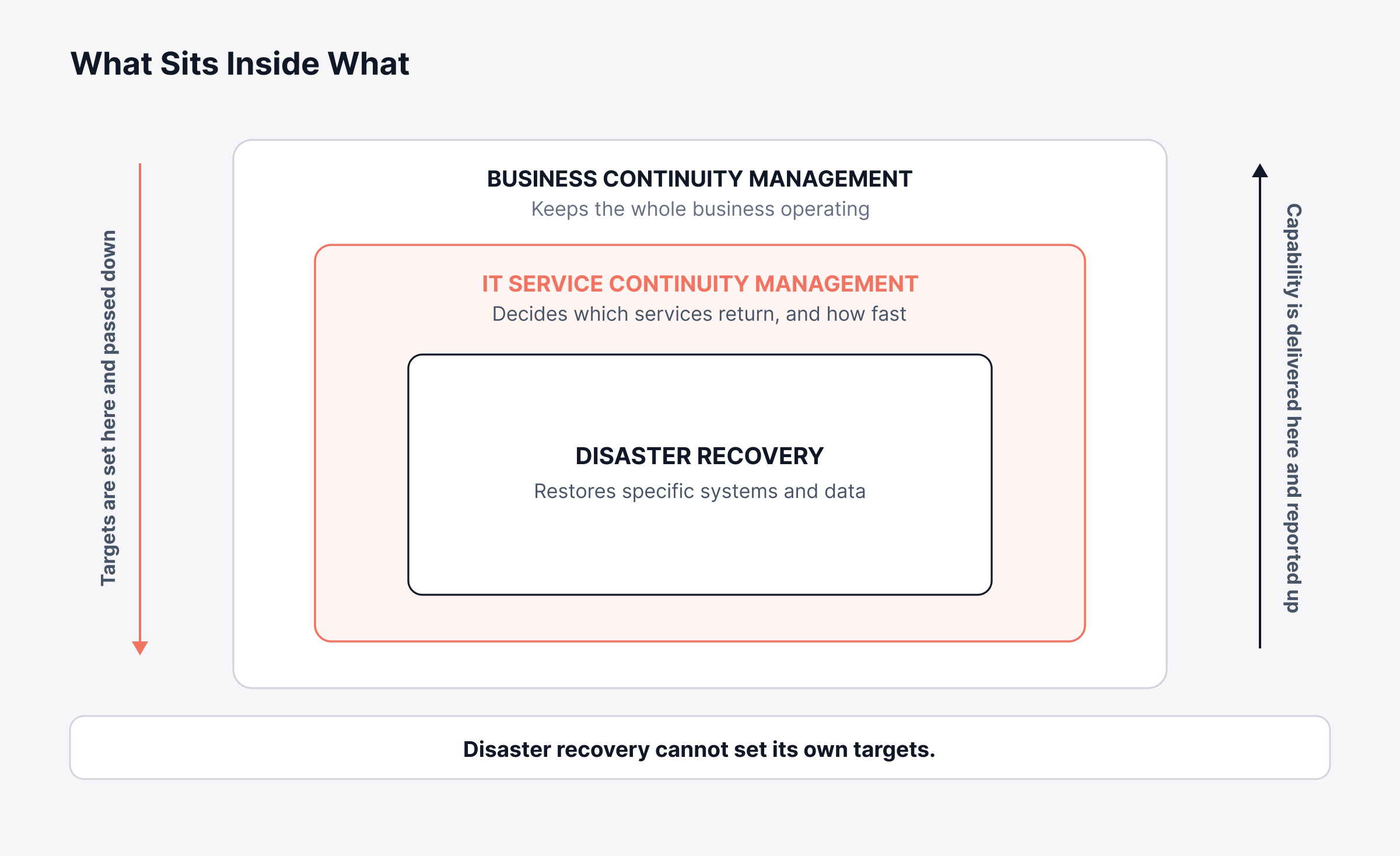
The three sit inside each other. Business continuity covers the whole business. ITSCM covers the IT services that support it, and disaster recovery covers the systems and data underneath.
Most confusion starts here, so it pays to be precise about who owns what.
Business continuity management | IT service continuity management | Disaster recovery | |
Scope | The whole business | The IT services it depends on | Specific systems and data |
Question it answers | How does the business keep operating? | Which services return, and how fast? | How do we restore this system? |
Main output | Business continuity strategy | ITSCM strategy and continuity plans | Runbooks and failover procedures |
Who owns it | Business leadership | IT service management | Infrastructure and platform teams |
Sets the targets | Yes, for the business | Translates them into service targets | No, it delivers against them |
Read the bottom row twice. Disaster recovery cannot set its own targets. Acceptable downtime for a service is a business decision, not a technical one.
Teams that skip ITSCM end up with recovery kit nobody mapped to a business need. That explains how a business pays for a hot standby on a service that could have waited a week.
The diagram below shows how the three fit together, and which direction the targets travel.
What Does the ITSCM Process Cover?
The ITSCM process covers four continuous activities, and only one of them involves writing the plan.
Activity | What it produces |
Support | Everyone with a recovery duty knows it, and the information they need is findable when it matters |
Design services for continuity | Risk reduction measures and recovery options that are justified by their cost |
Training and testing | Evidence that the measures and the people both work |
Review | Confirmation that the plans still match the risks the business sees today |
The design activity depends on two inputs that come from outside IT. One is the business continuity strategy, which names the activities the business cannot operate without.
The second input comes from a current view of risk. The IT risk management work that finds threats and weak points feeds directly into what you choose to protect.
RTO, RPO and MTPD: Where the Targets Come From
You set them from a business impact analysis, not from what the infrastructure can currently do. The analysis names each business-critical function, the services it depends on, and what losing them costs over time.
Three targets come out of that work, and they measure different things.
Target | What it sets | Measured | Decided by |
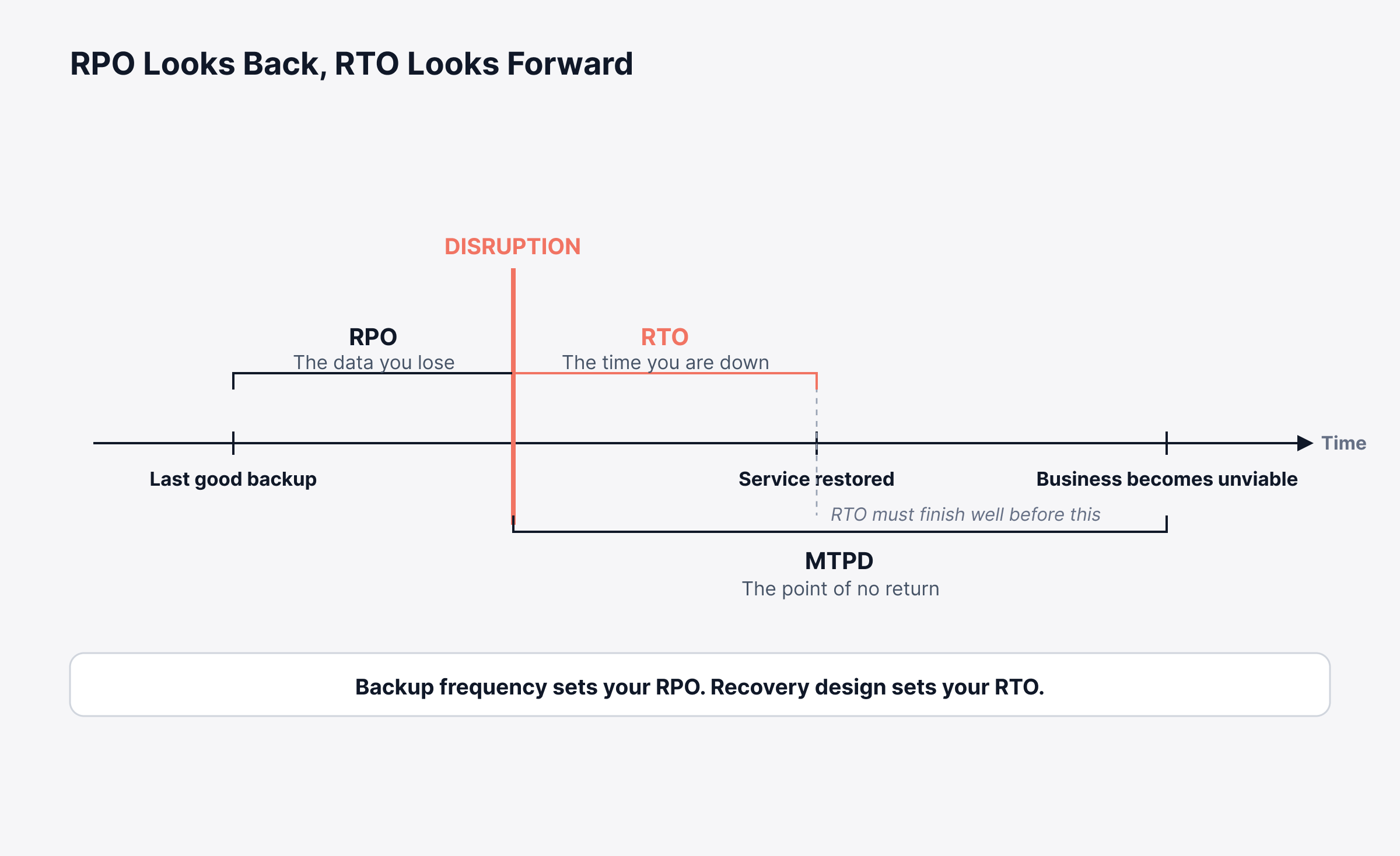
MTPD (maximum tolerable period of disruption) | The point at which the damage becomes permanent | Forward from the disruption | The business |
RTO (recovery time objective) | How quickly the service must be back | Forward from the disruption | The business, agreed with IT |
RPO (recovery point objective) | How much data you can afford to lose | Backward from the disruption | The business, delivered by backup design |
RTO has to be shorter than MTPD, with room to spare. A recovery that finishes exactly at the tolerable limit has no margin. Real recoveries always find something to go wrong.
The timeline below shows why the two targets are measured in opposite directions.
The impact analysis needs dependency data to be credible, and a maintained CMDB earns its cost right there. Without it, you ask service owners to remember what their service talks to.
Expect the first pass to come back with everything rated critical. That happens every time. Make the business rank services against each other rather than in isolation.
What are the Five Recovery Options
You choose by matching the RTO to the cheapest option that meets it. Recovery options are graded by how much standby capacity you pay to keep waiting.
The standard options run from least to most expensive.
Option | Standby | Typical recovery time | Where it fits |
Manual workaround | None | Hours to days | Services with a workable paper or phone fallback |
Gradual recovery | Cold | Over 72 hours | Services the business can run without for days |
Intermediate recovery | Warm | 24 to 72 hours | Important services with tolerant users |
Fast recovery | Hot | Under 24 hours | Services with tight, agreed RTOs |
Immediate recovery | Mirrored or active-active | Near zero | The handful of services the business cannot run without |
Cost climbs steeply down that table, so the ranking work in the impact analysis keeps the bill sensible. Every service promoted to immediate recovery is paid for twice, every day, whether or not anything breaks.
How Do You Build an IT Service Continuity Plan?
Build it in this order, because each step supplies the input the next one needs.
Get the business continuity strategy first: It names the business-critical functions and how long each can be interrupted. That is the only valid source for your targets.
Run the business impact analysis: Map services to functions, capture dependencies, and price what an hour and a day of loss costs.
Assess the risks: List credible threats against the services that matter. Separate the ones worth preventing from the ones worth planning around.
Agree the targets in writing: Get MTPD, RTO and RPO signed by the service owner and the business, not assumed by IT.
Select recovery options per service: Match each RTO to the cheapest option that meets it, and record why anything expensive was chosen.
Write the plans: Produce the continuity plan and the recovery procedures beneath it. Add the invocation guideline that says who declares a disaster and how.
Train the people named in it: A plan that only its author understands fails at the moment its author is unreachable.
Teams skip the invocation guideline in step six more than any other item. It defines the first actions for whoever picks up the call. Without it, a real disruption burns its opening minutes deciding whether it even counts as a disaster.
Recovery then runs through your normal major incident path rather than a separate process. The ITIL incident management workflow needs to know how to escalate into it.
Test the Plan Without Taking the Business Down
Test in layers. The cheap tests catch most of the errors, and only the expensive ones prove the whole thing works.
A workable schedule mixes all five.
Test | What it proves | Cost | Reasonable frequency |
Plan walkthrough | The document is current and contacts are correct | Low | Quarterly |
Tabletop exercise | Decisions and escalation hold under a scenario | Low | Twice a year |
Component restore | One system comes back from backup within its RPO | Medium | Quarterly, rotating by tier |
Partial failover | A service genuinely runs from the recovery site | High | Annually |
Full failover | The plan works end to end, including the people | Very high | Annually, or after major change |
Untested backups are the most common failure in this whole practice. A backup job that reports success proves the job ran, and nothing more.
Record every test result, including the failures. That evidence turns a continuity claim into something an auditor or a customer will accept.
Why Do Continuity Plans Fail?
Continuity plans fail for organizational reasons far more often than technical ones. Four patterns account for most of it.
The plan ages quietly: Systems change through the year and the plan does not, so it describes an estate that no longer exists.
Everything is critical:. When the business refuses to rank services, IT either over-invests everywhere or quietly picks the ranking itself.
Targets nobody signed: An RTO that IT invented is a number IT never agreed to. That gap surfaces during the first real disruption.
Tests that avoid failure: A test designed to pass proves very little. The useful ones let gaps surface.
We would rather see one honest tabletop exercise a quarter. A polished plan that nobody has stress-tested proves less. The tested capability counts as the deliverable, and the document just records it.
What Tooling Does ITSCM Need?
ITSCM is a planning and governance practice, so no product delivers it for you. Tooling supplies the data the plan depends on and the workflow the recovery runs on.
Motadata ServiceOps is listed in the PeopleCert ATV directory as ITIL 4 compliant across twelve practices. Service continuity is not one of them, and seven of the twelve feed it directly.
What ITSCM needs | Certified ITIL 4 practice that supplies it |
Dependency data for the impact analysis | IT Asset Management |
Availability targets to plan against | Availability Management |
Detection that a disruption has started | Monitoring and Event Management |
The path the recovery actually runs on | Incident Management |
Recovery runbooks people can find under pressure | Knowledge Management |
Plans that stay current as systems change | Change Enablement |
Evidence that the tests happened | Measurement and Reporting Management |
Change Enablement quietly decides whether the plan still works. A continuity plan goes stale through ordinary approved changes. Linking recovery documents to the change record keeps it honest.
Running service management and infrastructure monitoring on one unified observability and ITSM platform shortens the detection step. The alert and the incident record start in the same place.
Rank the Services Before You Price the Recovery
ITSCM narrows an open question about disaster into something workable. You end up with a short list of services and agreed numbers against them. Everything downstream, including what you spend, follows from that list.
Writing the plan takes the least time. Getting the business to rank its own services and sign the targets takes the most. That conversation takes longer than any technical work in the practice.
Teams that get it done stop guessing during disruptions. The recovery becomes a known sequence with owners attached. The incident management best practices already in place carry it the rest of the way.
FAQs
What is the difference between RTO and RPO?
RTO measures forward from a disruption and sets how quickly a service must be restored. RPO measures backward and sets how much data loss is acceptable, which your backup frequency has to deliver.
Is ITSCM the same as disaster recovery?
No, the two sit at different levels. ITSCM decides which services recover and how fast, based on business impact. Disaster recovery delivers the technical capability that restores specific systems against those targets.
Who owns IT service continuity management?
An IT service continuity manager owns the practice, but the targets belong to the business. IT cannot fairly decide how long a service can stay down, because that cost lands outside IT.
How often should a continuity plan be reviewed?
Review at least annually, and again after any major change to the services in scope. Most plans fail because ordinary approved changes moved the estate while the document stayed still.
Does ServiceOps support IT service continuity management?
ServiceOps is PeopleCert ATV certified for twelve ITIL 4 practices, and service continuity is not among them. Seven of those practices feed ITSCM directly, including IT Asset Management, Availability Management and Incident Management.
Author
Ramya Shah
Technical Writer
Ramya Shah is a technical content writer with a computer engineering background and roots in automotive journalism. He covers IT Service Management, observability, IT operations, and AI-driven automation. An early adopter of AI-assisted writing workflows, he turns complex IT processes into clear, engaging content optimized for search and answer engines (AEO), lifting content output and organic visibility.