What Happens When an SLA is Breached and How to Recover Customer Trust
What does your organization owe a customer when a priority ticket misses its resolution target by forty minutes? For most service providers and internal service desks, the answer stays unclear until the customer asks for a credit or a manager asks why the monthly SLA report shows a miss. By then, the facts that decide the outcome, such as when the clock started, whether it paused and who was told, are scattered across tickets, emails and chat threads.
A missed target creates work that continues long after the ticket closes. It has operational, contractual and relationship consequences, and customers often judge the provider more on how it handles the first hours than on the miss itself. Organizations that follow a defined breach process restore service faster, settle credits fairly and repeat the same failure less often.
This guide walks through what happens under a typical service level agreement, from the first notification to the final credit. In this blog, you will see what counts as a breach, how SLA violations are compensated, the six response steps to follow, why breaches happen and the prevention strategies that help tickets meet their targets.
What is an SLA Breach?
An SLA breach is any instance where a service provider fails to meet a measurable commitment written into its service level agreement. The commitment might cover how fast a ticket gets a first response, how long a fix takes or how much of the month a service stays available. Once the measured value crosses the agreed threshold, the SLA status changes to breached and the contract's remedies can apply.
In plain terms, the SLA breach meaning comes down to three parts:
A defined metric: Response time, resolution time, availability or another measurable target named in the contract
An agreed threshold: The number the provider promised to meet, such as four business hours or 99.9% monthly availability
A measurement rule: How the clock runs, when it pauses and which events are excluded from the count
Many disputes start with the third part. Two parties can agree a breach happened and still disagree on its size, because one side counted weekend hours or a waiting-on-customer period that the other side excluded.
Is an SLA Violation Different From an SLA Breach?
An SLA violation and an SLA breach usually mean the same thing in day-to-day service management. Both describe a missed contractual target, and most ticketing platforms use the terms interchangeably in their status fields.
Some contracts do draw a line between the two. A single ticket that misses its target may be logged as a violation, while a breach is declared only when violations push the monthly compliance figure below an agreed level. Read the definitions clause of each agreement before reporting, because that clause decides which events trigger remedies.
What Counts as an SLA Breach in a Ticketing System?
An SLA breach in a ticketing system is recorded when a ticket's tracked time passes the target set for its priority and service category. The platform compares elapsed time against the policy, marks the ticket as breached and, if configured, notifies the owner and the next escalation level.
Most agreements track four kinds of targets, and each tends to fail for a different reason:
Breach type | What the SLA measures | Common trigger |
Response time | Time from ticket creation to the first meaningful reply | Ticket routed to the wrong queue or left unassigned overnight |
Resolution time | Time from creation to a confirmed fix, minus paused time | Waiting on a vendor or another internal group |
Availability | Share of the measurement period the service was usable | Unplanned outage or maintenance outside the agreed window |
Update frequency | Interval between status updates on an open ticket | Engineer focused on the fix with no one owning communication |
Availability breaches usually trigger the largest credits, while response and resolution breaches happen more often. A useful breach policy covers both.
What Happens When an SLA is Breached?
When an SLA is breached, the provider moves through a predictable sequence of operational, contractual and governance steps. The exact order depends on the contract, and the effects go beyond the single ticket to the invoice, the customer relationship and the next contract review.
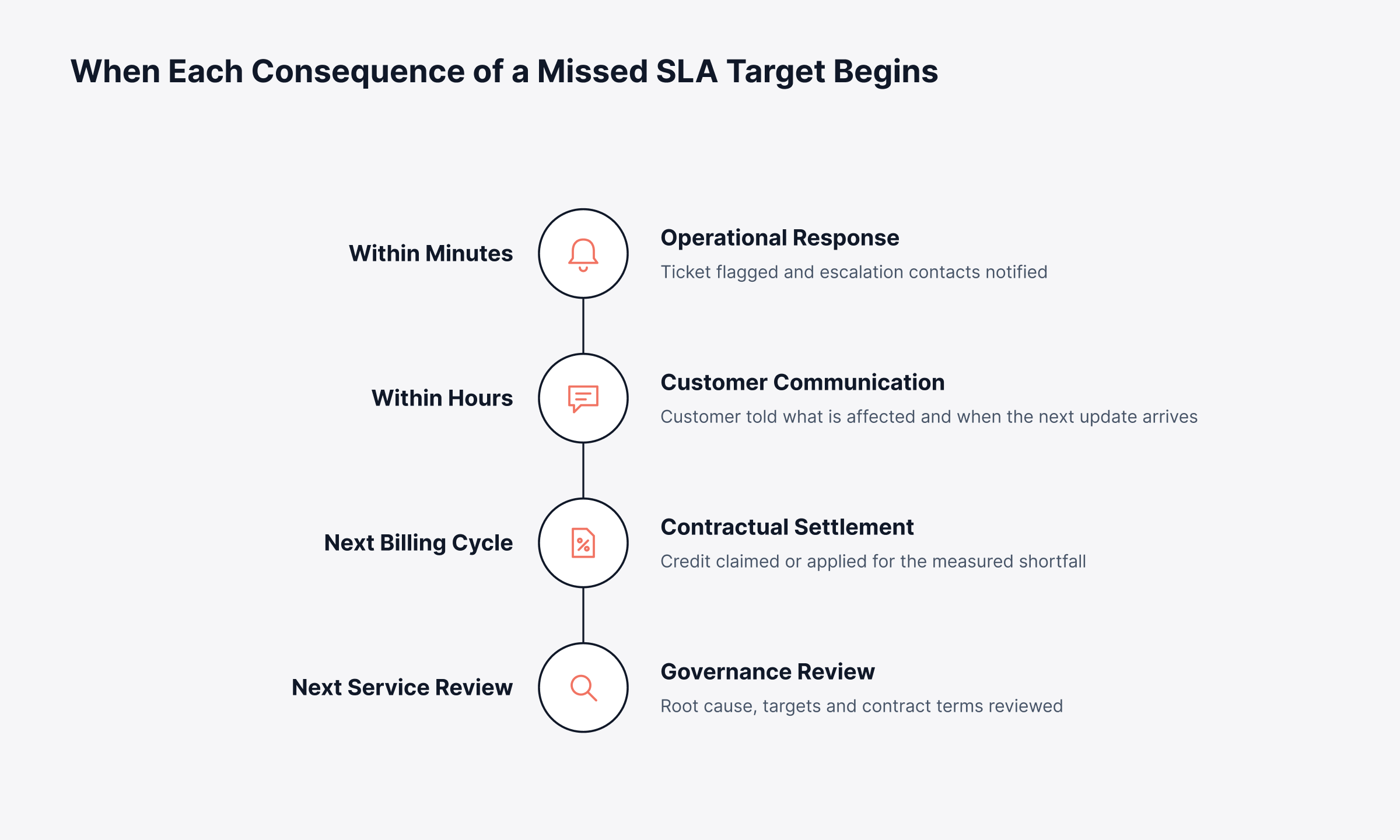
The typical aftermath unfolds in four stages:
Immediate operational response: The ticket is flagged, an SLA breach notification goes to the owner and escalation contacts, and restoring service becomes the priority
Customer communication: The provider informs the customer, shares an initial impact statement and commits to a follow-up report within the window the contract sets
Contractual settlement: The customer files a credit claim, or the provider applies one proactively, based on the measured shortfall for the billing period
Governance review: The breach enters the monthly service review, root cause analysis begins and repeated misses can lead to renegotiating the contract
Assign a named owner to each stage before a breach happens, so every step starts without delay. The timeline below spells out when each stage usually starts after a missed target.
What Does a Breach Cost Beyond the Credit?
The credit is often the smallest part of the cost. A breach also consumes engineering hours in escalation calls, report writing and review meetings, and it gives the customer a documented reason to question the provider at renewal.
For internal service desks, the cost shows up differently. No invoice changes hands, but repeated misses reduce the business's confidence in IT and make it harder to win budget for tooling or headcount. For external contracts, the next section explains how part of the cost is paid back to the customer.
How are SLA Violations Compensated?
SLA violations are compensated most often through service credits, which reduce the customer's next invoice by a percentage tied to the size of the shortfall. Credits are the standard remedy because they are simple to calculate, easy to audit and capped at a known share of the fee.
Other remedies appear in higher-value or regulated contracts:
Fixed penalties: A set amount per breached ticket or per incident, common in response-time commitments
Cumulative penalties: An amount that grows with each additional hour or each additional breach in the same period
Remediation commitments: Extra support hours, a dedicated engineer or a funded improvement plan in place of cash
Termination rights: The customer's right to exit the contract without penalty after repeated or severe breaches
Most agreements cap total credits at a share of the monthly fee and state that credits are the customer's sole remedy for missed targets. For a fuller breakdown of penalty types and caps, see our guide to SLA penalties.
How is a Service Credit Calculated?
A service credit is calculated by comparing measured performance against the committed target and applying the percentage listed for that tier in the credit schedule. Availability agreements usually express the schedule in bands of monthly uptime.
Here is a hypothetical credit schedule for a managed service billed at $20,000 per month with a 99.9% availability commitment:
Measured monthly availability | Credit as a share of the monthly fee |
99.9% or higher | No credit |
99.0% to below 99.9% | 10% |
95.0% to below 99.0% | 25% |
Below 95.0% | 50% |
Suppose the service was down for 216 minutes during a 30-day month. A 30-day month contains 43,200 minutes, so 216 minutes of downtime equals 0.5% of the period, and measured availability is 99.5%.
Run this arithmetic on your own contracts before a dispute starts, so both sides agree on the inputs. The walkthrough below spells out each step from total minutes to the final credit.
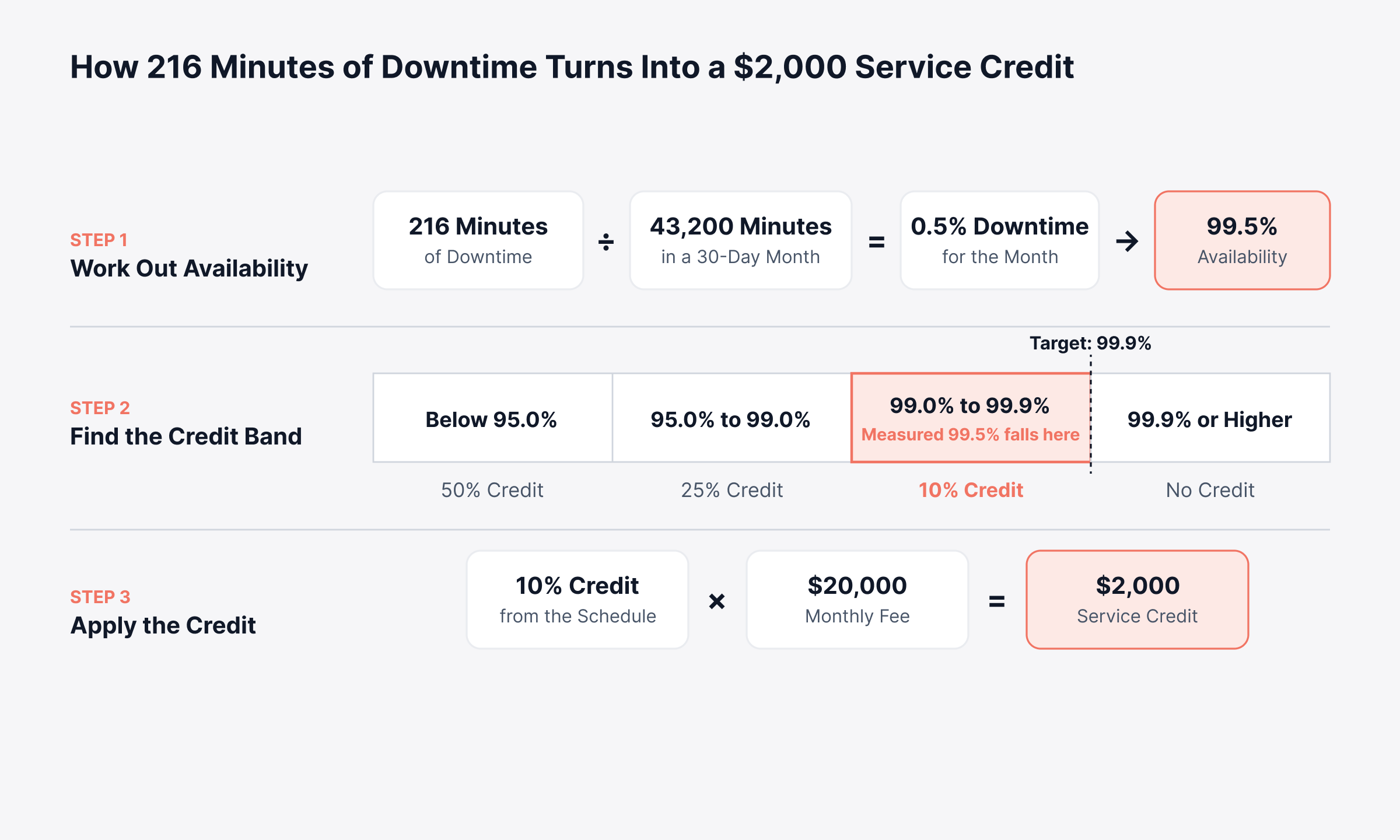
The 99.5% result falls into the 10% band, so the credit is $2,000. Response and resolution targets follow the same method. The provider counts breached tickets or hours over target, and the schedule sets an amount for each.
What Must a Customer Do to Claim a Service Credit?
Most agreements require the customer to request the credit within a fixed claim window, often one or two billing cycles after the incident. Requests usually need the incident dates, the affected service and evidence such as logs or ticket references that support the claimed outage.
Credits are also subject to exclusions, and these decide many disputes:
Scheduled maintenance: Downtime inside an announced maintenance window that the contract excludes
Customer-caused issues: Outages triggered by the customer's own configuration, equipment or changes
Force majeure events: Disruptions outside the provider's reasonable control, as defined in the contract
Suspended service: Periods when the provider suspended access under the agreement's terms
Providers that apply credits without waiting for a claim usually face fewer disputes. A credit sent with a clear calculation shows the customer that the provider accepts responsibility, while a credit issued only after weeks of negotiation damages trust.
What Should You Do Immediately After an SLA Breach?
Immediately after an SLA breach, restore service, confirm the breach against the contract terms and tell the customer what happened before they have to ask. The six steps below keep the response orderly and produce the evidence the settlement will need.
1. Confirm the Breach Against the Contract Clock
Check the breach against the agreement's own measurement rules before reporting it. Verify the business hours calendar, any pause conditions such as waiting on the customer, and whether the event falls inside an exclusion.
A ticketing platform can flag a breach that the contract would not count, or miss one it would. Checking early stops you from reporting breaches that invite unnecessary claims, and from missing breaches the customer later finds in their own records.
2. Restore Service Before Anything Else
Restoring service stops the shortfall from growing, so it takes priority over paperwork. Every additional minute of an availability incident can push the month into a higher credit band. For known failure types, a documented runbook with tested fix steps shortens the time to restore.
Assign one incident owner for the fix and a separate person for customer updates. Structured incident resolution practices, such as linked tickets and a shared timeline, help responders work without losing track of who is doing what.
3. Notify the Customer on the Contract's Terms
Tell the customer about the breach within the window the agreement sets, even if the fix is still in progress. The first message should state what is affected, when it started, what is being done and when the next update will arrive.
A short, factual notice written early does more for the relationship than a detailed one sent late. Avoid speculating about cause in the first message, since early theories often change.
4. Escalate by Business Impact
Escalate based on who is affected and how much, following the SLA escalation path defined for that service and priority. A breach on a revenue-facing application needs a senior engineer and the account manager involved quickly, while a breach on a low-priority internal request may only need a supervisor's attention.
Hypothetically, consider a provider whose payroll platform goes down on the last working day of a pay cycle. The resolution target is eight hours, but the business impact justifies escalating to the service owner and the customer's account lead within the first hour, well before the eight hours are up.
5. Record the Evidence While It is Fresh
Capture timestamps, ticket history, alert data, customer communications and actions taken as the incident unfolds. This record supports the credit calculation, the incident report and any later dispute.
Reconstructing a timeline days later from chat logs and memory tends to produce gaps. An automatically kept ticket history, with every status change and assignment recorded, removes most of that effort.
6. Settle the Credit and Close the Loop
Calculate the credit using the contract's schedule and share the calculation with the customer, along with the root cause summary and the corrective actions agreed. Sending all three together shows the customer that the provider understood the breach and has acted on it.
Follow up with formal root cause analysis for any breach that was severe or repeated. The goal is a specific corrective action, such as a routing change or a new monitoring check, with an owner and a date.
Why Do SLA Breaches Happen in the First Place?
SLA breaches happen mostly because of gaps in how targets are set, how work is routed and how dependencies are managed. Most repeat breaches trace back to a small set of structural causes, and each one can be fixed by changing a process or a configuration.
Procedure gaps are a major factor across IT operations. The Uptime Institute's 2025 outage analysis found that 85% of outages attributed to human error stemmed from staff not following procedures or from flaws in the procedures themselves.
The causes below show up again and again in breach reviews:
Targets set without baseline data: Commitments agreed during a sale that the service desk has never met in practice
Misconfigured clocks: Business hours, holidays or pause states that differ between the contract and the ticketing platform
Routing delays: Tickets that wait in a general queue or land with the wrong group before anyone starts work
Unaligned internal handoffs: Resolution depending on a database or network group that has no matching internal target
Third-party dependencies: A vendor fix the provider cannot control and has no contract covering
Late detection: An outage that users report before monitoring does, so the clock starts running before anyone is working
Late detection matters most in availability agreements. Downtime counts from the moment the service fails, so every minute before anyone notices is lost from the monthly allowance.
How Do Internal Agreements Contribute to External Breaches?
Internal agreements contribute to external breaches when the groups a service desk depends on work to different timelines. A four-hour customer commitment cannot hold if the network group that owns the fix works to a next-day internal target.
Operational level agreements set targets between internal groups, and underpinning contracts do the same for external suppliers. Aligning both with the customer-facing SLA is one of the most direct ways to reduce breaches, and our comparison of SLAs and OLAs explains how the two fit together.
Why Do SLA Breaches Still Happen With a Ticketing Tool in Place?
SLA breaches still happen with a ticketing tool in place when the tool measures only part of the service or when its warnings get lost among other alerts. Three patterns come up most often:
Green reports with unhappy users: Ticket targets are met while users still face slow or unreliable service, a pattern sometimes called the watermelon effect, because the SLA tracks ticket handling and leaves the service experience unmeasured
Alert fatigue: Engineers receive so many low-value notifications that an SLA warning is missed or read too late
Disconnected tools: Monitoring, ticketing and chat run as separate systems, so a fault spotted in one reaches the ticket owner late
Adding an experience measure, such as service availability or user satisfaction, next to ticket targets exposes problems that green reports hide. Reducing alert fatigue and connecting monitoring to the service desk help SLA warnings reach the right person while there is still time to act.
How Can You Avoid an SLA Breach Before the Clock Runs Out?
To avoid an SLA breach, warn the right people while there is still time to act, route work to the correct group at intake and keep every internal dependency on a matching target. The key is to act when half of the target time has passed, while the ticket can still be fixed on time.
Knowing how to avoid SLA breach problems starts with the causes and patterns listed above. The five SLA breach prevention strategies below address each one.
1. Set Escalation Thresholds at Stages of Elapsed Time
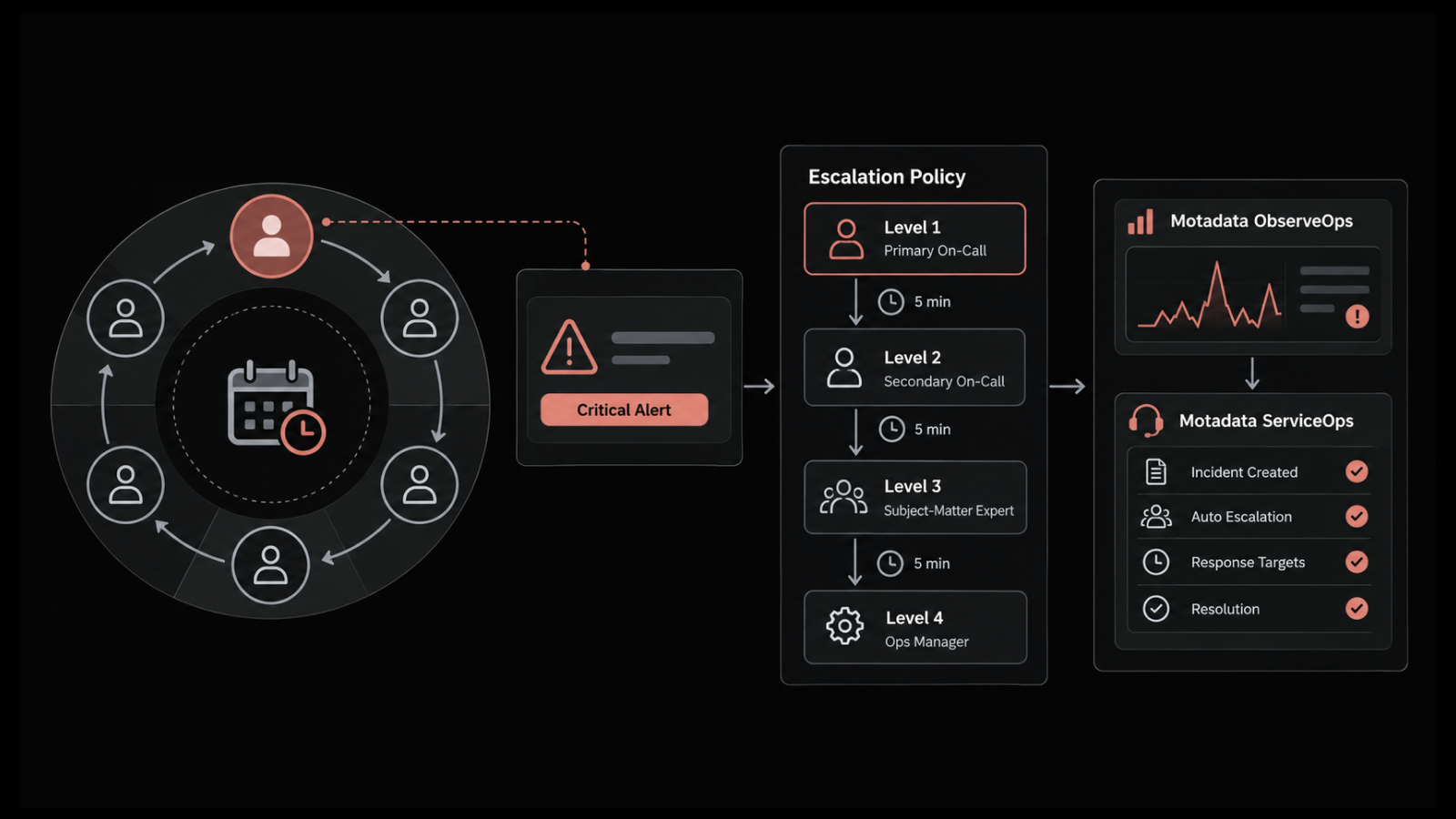
Configure escalations to fire at defined shares of the target, so each person in the escalation chain is alerted while there is still time to meet the target. A single alert at the moment of breach arrives too late to change the outcome.
A staged approach typically looks like this:
At 50% of time elapsed: The assigned engineer receives a reminder
At 75% of time elapsed: The group lead is notified and can reassign or add help
At 90% of time elapsed: The service owner is alerted and customer communication is prepared
At 100% of time elapsed: The breach is recorded and the response steps begin
Tune these thresholds by priority, since a critical ticket needs earlier warnings than a routine request. The staircase below lays out who is notified at each stage of elapsed time.
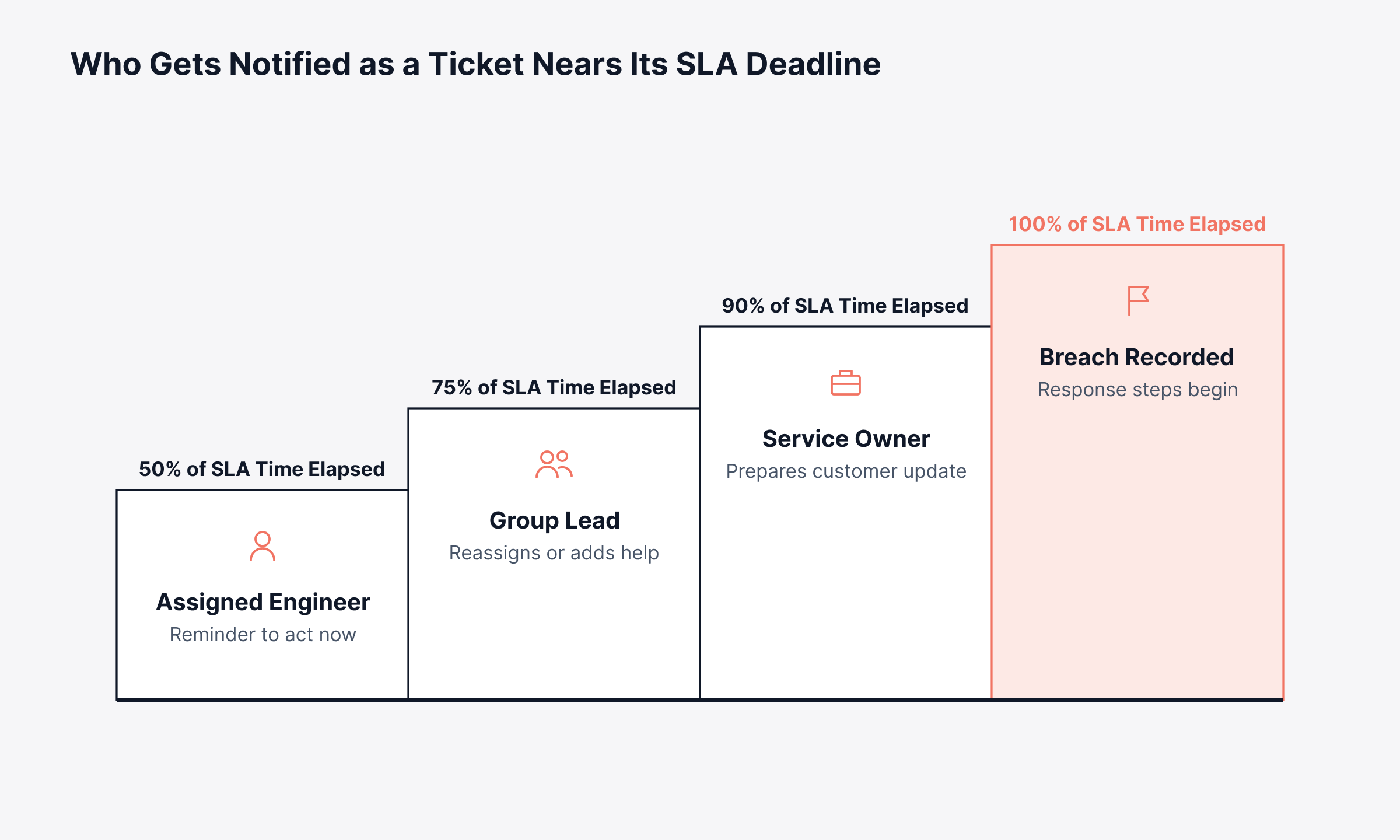
Rules like these are configurable in Motadata ServiceOps SLA management, where each SLA can carry several escalation levels that respect the business hours calendar. This means warnings follow the same working hours the contract uses.
2. Route Tickets to the Right Group at Intake
Misrouted tickets lose the most time in the first hour, which is exactly when response targets are measured. Routing rules based on category, priority, location or skill send each ticket to a group that can act on it.
Motadata's smart routing recommends the category, technician group and knowledge article at intake, based on the organization's own request history. Fewer reassignments mean fewer response-time breaches and less time lost on handoffs.
3. Align Internal Targets with External Commitments
Every group that touches a ticket should work to a target that fits inside the customer-facing SLA. Map each service to its resolver groups and suppliers, then set internal targets that leave room for handoffs.
Formal operational level agreements make those internal targets visible and measurable. When a breach happens, the review can then show which handoff caused the delay.
4. Start the Clock at Detection
For availability agreements, the fastest prevention step is detecting the problem before users report it. Continuous observability of the services behind each agreement means engineers learn about a fault sooner and start fixing it sooner. Redundant components with tested failover keep the service running while the fault is fixed, so one failure uses up little or none of the monthly downtime allowance.
Motadata's uptime assurance capability supports this by tracking the availability of network devices, interfaces and links against business commitments and alerting on breaches. Early warnings give responders room to fix the fault before downtime exceeds the monthly allowance.
5. Review the At-Risk Queue Every Shift
Build a view of open tickets that have passed 50% of their target and review it at every shift handover. This turns prevention into a routine check and stops at-risk tickets from being forgotten between shifts.
Hypothetically, a service desk handling several hundred tickets a week might find that most of its breaches come from tickets opened late in a shift. A handover review of the at-risk queue addresses that pattern directly.
How Does Service Level Management Prevent Repeat Breaches?
Service level management is the practice of setting, monitoring and reviewing service targets with customers so that commitments stay realistic and measurable over time. The prevention steps above protect individual tickets, while service level management looks at patterns across months and uses breach data to adjust targets, fix processes or update the contract.
ITIL 4 describes service level management as a practice that sets clear, business-based targets and ensures delivery is properly assessed and reviewed against them. In practice, that means the SLA is revisited on a set schedule throughout the contract term.
How Do SLAs, SLOs and SLIs Work Together?
SLAs, SLOs and SLIs form a hierarchy, with the external commitment at the top and the raw measurement at the bottom. Setting internal objectives tighter than the external agreement gives the provider an early warning before the customer-facing target is missed.
Term | What it is | Hypothetical example |
SLA | The external commitment and its remedies | 99.9% monthly availability, with credits below that level |
SLO | The internal objective set tighter than the SLA | 99.95% monthly availability tracked by the service owner |
SLI | The measured value used to judge both | Share of successful health checks over the month |
The provider tracks its internal service level objectives, so missing an SLO acts as a warning while the SLA is still being met. For infrastructure-backed commitments, Motadata ObserveOps applies corrections and penalties to SLO measurements, excluding maintenance windows and external outages with an audit trail for every adjustment.
What Should a Service Level Review Cover?
A service level review should cover performance against every target, the breaches in the period and the actions taken since the last review. Holding it monthly or quarterly with the customer keeps both sides working from the same numbers.
A useful review agenda includes:
Compliance by target: The share of tickets or minutes that met each commitment, split by priority
Breach causes: Each breach grouped by cause category, such as routing, dependency or detection
Credits issued: The amount and the calculation behind each credit in the period
Corrective actions: Status of each action agreed after earlier breaches, with owners and dates
Target changes: Any commitment that needs revision because the service or the business has changed
Tracking SLA compliance this way shows whether breaches are isolated events or a trend. Our guide to SLA compliance covers how to calculate the compliance ratio and where it can mislead.
When Should an SLA Target be Renegotiated?
An SLA target should be renegotiated when the provider cannot meet it consistently despite corrective action, or when the business need behind it has changed. Keeping an unrealistic target produces steady breaches, credits and friction without improving the service.
Renegotiation works best when it is backed by data from the reviews. Showing the customer several months of performance, the causes behind misses and the cost of meeting a tighter target leads to a commitment both sides can keep.
Catch At-Risk Tickets Before They Become Credits With Motadata ServiceOps
Many ticketing tools record an SLA breach accurately but only after it has happened, leaving the provider to explain a miss it had no warning about. The escalation, the evidence and the credit calculation then depend on people collecting details from separate systems.
It is fair to say that no service desk platform can fix a target that was unrealistic when it was signed, or remove an outage at a supplier with no underpinning contract. Those are contract decisions, and they need to be settled when the agreement is negotiated or renewed.
Motadata ServiceOps handles the operational side of the problem:
Condition-based SLAs: Response and resolution targets with time criteria for each priority and service
Business hours support: SLA clocks that follow calendar hours or a custom business hours schedule
Multi-level escalations: Escalation rules that notify the next level before a target is missed
Breach notifications: Alerts sent from predefined templates when a breach occurs
Penalty tracking: Fixed and cumulative penalty types recorded against each agreement
OLAs and underpinning contracts: Internal and supplier targets managed alongside the customer SLA
With these in one platform, service owners see which tickets are at risk while there is still time to act, and every breach comes with a complete ticket history for settling the credit.
FAQs
What does "SLA status breached" mean in a ticketing system?
It means the ticket's tracked time has passed the target set for its priority and service category. The platform marks the ticket as breached and may notify the owner and escalation contacts. The ticket still needs resolving, and the breach is recorded for reporting and any credit calculation.
Is an SLA violation the same as an SLA breach?
In most service desks, the two terms mean the same thing and describe a missed contractual target. Some contracts separate them, treating a single missed ticket as a violation and a drop below the monthly compliance level as a breach. The definitions clause in each agreement decides which applies.
Are service credits applied automatically after a breach?
Many contracts require the customer to request the credit within a claim window, often one or two billing cycles after the incident. Some providers apply credits proactively to protect the relationship. Check the agreement for the claim process, the evidence required and any exclusions that could reduce the credit.
Can repeated SLA breaches lead to contract termination?
Yes, many agreements give the customer a right to terminate after a set number of breaches in a period or after one severe breach. These clauses usually appear alongside a cap on total credits. Tracking breach counts against the contract's thresholds helps the provider act before termination rights are triggered.
How can a service desk warn engineers before an SLA breach?
A common method is staged escalation, with notifications at set shares of elapsed time such as 50%, 75% and 90%. Platforms like Motadata ServiceOps support several escalation levels per SLA that follow the business hours calendar. Pairing this with an at-risk queue reviewed every shift helps catch tickets before they miss target.
Author
Poonam Lalani
Content Strategist
Poonam Lalani is a B2B content strategist and writer with a background in computer engineering and experience across enterprise technology domains, including AI, cloud, DevOps, data engineering, and IT operations. She specializes in creating research-driven content that simplifies complex ideas and supports product education, thought leadership, and business growth.