How to Meet GLBA Compliance Requirements Without an Audit Scramble
Can you produce, on demand, a record of every person who touched customer account data last quarter, and show that none of them held access beyond their job? That single question decides more GLBA audits than any policy document does. Your written program states what the organization intended to do, while the records show what actually happened.
The Gramm-Leach-Bliley Act has been law since 1999, so the obligation is not new. What changed is the standard of proof. The amended FTC Safeguards Rule replaced a broad policy exercise with specific technical controls, and each control is judged on the evidence your systems can produce.
That change moved GLBA work out of the legal department and into IT operations. Logging, access control, configuration management and continuous monitoring now account for most of what the Rule asks, and all four live inside your observability and service management platforms. Anyone who has run a cybersecurity compliance program will recognize the groundwork.
In this blog, you will see which sections of the Safeguards Rule map to which IT operations controls, what evidence satisfies each one, how long to keep that evidence, and how to build a GLBA compliance checklist an examiner can follow without further explanation.
What Is GLBA Compliance?
GLBA compliance means meeting the privacy and security obligations that the Gramm-Leach-Bliley Act places on financial institutions handling nonpublic personal information. The statute sets the principle. The Federal Trade Commission's Safeguards Rule sets the operating detail, and that detail is where IT spends its time.
The version in force today came out of a 2021 amendment, with a breach reporting requirement added later and effective from May 2024. Before that, an institution could satisfy an assessor with a written program and reasonable intentions. The text now names specific controls, and each one either produces an artifact or fails to.
What Are the Three Main Components of GLBA?
The three main components of GLBA are the Financial Privacy Rule, the Safeguards Rule and the Pretexting Provisions:
Financial Privacy Rule: Governs how institutions collect, use and disclose customer financial information, and requires a privacy notice with opt-out choices
Safeguards Rule: Requires a written information security program with administrative, technical and physical controls, and it is the section IT operations owns
Pretexting Provisions: Prohibit obtaining customer information under false pretenses, which means social engineering defenses and identity verification discipline
Only the second generates telemetry. That is why an IT director can read the full Act and still miss the part that gets examined.
What Counts as Nonpublic Personal Information?
Nonpublic personal information covers any record identifying a customer that the institution holds, in any format. The definition is deliberately wide:
Account numbers, balances and transaction histories
Loan and credit applications, including declined ones
Social Security numbers and government identifiers
Income, tax and employment records supplied by the customer, plus anything derived from them
Format does not narrow it. Paper files, database rows and PDF exports in a shared folder are all in scope, which is why GLBA compliance for document management belongs inside the same program rather than beside it.
The breadth of that definition explains the next question, because plenty of organizations hold this data without considering themselves a bank.
Who Is Required to Comply with GLBA?
Who is required to comply with GLBA extends well past banks. The FTC enforces the Safeguards Rule against non-bank financial institutions, a category that catches organizations that do not think of themselves as financial at all.
Covered entities commonly include:
Mortgage brokers, mortgage lenders and loan servicers
Auto dealers that arrange or extend credit
Tax preparers, accountants and bookkeepers handling customer financial records
Non-SEC investment advisers, collection agencies and finders
Payday lenders, check cashers and money transmitters
Banks, credit unions and SEC-registered entities answer to their own prudential regulators under parallel standards, and the technical expectations converge.
One narrowing provision is worth knowing. Institutions holding information on fewer than 5,000 consumers are exempt from the written risk assessment, the continuous monitoring or penetration testing obligation, the written incident response plan and the annual board report. Access controls, encryption and multi-factor authentication still apply.
Once you know the Rule applies to you, the practical question is which department carries the work.
Why Have GLBA Safeguards Rule Technical Controls Moved to IT Operations?
GLBA Safeguards Rule technical controls moved to IT operations because the amended text describes system behavior rather than corporate policy. Section 314.4 lists nine lettered elements, and most resolve to something your infrastructure either records or does not.
The mapping below is the part legal summaries tend to leave out. They restate the Rule accurately and stop, which leaves the reader holding a requirement with no named source of evidence.
Safeguards Rule element | What the text asks for | Where the evidence lives |
314.4(b) | Written risk assessment with evaluation criteria | Asset inventory, CMDB, vulnerability scan history |
314.4(c)(1) | Access controls that authenticate users and limit access to what the role needs | Identity platform, RBAC configuration, quarterly access review exports |
314.4(c)(2) | Identification and management of data, personnel, devices, systems and facilities | Discovery scans, asset records, network topology maps |
314.4(c)(3) | Encryption of customer information in transit and at rest | Certificate inventory, storage configuration, key management records |
314.4(c)(5) | Multi-factor authentication for anyone accessing an information system | Authentication logs showing factor type per session |
314.4(c)(6) | Secure disposal within two years of last use, with periodic retention review | Retention policy, disposal records, storage lifecycle configuration |
314.4(c)(7) | Procedures for change management | Change records, approval history, configuration version diffs |
314.4(c)(8) | Monitoring and logging of authorized user activity, plus detection of unauthorized access or tampering | Centralized log store, correlation rules, alert history |
314.4(d)(2) | Continuous monitoring, or annual penetration testing plus vulnerability assessments every six months | Monitoring coverage reports, scan results, test reports |
314.4(f) | Selection, contractual obligation and periodic assessment of service providers | Vendor contracts, software inventory, assessment records |
314.4(h) | Written incident response plan covering roles, communication and remediation | Incident records, timelines, post-incident reviews |
314.4(i) | Written report from the Qualified Individual to the board at least annually | Program status reporting, testing results, control decisions |
Read the right column as a coverage list. Any row without a system behind it turns into a finding at audit, and the remediation lands on IT rather than on legal.
Who Owns GLBA Compliance Inside the Business?
GLBA compliance is owned by a single named person. Section 314.4(a) requires you to designate a Qualified Individual responsible for the information security program, and Section 314.4(i) requires that person to report in writing to the board or an equivalent governing body at least annually.
That annual report has a defined scope:
Program status: Overall standing of the information security program and compliance with the Rule
Testing results: What monitoring, penetration testing and vulnerability assessments found
Control decisions: Risk management choices made, including risks knowingly accepted
Service provider arrangements: How third parties are selected, contracted and reassessed
Security events: Incidents and violations, with management's response to each
Those two clauses turn financial institution data security into a standing board agenda item. The quality of your reporting becomes visible at the highest level in the organization, on a fixed schedule, whether or not an examiner is in the building.
For a CIO or CISO, that changes the calculation:
Evidence taking three weeks to assemble becomes a reporting problem the board experiences directly
A gap found during report preparation is a gap you disclose rather than quietly close
Programs built on asset management compliance records and a maintained CMDB shorten the cycle considerably
With ownership settled, the rest of the work divides into four control areas. Access comes first, because every other control assumes you know who can reach what.
What Are the GLBA Access Control Requirements?
GLBA access control requirements come from two sections working together: 314.4(c)(1), which requires authentication and least privilege, and 314.4(c)(5), which requires multi-factor authentication for any individual accessing an information system. The second is close to absolute. The only escape is a written approval from the Qualified Individual accepting a reasonably equivalent or stronger control.
Least privilege is where most programs get uncomfortable, because the Rule asks you to review access periodically rather than grant it correctly once. A role-based access control model makes that review tractable, since you certify a few dozen roles instead of a few thousand individual grants.
How Do You Prove Least Privilege at Audit Time?
Proving least privilege means showing the decision behind the end state. An examiner takes a current permissions export as a starting point, then asks who approved it and when it was last checked. Four artifacts keep that conversation short:
Role definitions: A documented list of roles, the customer data each may reach, and the business justification
Grant history: Records showing who requested access, who approved it, and when it took effect
Review evidence: Dated certification results from each periodic review, including revocations that resulted
Offboarding proof: Timestamps showing access removal against departure dates, with the gap measured
Consider a mortgage servicer where a collections analyst moves into underwriting. The permissions export shows the correct new role, which looks clean. What the examiner wants is proof the old entitlements were withdrawn on the transfer date rather than accumulating quietly for eleven months.
What Are the GLBA IT Audit Logging Requirements?
GLBA IT audit logging requirements come from Section 314.4(c)(8), which asks you to log the activity of authorized users and detect unauthorized access, use or tampering by those same users. Note the emphasis: the Rule is concerned with people who already hold legitimate credentials.
That framing changes what you collect. Perimeter logs describe outsiders, while insider misuse surfaces in application queries, database access patterns, privilege changes and export activity. Those records often live in systems nobody thought to forward into a SIEM or a central log platform.
Which Events Belong in a GLBA Log Record?
The events that matter are the ones that touch customer information or the controls protecting it:
Authentication attempts, successes, failures and the factor used
Privilege changes, role assignments and administrative account use
Queries, reads and exports against systems holding nonpublic personal information
Configuration changes on network devices, servers and security controls
Log pipeline health, including collection failures and gaps
That last one gets skipped and then costs you. A gap in the record is indistinguishable from an absence of activity, and an examiner reads it the less favorable way. Sound log management security practice treats collector downtime as an incident.
How Long Should You Keep GLBA Logs?
GLBA log retention has no fixed period in the Safeguards Rule, which surprises people who go looking for a number. What the Rule does set are two adjacent obligations:
Secure disposal: Customer information disposed of no later than two years after its last use, with narrow exceptions for legitimate business need or legal requirement
Policy review: Periodic review of the retention policy itself, to keep unnecessary data from accumulating
Most financial institutions settle on twelve months of searchable log data with longer cold storage behind it, driven by investigation timelines rather than by the Rule. Three points decide whether that choice holds up at audit:
Documented period: An undocumented retention practice reads as an absent control
Consistent application: A period applied to some systems and not others invites a sampling question
Retrievable format: Data held in cold storage still counts, provided you can produce it inside the examiner's window
Evidence quality depends less on volume than on whether the record can be reconstructed in one place. This diagram traces how raw device output becomes something an auditor can follow.
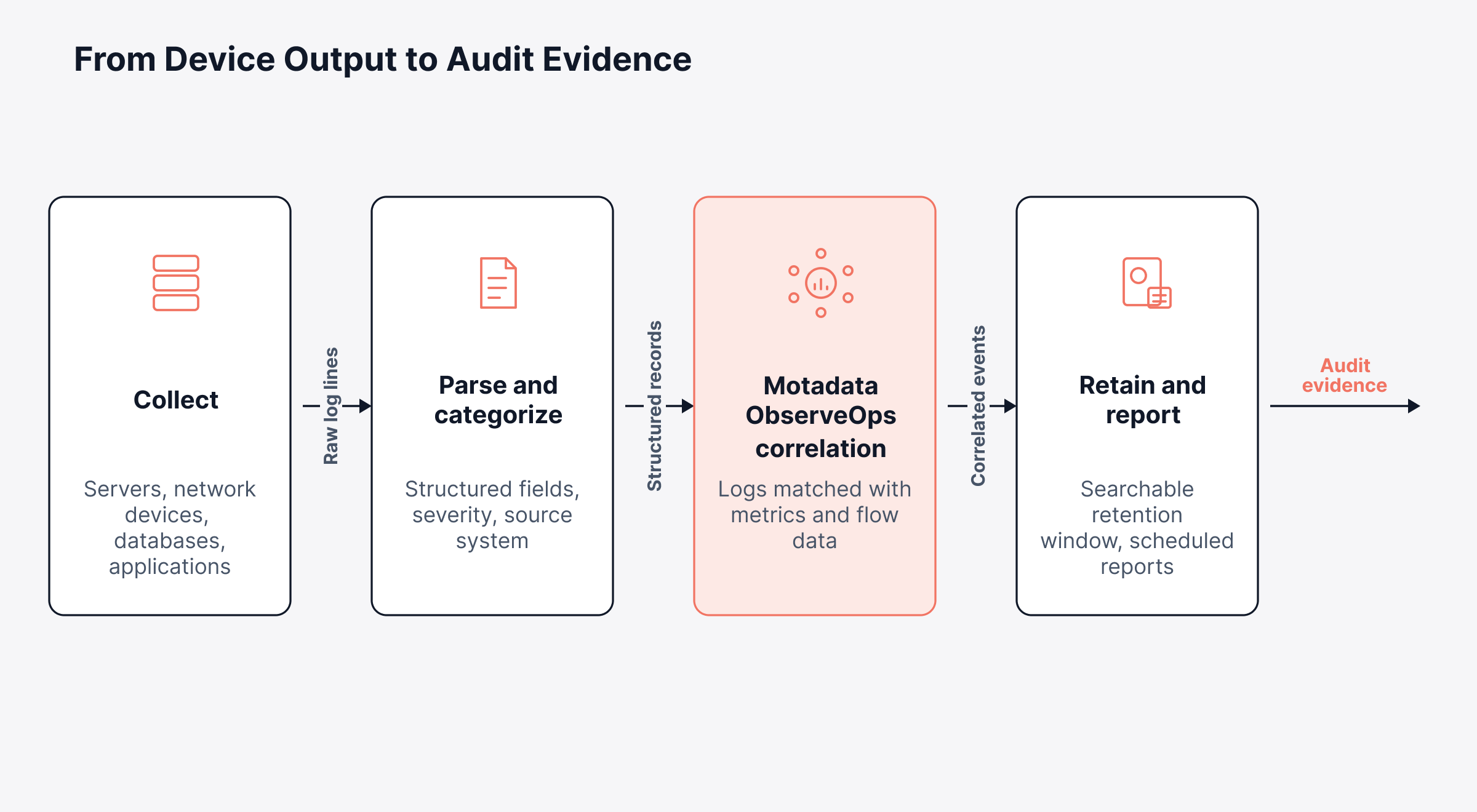
Run those four stages inside one platform and an evidence request becomes a query. Split them across four tools and the same request becomes a week of reconciliation billed to your most expensive people.
How Does Continuous Monitoring for GLBA Compliance Replace Annual Penetration Testing?
Continuous monitoring for GLBA compliance replaces annual penetration testing because Section 314.4(d)(2) offers the two as alternatives. Choose ongoing detection and the scheduled testing obligation falls away. The choice carries budget consequences most institutions never price out.
If you operate effective continuous monitoring, or other systems that detect changes creating vulnerabilities on an ongoing basis, that path stands on its own. If you do not, the Rule requires annual penetration testing plus vulnerability assessments at least every six months, and again after any material change to operations or business arrangements.
The branch below is worth working through with your Qualified Individual before the next budget cycle.
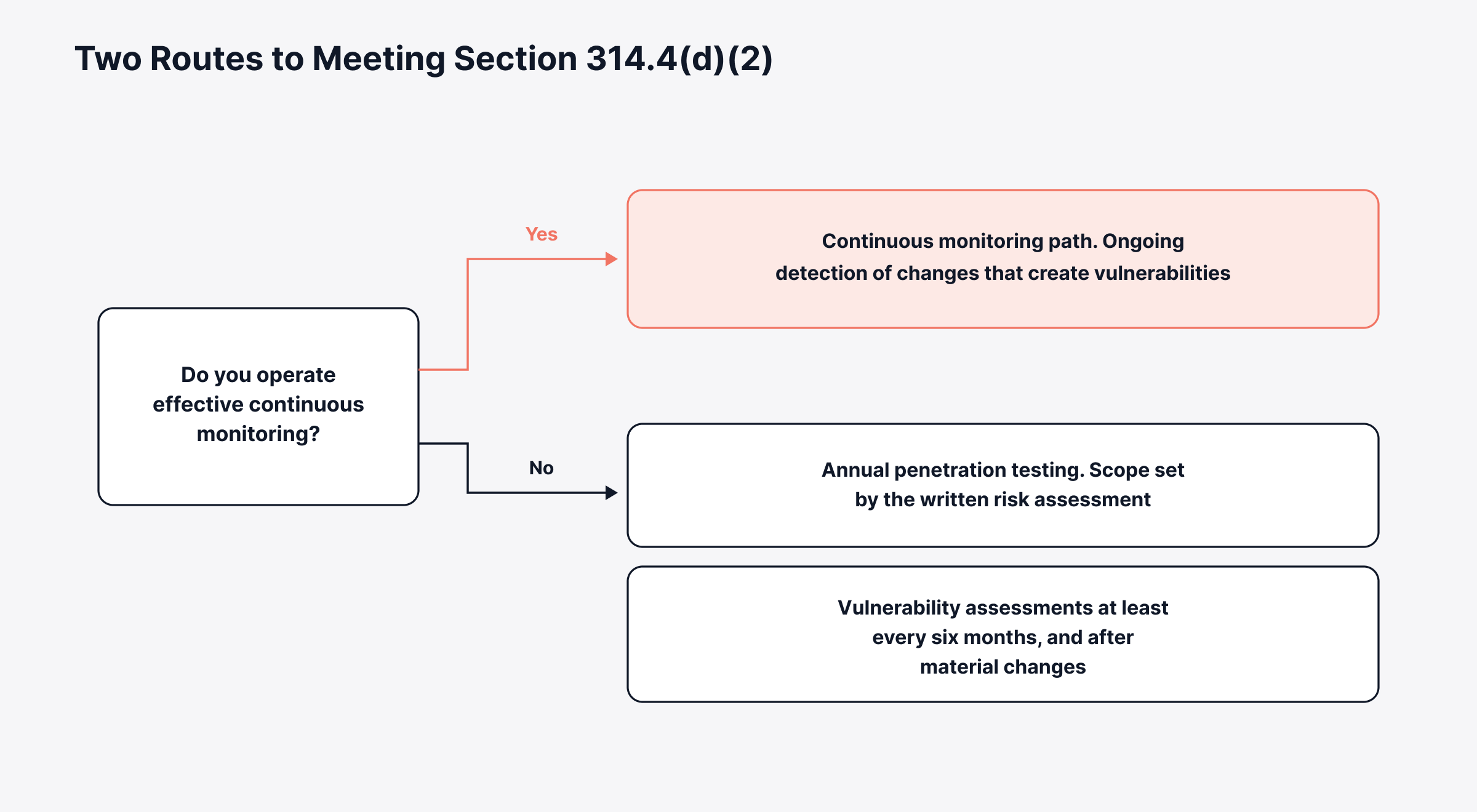
The financial comparison is worth putting on a page. The testing route buys a predictable annual assessor fee and a snapshot that ages within weeks. The observability route costs more up front, then serves the risk assessment, the board report and incident investigation from the same data.
Continuous monitoring is not a single product category. It comes from several capabilities running together:
Anomaly detection: Baselines that flag departures from normal access, traffic and system behavior
Configuration drift detection: Alerts when a device configuration changes outside an approved window
Vulnerability visibility: Scan coverage that keeps pace with what discovery finds on the network
Alert correlation: Grouping related signals so a genuine detection is not buried under noise
Network devices deserve particular attention here. A switch or firewall change can quietly undo an access control decision that still reads as current in your policy document.
Network compliance management in Motadata ObserveOps covers that layer:
Configuration capture: Device configurations collected and versioned automatically, with rollback to a known-good state
Change detection: Deviations flagged in real time through syslog or scheduled comparison
Compliance assessment: Configurations evaluated against standards including CIS, GDPR, HIPAA and SOX
For institutions in India already reporting under SEBI's LAMA framework, the same collection and forwarding pipeline serves both regimes.
Why Does GLBA Treat Change Management as a Security Control?
GLBA treats change management as a security control through Section 314.4(c)(7), which requires documented procedures for how modifications to information systems get proposed, reviewed, approved and recorded. The Rule states the requirement in a single clause, which understates how often it produces findings.
The failure pattern is consistent. A change process exists and works for application releases, while firewall rules, access group membership and device configurations move through informal channels. An examiner sampling ten changes finds the informal ones.
Two systems carry this between them:
Service management side: Change records, approval chains, scheduling and post-implementation review, handled through ITIL-aligned change management in Motadata ServiceOps
Infrastructure side: Configuration backups, version history and difference reports that show what actually changed on the device, through network configuration management
Patching falls inside this boundary too. A missing patch is a vulnerability finding under 314.4(d), and an undocumented emergency patch is a change management finding under 314.4(c)(7), so patch management compliance needs to satisfy both readings at once.
How Do You Meet the GLBA Incident Response and Notification Requirements?
GLBA incident response requirements come from two sections working together. Section 314.4(h) specifies seven areas a written plan must address, and Section 314.4(j) attaches a reporting deadline to security events that cross a defined threshold.
That reporting duty turns on three conditions:
Unencrypted information: The customer information acquired without authorization was not encrypted
Scale: The event involves at least 500 consumers
Timing: You notify the FTC as soon as possible, and no later than 30 days after discovery
Discovery is defined against your organization rather than your security function. The clock starts the first day any employee, officer or agent knows about the event, so a help desk ticket can begin a regulatory countdown nobody escalates.
That definition puts pressure on detection speed. According to IBM research, the mean time to identify and contain a breach was 241 days in 2025, the lowest figure in nine years of the study. An eight-month lifecycle leaves very little room inside a 30-day window measured from first internal knowledge.
Practical steps that shorten the path:
Route security-relevant tickets into a defined triage queue with a named owner
Record discovery timestamps explicitly rather than inferring them later
Keep the incident management plan reviewed against the seven areas the Rule lists
The same clock applies when the breach happens at a supplier rather than in your own infrastructure, which is where the next requirement comes in.
How Should You Oversee Service Providers Under GLBA?
Service provider oversight under Section 314.4(f) requires three actions. Responsibility stays with you regardless of who runs the system:
Selection: Reasonable care in choosing providers capable of maintaining appropriate safeguards for the data they will hold
Contracting: Written obligations requiring those providers to implement and maintain the safeguards
Reassessment: Periodic review based on the risk each provider presents and whether its controls still hold
The operational problem is knowing the full list. Procurement holds the contracts, while the software actually installed across your infrastructure rarely matches them, so the assessment starts by reconciling three views:
Discovered inventory: What agent-based and agentless scanning finds running on servers and endpoints
Contracted inventory: What procurement believes the organization is entitled to run
The gap between them: Applications present in one view and missing from the other, each needing a decision and an owner
Software license management in Motadata ServiceOps tracks allocations against actual usage, which turns that reconciliation into a report rather than a spreadsheet project. Broader asset governance practice is covered in our guide to compliance in ITAM.
That covers the individual requirements. Pulling them into one operating rhythm is what keeps the program running between audits.
What Should a GLBA Compliance Checklist Cover?
A GLBA compliance checklist should be organized by cadence rather than by rule section, because that is how the work gets scheduled. Grouping by frequency also makes gaps visible, since an item with no owner and no interval is an item nobody does.
Continuous Controls
Multi-factor authentication enforced on every information system, with exceptions approved in writing
Centralized log collection covering authentication, privilege changes and customer data access
Alerting on collection failures and log pipeline gaps
Configuration change detection on network devices and security controls
Periodic Controls
Access certification, with revocations tracked to completion
Vulnerability assessments at least every six months if continuous monitoring is not in place
Service provider risk reassessment proportionate to the data they hold
Change record sampling across infrastructure as well as applications
Annual Controls
Written risk assessment refresh with documented evaluation criteria
Penetration testing if the continuous monitoring path is not taken
Qualified Individual report to the board or equivalent governing body
Security awareness training refresh reflecting risks the assessment identified
What Are the Penalties for GLBA Non-Compliance?
The penalties for GLBA non-compliance rarely arrive as a single fine. Enforcement usually opens with findings, a remediation deadline and a reporting obligation, and the cost shows up as unplanned work rather than as a line on a penalty notice.
Four consequences carry more weight than the headline figures:
Consent orders: FTC enforcement can impose multi-year obligations, including independent security assessments paid for by the institution
Personal exposure: The statute reaches officers and directors, so accountability does not stop at the corporate entity
Commercial friction: Banking partners and enterprise customers now ask for Safeguards Rule evidence during vendor review, and slow answers cost deals
Insurance terms: Cyber insurers price control maturity, and open findings affect both premium and coverage
Consider a mid-sized loan servicer that clears an examination with two findings, one on access review and one on log retention. No fine is issued. What follows is eighteen months of outside assessor fees, a security lead pulled off planned work, and two partnership deals held while the findings stay open.
That is where the cost actually lands, and it is why the evidence question deserves attention before an examiner raises it.
What Does a GLBA Compliance Audit Ask For?
A GLBA compliance audit asks you to produce evidence rather than describe practice. Requests arrive structured around sampling: a date range, a control, and the records covering it. Typical openers include an access review export for a named quarter, the change record behind a firewall modification, log extracts showing administrative activity on a customer database, and the risk assessment with its revision history.
Build Continuous GLBA Audit Readiness with Motadata ObserveOps
Most findings letters point at a working control whose evidence nobody could retrieve inside the audit window. Fixing that is an infrastructure question.
Motadata ObserveOps answers it through unified observability, holding logs, metrics, flow data and configuration history correlated in one platform with scheduled reporting. Motadata ServiceOps carries the governance side, covering change records, approvals, asset inventory and incident documentation. Between them they produce the artifacts most of Section 314.4 calls for.
One concession. No platform makes an organization GLBA compliant on its own, since the Rule assigns that responsibility to a named Qualified Individual running a written program. What tooling changes is how much of the program runs on evidence you already hold.
That advantage compounds across regimes. Programs already covering CCPA compliance or POPIA compliance draw on the same underlying records.
FAQs
What is GLBA compliance in simple terms?
GLBA compliance means a financial institution protects customer financial information and explains how it uses that data. The security half comes from the FTC Safeguards Rule, which requires a written program covering access control, encryption, logging, monitoring and incident response.
Who is required to comply with GLBA?
Any organization significantly engaged in financial activities involving consumers. That includes mortgage brokers, auto dealers extending credit, tax preparers, collection agencies, non-SEC investment advisers and money transmitters, alongside banks and credit unions supervised by their own prudential regulators.
How long should logs be retained for GLBA compliance?
The Safeguards Rule sets no specific log retention period. Most institutions keep twelve months of searchable log data with longer archival storage, driven by investigation needs. Document whichever period you choose and apply it consistently, since an undocumented practice reads as an absent control.
What are the best tools for GLBA compliance?
The useful categories are centralized log management, identity and access governance, vulnerability assessment, configuration management and IT service management. Motadata ObserveOps and ServiceOps cover the logging, monitoring, configuration and change management side, which is where most Safeguards Rule evidence originates.
Does GLBA require continuous monitoring?
Not strictly. Section 314.4(d)(2) allows continuous monitoring or, in its absence, annual penetration testing plus vulnerability assessments every six months. Platforms such as Motadata ObserveOps support the first route, which usually costs less over time and produces evidence year round rather than in scheduled bursts.
Author
Poonam Lalani
Content Strategist
Poonam Lalani is a B2B content strategist and writer with a background in computer engineering and experience across enterprise technology domains, including AI, cloud, DevOps, data engineering, and IT operations. She specializes in creating research-driven content that simplifies complex ideas and supports product education, thought leadership, and business growth.