How the ITIL 4 Service Value System Connects Daily IT Operations to Business Outcomes
Why do incident, change, and request processes that each run well still leave IT unable to show leadership what the service operation delivers? Each practice reports its own numbers. Nobody ties those numbers to the outcomes the business pays for.
ITIL 4's answer is the service value system. Under it, practices, decisions, and improvement work all belong to one system. The conversation then turns to the value each service brings to customers and to the business.
Anyone new to the ITIL 4 framework should start with the service value system. Most other ITIL 4 ideas lead back to it. In this blog, you will see the ITIL 4 service value system part by part, then what ITIL 5 changes.
What is the Service Value System in ITIL 4?
The ITIL 4 service value system (SVS) is ITIL's map of how IT work becomes business value. AXELOS introduced it in 2019. Its key idea is value co-creation: the provider and the people using a service create its value together.
That makes the service value system in ITIL 4 a model about connections. Each practice keeps its own owner and workflow. Pick any approved change and you can trace it back to the request behind it and forward to the result it delivered.
What are the Inputs and Output of the Service Value System?
The service value system has two inputs and one output:
Opportunity: Options to add value for stakeholders or improve the organization, such as a new self-service channel
Demand: The need or desire for products and services from internal and external consumers, such as a new hire's laptop request
Value: The perceived benefits, usefulness, and importance of a service, judged by the people who use it
ITIL 4 splits value into utility, meaning fitness for purpose, and warranty, meaning the availability, capacity, security, and continuity users can count on. Take payroll: paying staff the right amount gives it utility and paying them on time every month gives it warranty.
ITIL builds its idea of service in ITSM around that pairing. Most service desk managers have dealt with each kind of failure. We've all seen the quick tool that kept crashing, and the stable one that people quietly stopped using.
Why does the ITIL 4 Service Value System Matter to Business Leaders?
The ITIL 4 service value system matters to business leaders because it lets them weigh any IT request by its outcomes, costs, and risks. A service that returns more than it costs, once risk is counted, deserves its budget.
Here's what changes for the people who sign off on IT budgets:
Clearer return on IT spend: Each value stream links service costs to the business outcome it supports
Fewer silos between groups: Shared principles and value streams give the service desk, operations, and development one way of working
Faster change with control: Low-risk work skips steps it doesn't need, while governance keeps oversight of high-risk changes
Better investment decisions: Leadership can see which services underperform and where improvement money should go
Room for modern ways of working: The model fits Agile and DevOps delivery without a separate framework
Say IT wants a new service desk tool. The pitch should name outcomes the business can check, like faster onboarding. Later on, board-level service metrics show leadership whether those gains arrived.
How is the Service Value System Different from the ITIL v3 Service Lifecycle?
The ITIL 4 service value system differs from the ITIL v3 service lifecycle mainly in how freely work can move. ITIL v3 expected work to pass through five stages, one after another:
Service strategy
Service design
Service transition
Service operation
Continual service improvement
Ask someone about the stages of ITSM and these five usually come up. Our guide to ITSM vs ITIL explains how those two terms differ. The table shows what changed with the move to a value system.
Area | ITIL v3 service lifecycle | ITIL 4 service value system |
Structure | Five sequential lifecycle stages | Five interacting components |
Unit of work | 26 processes | 34 practices |
Flow of work | Strategy through operation, in order | Value streams that combine activities as needed |
Main focus | Process control and compliance | Value co-created with stakeholders |
Improvement | A separate lifecycle stage | Applied across every component |
Ways of working | IT service delivery | Fits alongside Agile, DevOps, and Lean |
The result is flexibility. A routine password-policy tweak can skip the stages it has no use for. An ERP upgrade may well need all of them, and the components covered next are what let both fit one framework.
What are the ITIL 4 Service Value System Components?
There are five ITIL 4 service value system components. Each answers one question, so the list below doubles as an ITIL 4 service value system overview:
Guiding principles: How should we make decisions in any situation?
Governance: Who directs and controls the organization, and how?
Service value chain: Which activities turn demand into products and services?
Practices: Which organizational capabilities carry out the work?
Continual improvement: How do we keep getting better at all of the above?
Any leadership group can write those answers down. Proving them six months later is harder. The table below lists the kind of evidence to look for.
Component | Role in the system | Evidence it's working |
Guiding principles | Shape decisions at every level | Change reviews and project approvals refer to them |
Governance | Sets direction, policy, and decision rights | Approval rules are written down and leadership reviews performance on a schedule |
Service value chain | Converts demand into delivered services | The top services have documented value streams with named owners |
Practices | Supply the people, workflows, and tools that do the work | Each practice has an owner, a workflow, and at least one measure |
Continual improvement | Keeps the whole system aligned with changing needs | An improvement register shows items opened, owned, and closed |
The five components only work as a set. When governance goes quiet, practices drift, and a value chain run without principles soon turns into a rigid process map. That's one reason the SVS works best as part of a wider ITSM strategy.
What are the ITIL 4 Guiding Principles?
The ITIL 4 guiding principles are seven recommendations. They apply to any organization, whatever its size or structure. Here's each one from the ITIL 4 guiding principles list, paired with a service desk example:
Focus on value: Tie every activity to an outcome a stakeholder cares about, such as faster onboarding or fewer outages
Start where you are: Assess existing processes and tools before replacing them, since much of what works can stay
Progress iteratively with feedback: Deliver improvements in small steps and check results after each one
Collaborate and promote visibility: Share work, data, and decisions across groups so nobody plans from assumptions
Think and work holistically: Consider how a change in one practice affects the others and the service as a whole
Keep it simple and practical: Remove steps, approvals, and reports that add no value
Optimize and automate: Simplify a process first, then automate the repeatable parts
An IT manager fixing slow access requests is a good example. She confirms the delay matters to the business and removes a sign-off nobody reads before she automates anything. That one change uses three principles.
Tool choices follow the same order. Use workflow automation on a clean process, because on a broken one it locks the problems in. Deciding who approves changes like that falls to governance.
How does Governance Work in the Service Value System?
Governance in the ITIL 4 service value system is how the organization is directed and controlled, usually by the board or executive team. ITIL 4 splits it into three activities that repeat:
Evaluate: Review the organization's strategy, portfolios, and relationships as needs change
Direct: Assign responsibility and set policies for strategy and performance
Monitor: Track performance against those policies and directions, then feed the results back into evaluation
Decide early who approves what. The diagram below shows the split between leadership and service owners, and what reports back up.
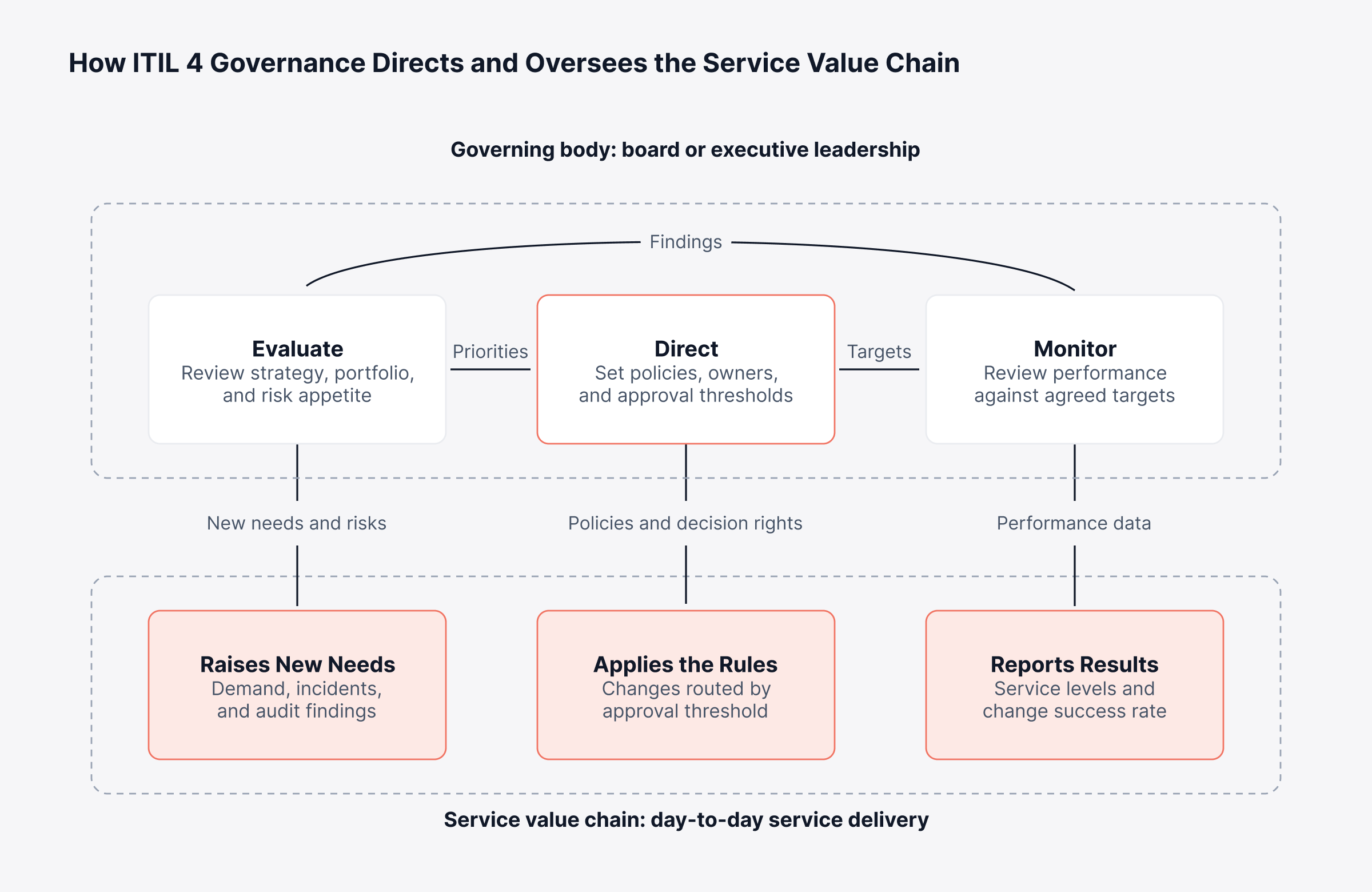
Governance shapes the whole SVS without running daily operations. It draws the lines others work within. A CFO sign-off on payment-system changes counts as governance, and so does a risk management review before every launch.
You'll see governance in the service desk's approval rules and in what gets reported to the CIO. Everything the service value chain does happens inside those limits.
What is the ITIL Service Value Chain?
The ITIL service value chain is the operating model at the center of the SVS, made up of six interconnected activities that turn demand into products and services. The six ITIL 4 service value chain activities are listed below with their purpose and the outputs they typically produce.
Activity | Purpose | Typical outputs |
Plan | Create a shared understanding of vision, current status, and improvement direction | Strategic plans, portfolio decisions, policies |
Improve | Keep products, services, and practices improving across every activity | Improvement initiatives and status reports |
Engage | Understand stakeholder needs and maintain good relationships | Requests, feedback, demand, and contracts |
Design and transition | Make sure services meet expectations for quality, cost, and time to market | Service designs, tested changes, new or changed services |
Obtain/build | Make service components available when and where they're needed | Built or acquired components such as software, hardware, or licenses |
Deliver and support | Deliver and support services to agreed specifications | Restored services, fulfilled requests, and user support |
There's no fixed entry point in the ITIL 4 service value chain. Engage often receives the demand first, yet any activity can hand work to any other, which is the main structural break from the v3 lifecycle.
How Value Streams Combine Value Chain Activities
A value stream is the path a piece of work follows, from request to result. Each one uses only the value chain activities it needs, in its own order. Onboarding a new employee through service request management is a common example:
Engage: HR submits the onboarding request through the service catalog
Obtain/build: IT assigns a laptop from stock and provisions the software licenses
Deliver and support: A technician configures access and confirms the new hire can sign in
Improve: Repeated delays in any step go into the improvement register
An outage takes a different route through those same six activities.
Map your most frequent outage pattern across all six activities, because the handoffs between lanes are where restoration time usually goes. The map below traces one payroll outage through the four activities it needs, the practice at work in each step, and what passes between them.
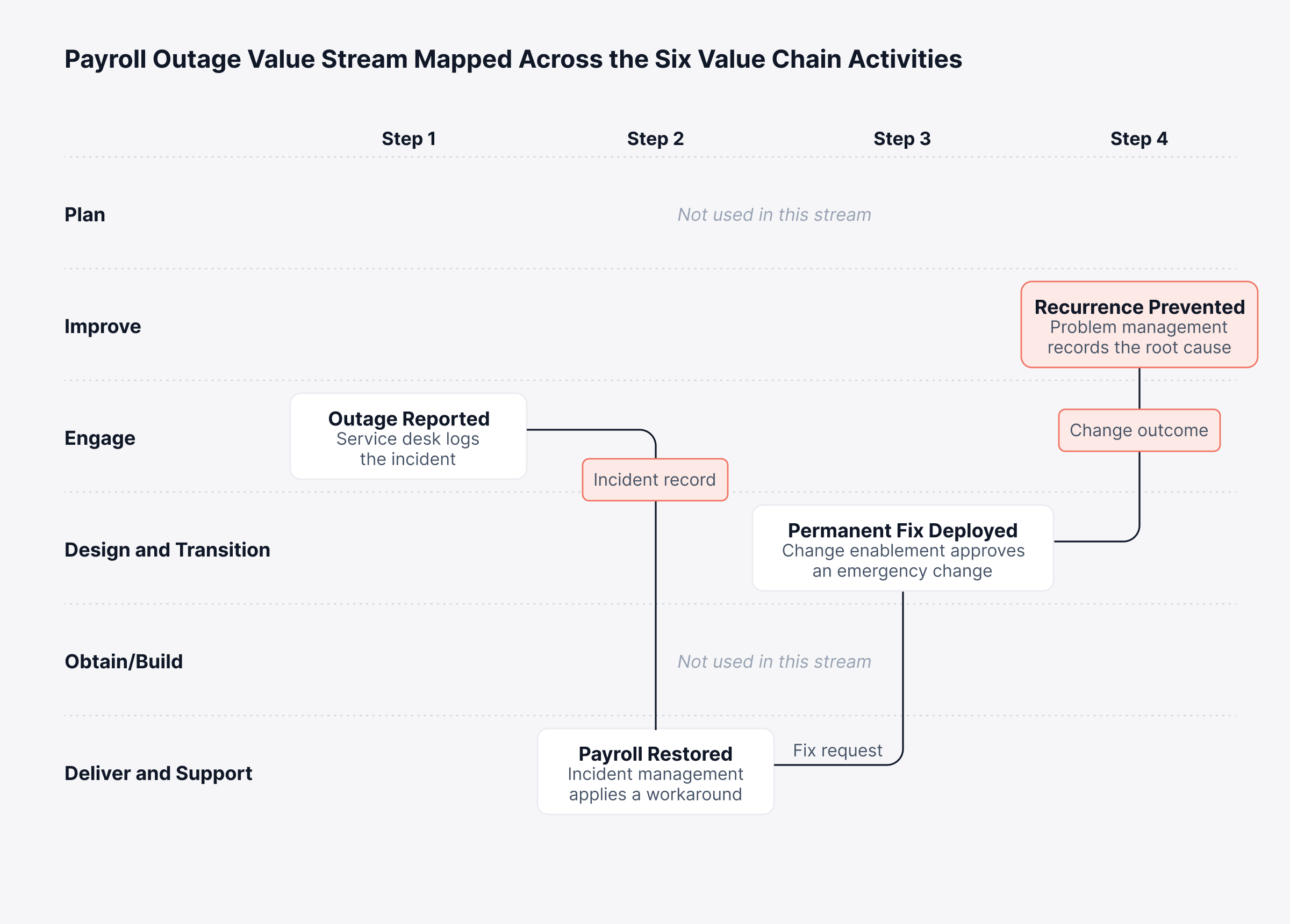
The same stream runs every time a critical service fails, and in many organizations, it starts before anyone calls, when observability data flags the failing service. After that, incident resolution speed comes down to how cleanly each activity hands off to the next.
Which ITIL 4 Practices Support the Service Value System?
ITIL 4 practices are 34 sets of organizational resources for doing work or meeting an objective, split into general management, service management, and technical management groups. They took over from the ITIL v3 processes. Every practice mixes people, information, partners, and workflows.
Practice group | Count | Practices |
General management | 14 | Architecture management, continual improvement, information security management, knowledge management, measurement and reporting, organizational change management, portfolio management, project management, relationship management, risk management, service financial management, strategy management, supplier management, workforce and talent management |
Service management | 17 | Availability management, business analysis, capacity and performance management, change enablement, incident management, IT asset management, monitoring and event management, problem management, release management, service catalog management, service configuration management, service continuity management, service design, service desk, service level management, service request management, service validation and testing |
Technical management | 3 | Deployment management, infrastructure and platform management, software development and management |
Most organizations never need all 34 at full depth, and adopting them together mainly adds cost. A sensible start is the service management practices users feel every day, adding more as maturity grows. A handful of them handle most of the daily load:
Incident management: Restores normal service as quickly as possible, with ITIL incident management defining priority and escalation
Change enablement: Assesses and authorizes changes to lower risk, with change management routing approvals by risk level
Problem management: Finds and removes the root causes behind repeated incidents
Service desk: Gives users a single point of contact for incidents and requests
These practices feed each other records. When a problem record is linked to the incidents behind it and the change that fixed them, anyone can see the whole story in one place. Each improvement cycle then adds a little more of that context.
How does Continual Improvement Work in the ITIL 4 Service Value System?
Continual improvement in the ITIL 4 service value system is the recurring work, at every level, of keeping services, practices, and the SVS itself current as needs change. ITIL 4 places it in three spots. It's an SVS component, the Improve activity in the value chain, and a general management practice.
Work moves through improvement using a model with seven steps:
Define the vision: Confirm which business goal the improvement supports
Assess the current state: Baseline today's performance with data
Set the target state: Agree on measurable targets
Plan the route: Choose the actions, owners, and timeline
Take action: Deliver the improvement, often in small iterations
Check the result: Compare outcomes against the targets
Keep the momentum going: Share results and feed lessons into the next cycle
An improvement register keeps this visible. Each entry needs an owner and a review date. Otherwise ideas tend to fade away, since incidents and changes always seem more urgent.
A year later, those closed entries are some of the best evidence of ITSM maturity an organization can show.
How do the Four Dimensions of Service Management Relate to the Service Value System?
The four dimensions of service management are the viewpoints every service value system component has to consider, which keeps decisions from focusing on technology or process alone. You'll also hear them called the four pillars of ITIL 4. ITIL 4 lists them as:
Organizations and people: Roles, skills, culture, and structure
Information and technology: The data, knowledge, and tools behind services, including the configuration records kept in a configuration management database, or CMDB
Partners and suppliers: The external organizations that help design, deliver, and support services
Value streams and processes: How the parts of the organization work together to create value
Events outside the organization affect all four dimensions too. ITIL 4 suggests checking them with PESTLE: political, economic, social, technological, legal, and environmental.
Take a new privacy law. Within a quarter, IT may be rewriting data handling rules, renegotiating supplier contracts, and retraining staff, all because of one regulation.
How do You Read the ITIL 4 Service Value System Diagram?
The ITIL 4 service value system diagram shows the whole model on one page, with opportunity and demand coming in from the left and value going out on the right. You'll find the ITIL 4 service value system official diagram in ITIL 4 Foundation. The AXELOS ITIL 4 service value system drawing reads top down, from principles and governance to practices and continual improvement.
Compare the diagram below with your own setup. It shows what each SVS component holds, from the three governance activities to the 34 practices.
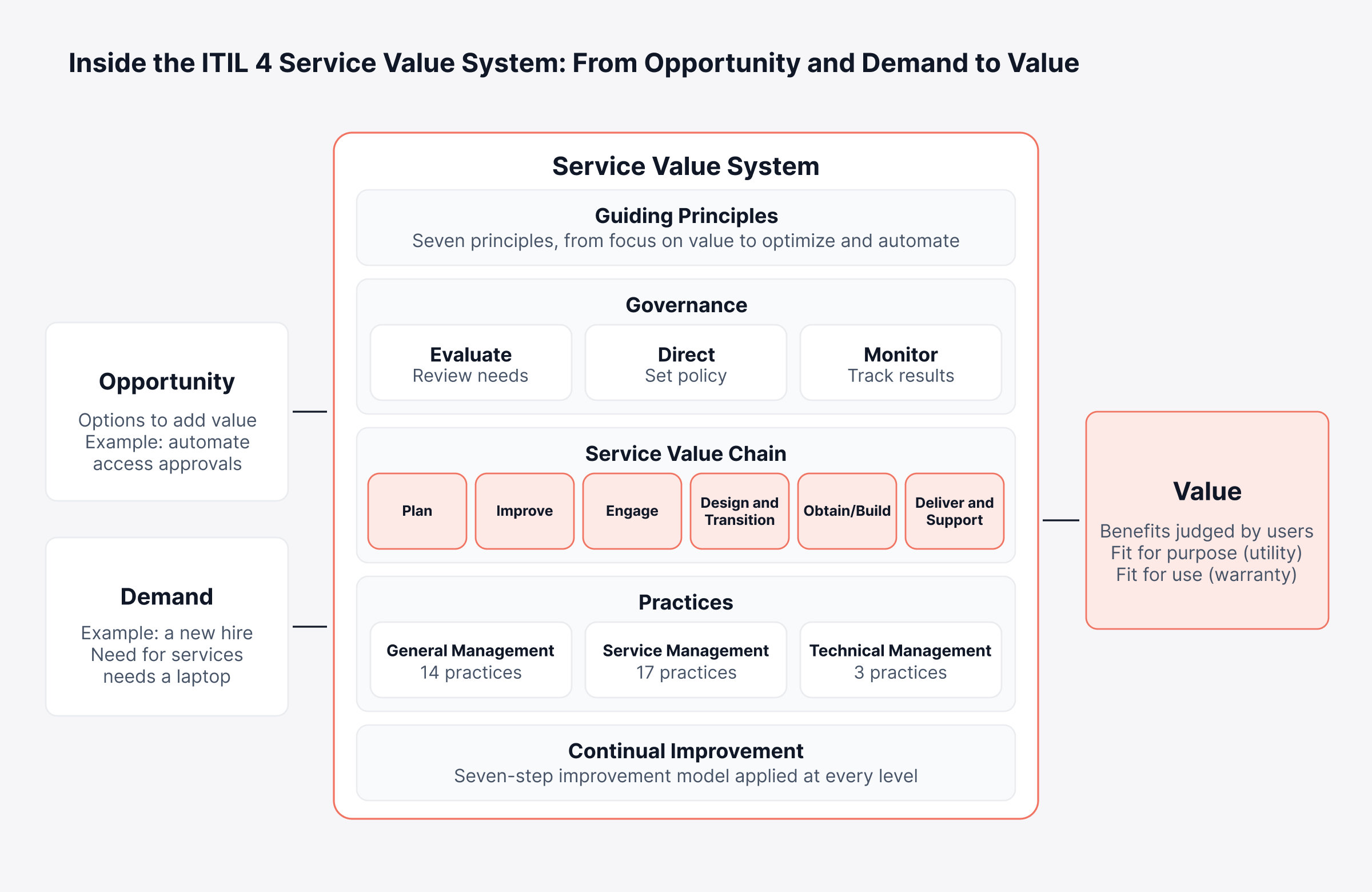
Three reading habits make any ITIL service value system diagram more useful:
Read left to right for flow: Inputs enter, value leaves, and the system in between does the work
Read top to bottom for authority: Principles and governance shape the chain, and practices supply what it needs
Read the box as one unit: Removing any component weakens the whole system
It's worth redrawing the diagram with your own services, owners, and tools filled in. On one page, a missing owner or a handoff nobody tracks becomes obvious, and workflow orchestration can then manage those handoffs between groups. Once that picture exists, the natural next question is whether the whole thing works.
How Can You Measure Whether Your Service Value System is Working?
You can measure the ITIL 4 service value system with one or two outcome metrics for each component, as long as every metric connects to the value a stakeholder would recognize. Here's a reasonable set to start from.
Component | What to measure | Example metric |
Guiding principles | Whether decisions follow them | Share of improvement proposals with a stated value outcome |
Governance | Decision speed and control | Average approval time for normal changes |
Service value chain | Flow from demand to value | End-to-end lead time for the top three value streams |
Practices | Practice performance | Change success rate, first contact resolution, and service level attainment |
Continual improvement | Improvement throughput | Improvement items closed per quarter against target |
Fewer metrics work better. Pick five or six numbers leadership will look at each month and tie them to service level agreement targets. If the numbers stop moving, look first at the mistakes below.
What are Common Mistakes When Applying the ITIL 4 Service Value System?
Most mistakes with the ITIL 4 service value system start when an organization copies the diagram as it is, without fitting it to the way it works. Six show up again and again:
Treating the value chain as a sequence: Forcing every request through all six activities adds delay to simple work
Confusing the SVS with the value chain: The chain is one of five components, so mapping it alone leaves governance and principles undefined
Adopting practices in isolation: Incident, change, and problem records kept apart lose the links that show cause and impact
Measuring activity over outcomes: Ticket counts show workload and say little about the value users received
Equating a tool purchase with adoption: Software supports records and workflows, while people still define value, governance, and priorities
Skipping governance: Without clear decision rights, approvals stall or get bypassed
One fix covers all six. Begin with the outcome a stakeholder is waiting for, then work out which components have to change to deliver it. Our list of common ITSM implementation pitfalls covers several of the same problems from a different angle.
How do You Start Applying the Service Value System in Your Organization?
One service is enough to start applying the ITIL 4 service value system. Choose something people use every week, map how a request moves from start to finish, and fix that before moving on. Here's the five-step version:
Pick one high-value service: Choose a service users depend on daily, such as onboarding or access requests
Map its value stream: List the value chain activities it uses, plus the owner and tool at each step
Check the components: Confirm which principles, governance rules, and practices apply, and note the gaps
Fix the largest handoff delay: Simplify the step first, then automate it
Measure and repeat: Track lead time and user satisfaction, then move to the next service
Done this way, the rollout itself follows three of the guiding principles: start where you are, progress iteratively, and focus on value. The harder part is often getting people on board, which our guide to ITIL implementation covers in detail.
Where ITSM Tools Fit in the Service Value System
ITSM tools support the SVS by putting every practice's records in one place. That way, the technician who closes an incident sees the linked problem, the fix that went in, and the affected server, all without switching systems.
That's the approach behind Motadata ServiceOps, where the service desk, IT asset management, and the CMDB share one platform. Day to day, that shows up in a few ways:
Linked records: Tickets connect to the affected configuration items through configuration item management
Reusable fixes: Knowledge management suggests existing articles while a ticket is being logged
Observability context: A native integration with Motadata ObserveOps lets observability alerts open service desk tickets
ServiceOps also appears in PeopleCert's tool directory with seven certified ITIL practices, including incident management, change enablement, problem management, and knowledge management.
Users tend to notice the connected records first. This is what one of our users says about Motadata ServiceOps on G2:
Does ITIL 5 Change the Service Value System?
ITIL 5 keeps the service value system, but the value chain now follows the lifecycle of digital products and services. PeopleCert brought out the new version in early 2026. Training providers' early material points to these differences:
Retained: The service value system, guiding principles, governance, continual improvement, and the 34 practices, which are regrouped
Reframed: The six-activity value chain gives way to a product and service lifecycle model with eight activities
Added: Stronger guidance on AI governance and on managing products and services together
Certifications: ITIL 4 credentials stay valid, and both versions run in parallel during the transition
Work done under ITIL 4 isn't wasted. Both versions share the same components. A value stream mapped today should still work after a move to ITIL 5.
Run Your Service Value System as One Connected Workflow with Motadata ServiceOps
Connections make the ITIL 4 service value system work. Those connections break fast when every practice keeps its records in a different tool. Software can help with that, though leadership still has to define value and set the rules.
Motadata ServiceOps gives that work a single home. Incident, change, and asset records live side by side, and seven of its ITIL practices carry PeopleCert certification. When leadership asks what a service delivered last quarter, the answer comes from one place.
FAQs
What are the components of a service value system (SVS)?
The five components are guiding principles, governance, the service value chain, practices, and continual improvement. Together they turn opportunity and demand into value for customers and other stakeholders. Each component answers a different question, from how decisions get made to which capabilities carry out the work.
Is ITIL still relevant in 2026?
Yes. ITIL 4 remains in active use across IT organizations, and ITIL 5, released in early 2026, builds on the same service value system, guiding principles, and practices. Concepts adopted from ITIL 4 today carry forward into the new version with little rework.
What are the 7 guiding principles of ITIL 4?
They are: focus on value, start where you are, progress iteratively with feedback, collaborate and promote visibility, think and work holistically, keep it simple and practical, and optimize and automate. The principles guide decisions in every situation, whatever the organization's size, structure, or ways of working.
What are the 5 stages of ITSM?
The five stages usually refer to the ITIL v3 service lifecycle: service strategy, service design, service transition, service operation, and continual service improvement. ITIL 4 replaced these sequential stages with the service value system, which lets activities combine in whatever order a value stream needs.
How do ITSM tools support the ITIL 4 service value system?
ITSM tools keep practices such as incident, change, and request management connected through shared records and workflows. Platforms like Motadata ServiceOps, which holds PeopleCert certification for seven ITIL practices, help organizations trace a value stream from request to outcome. The organization still defines value and governance, and the tool keeps that work consistent.
Author
Poonam Lalani
Content Strategist
Poonam Lalani is a B2B content strategist and writer with a background in computer engineering and experience across enterprise technology domains, including AI, cloud, DevOps, data engineering, and IT operations. She specializes in creating research-driven content that simplifies complex ideas and supports product education, thought leadership, and business growth.