Post-Quantum Cryptography and How to Prepare Your Organization
Do you actually know where encryption lives inside your infrastructure? Not the vendor's answer. The full map: every TLS handshake, every signed software update, every VPN tunnel, every certificate your systems trust.
That map is where post-quantum cryptography starts to matter. The technology has moved from a research topic into a compliance deadline, and the algorithms protecting your data today were built for a world without quantum computers.
Those algorithms are mostly RSA and elliptic-curve cryptography, and a machine powerful enough to break them doesn't exist yet. But moving off them touches nearly every system you run, which makes the shift as much an asset discovery problem as a cryptography one.
This guide covers what post-quantum cryptography is, why the threat is already here, the NIST standards that now define the target, and a way to start that doesn't depend on hype. Just the work in front of you.
What is Post-Quantum Cryptography?
Post-quantum cryptography is a group of encryption and digital-signature algorithms built to withstand attacks from a large quantum computer. It runs on the classical computers you already operate, with no special quantum hardware needed.
Post-quantum cryptography is often confused with quantum cryptography, though the two are separate fields. Quantum cryptography, such as quantum key distribution, depends on the physics of light and needs dedicated hardware and fiber. Post-quantum cryptography is ordinary software that installs on the systems you run today.
The goal is narrow. Replace the public-key algorithms a quantum computer could break, chiefly RSA and elliptic-curve cryptography, with math that resists both classical and quantum attacks. These are the algorithms behind everyday network protocols, from web sessions to secure logins.
Why Today's Encryption is at Risk
Today's encryption is at risk because its security rests on two math problems that are hard to reverse. RSA relies on factoring a very large number back into its prime factors. Elliptic-curve cryptography relies on a related problem called the discrete logarithm.
For a classical computer, working either problem backward would take longer than the universe has existed, and that difficulty is what keeps the encryption strong. Both problems fall apart on a quantum computer running Shor's algorithm, a method published back in 1994. A qubit, the quantum version of a bit, lets the machine weigh many answers at once, and with enough stable qubits, Shor's algorithm solves both problems in a workable amount of time.
Not everything breaks, though.
At risk: public-key cryptography, mainly RSA and elliptic-curve, which covers key exchange and digital signatures
Mostly safe: symmetric encryption like AES and the hash functions behind file integrity, where doubling the key size is usually enough
Where the work goes: almost every migration points at the public-key layer, because that's the exposed part
How close is that machine? No one can give a firm date. A quantum computer able to break RSA at scale doesn't exist yet, and credible estimates range from several years out to a decade or more. That uncertainty is the problem, because you have to protect long-lived data today against a deadline no one can pin down.
Why Harvest Now, Decrypt Later is Already a Threat
Harvest now, decrypt later is the practice of stealing encrypted data today and storing it to decrypt once a quantum computer exists. The attacker doesn't need to break anything now. They only need to keep the ciphertext. That shifts the timeline in a way many teams miss.
If your data must stay confidential for ten or fifteen years, the clock started the moment it crossed the wire.
The data most exposed to this:
Health and medical records, which stay sensitive for a lifetime
Financial and payment data with long regulatory tails
Government, defense, and trade secrets
Intellectual property and source code
Here's the position worth arguing with your own team about: waiting for "Q-Day," the day a quantum computer can break today's encryption, is a mistake for any data with a long shelf life. You can patch a weak system later. You can't un-leak the traffic an adversary already captured.
Concrete scenario: a hospital encrypts its patient records in transit today, and everything looks fine. An attacker quietly copies that traffic and files it away. Ten years later, a quantum computer unlocks the copy, and records that were meant to stay private for a lifetime are suddenly readable.
The quantum threat pushes cryptography squarely into risk management, which is why a standards body like NIST had to step in and choose the replacements.
The NIST Post-Quantum Standards You Need to Know
The NIST post-quantum standards are the algorithms you'll migrate to, set by the US National Institute of Standards and Technology, the agency whose cryptographic choices tend to become the global default. Once you accept the threat is live, these are the replacements for the RSA and elliptic-curve algorithms at risk. Those first three landed in August 2024, at the end of an eight-year public competition.
A note on the names: Older articles still call these Kyber, Dilithium, and SPHINCS+, the names they carried as competition entries. In policy, procurement, and audit documents, use the standard names (ML-KEM, ML-DSA, SLH-DSA), because the submission names create confusion where you least want it.
Still in the pipeline: Two more algorithms are on the way. In March 2025, NIST added HQC as a second option for key exchange, a code-based design that gives you a fallback if a weakness ever surfaces in the lattice-based ML-KEM. A fourth scheme, the FALCON-based FIPS 206, should follow in late 2026 or early 2027. Treating weak cryptography as a class of vulnerability management is what makes these standards actionable rather than academic.
Where Post-Quantum Migration Hits First
Knowing the algorithms is one thing, and knowing where they live is another, because post-quantum migration hits public-key cryptography first and reaches further into your stack than most inventories expect. It belongs inside your wider cybersecurity strategy, and six areas carry the bulk of the exposure.
1. TLS and HTTPS
Every HTTPS connection sets up its key with RSA or an elliptic curve. That puts web servers, APIs, and load balancers on the list, and VPNs land there too, along with the remote-access and site-to-site tunnels they carry.
2. Code signing
Updates, container images, and firmware all carry a signature that proves nobody tampered with them. Break the public-key math behind that signature and an attacker can forge it, then ship code your systems will trust and run.
3. Certificates and PKI
Your certificate authorities and internal PKI, the machinery that issues and tracks certificates, run on classical cryptography from top to bottom. Re-issuing at scale takes time. And since machine identities tend to outnumber human ones many times over, the sheer count surprises teams that only planned for the obvious systems.
4. Stored long-life data
Backups, archives, and records held under long retention rules make ideal harvest-now-decrypt-later targets. Their value holds steady while an attacker holds the ciphertext and waits for the hardware to arrive.
5. Embedded and IoT devices
Field devices often ship with fixed cryptography and little room to update. That makes them the hardest to migrate and the easiest to forget.
6. Application code and APIs
Cryptography hides in your own code too: algorithms hard-wired into functions, signed tokens issued at login, and encryption inherited from third-party libraries. Worse, weak cipher negotiation and downgrade attacks can slip a vulnerable algorithm back in at runtime. A one-time scan won't catch that, so this layer needs visibility that stays on.
Map these six, and you have the shape of the migration before anyone argues about algorithms.
What Quantum Agility Means in Practice
Quantum agility, usually called crypto-agility, is the ability to swap cryptographic algorithms across your systems without rebuilding them. It's the key to post-quantum readiness, and the design goal that outlasts any single algorithm choice while the standards keep moving.
Why it matters: The standards are still moving. HQC and the FALCON-based scheme haven't landed yet, and guidance will keep shifting as researchers stress-test the new algorithms. Agility is what lets you absorb those changes without reopening the whole project each time.
What it looks like in code: Hard-code an algorithm into a hundred places, and every update turns into a migration of its own. Route the same cryptography through shared libraries or services you control, and swapping it drops to a config change.
Hybrid mode: Most early movers run a hybrid during the transition. The handshake pairs a classical algorithm with a post-quantum one, so the connection stays safe as long as either half survives. It follows the same instinct as zero trust: assume today's protection won't last, and build so you can change it quickly.
The catch: picking the algorithm is the easy part. The hard part is building the agility to keep swapping algorithms for the next decade, and that's where most of the engineering hours disappear.
The 2030 Deadline and What Regulators Now Expect
The 2030 deadline is what turns post-quantum readiness from a good idea into an obligation, and the sharpest signal arrived in June 2026.
1. The Federal Deadline:
Signed on June 22, 2026, Executive Order 14412 hands US agencies two fixed dates: post-quantum key establishment by December 31, 2030, and digital signatures a year later, by December 31, 2031. It also directs contractors to meet post-quantum FIPS standards by the end of 2030, which pulls their vendors and partners into the same timeline. The NSA's CNSA 2.0 program keeps national security systems on a separate track toward 2033.
2. The Payment Industry Angle:
Payment security already moved first. Since March 31, 2025, PCI DSS v4.0 has required anyone handling cardholder data to document every cipher and protocol in use, track those choices for weakness, and keep a plan ready for when they age out. Quantum never comes up by name, and yet the habit it enforces is the one a post-quantum migration runs on.
3. Why it Reaches You:
For most private organizations, no statute forces the date. But when the government commits its own systems and its whole supply chain to a 2030 line, that date becomes the baseline your customers, insurers, and regulators start to expect. Post-quantum readiness has become a governance question as much as a technical one, which is why it now belongs alongside your other compliance and security work.
4. The Inventory Mandate:
One detail in the executive order tells you where the work actually starts. Within 270 days, CISA and NIST are to publish the minimum elements for a cryptographic bill of materials (CBOM), a machine-readable list of the cryptographic assets inside a piece of hardware or software. You can't swap out weak algorithms on a deadline if you don't know where they run.
How to Start Your Post-Quantum Migration
Start your post-quantum migration by finding where cryptography runs before you touch a single algorithm. The order of operations matters, and skipping the inventory is the most common way these programs stall.
1. Build a Cryptographic Inventory:
Find every place key exchange and signing happen. This is your cryptographic bill of materials, and it's the base for everything after. Scan for:
TLS endpoints, VPNs, and internal service-to-service traffic
code-signing pipelines, certificates, and PKI
third-party libraries and embedded devices you don't fully control
The discipline is the same one behind IT asset management: you can only govern what you can see.
2. Prioritize by Data Lifetime and Exposure:
Score each system on two axes, how long its data has to stay secret, and how exposed it is to harvest-now-decrypt-later capture. Anything that needs a decade of confidentiality moves to the front of the line.
3. Design for Crypto-Agility:
Get the hard-coded algorithms out of your application logic, and route every crypto call through shared libraries or services you can update from one spot. That's the difference between a one-time swap and a capability you keep.
4. Adopt Hybrid Mode Where it's Supported:
Pair a classical algorithm with a post-quantum one for the transition period, so you pick up quantum resistance while keeping a proven fallback under it.
5. Test Before you Trust:
ML-DSA signatures run bigger than ECDSA, and post-quantum handshakes push more bytes across the wire. Measure what that does to latency, storage, and older hardware in a lab, well before any of it reaches production. Some constrained and embedded systems will break, and you want to find that before production does.
6. Re-Scan and Keep Watching:
Cryptography drifts. New systems reintroduce old algorithms, and acquisitions bring their own stack. A one-time audit goes stale within a quarter, so the inventory has to stay live.
None of this is fast. A full migration runs across years for most organizations, hybrid mode adds overhead of its own, and the standards themselves are still filling in. That's the trade you're accepting, and dressing it up only sets the wrong expectations.
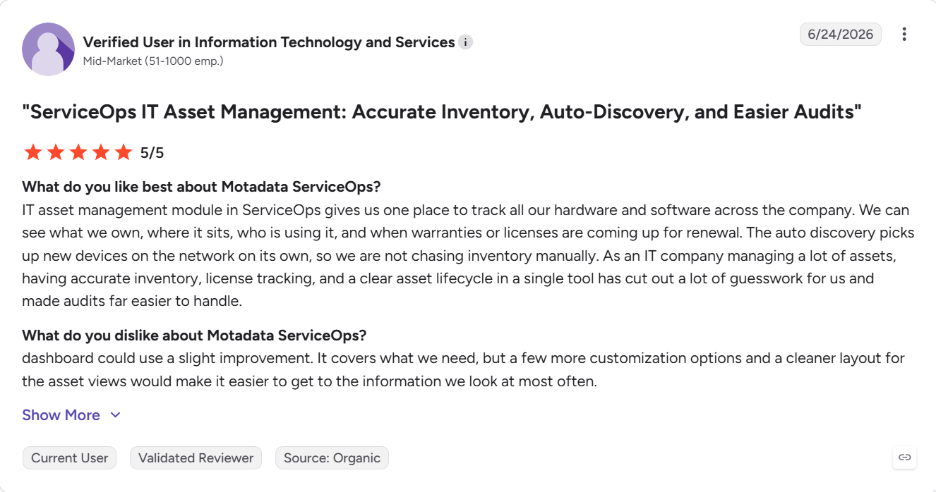
Here's what our customers say about Motadata ServiceOps on G2.
Managing Cryptographic Risk with Motadata ServiceOps
Map where your cryptography lives, then bring it under management in Motadata ServiceOps before the 2030 clock sets the pace for you. A post-quantum program starts as an inventory problem, and inventory is exactly what an ITSM and asset-management platform holds well. ServiceOps brings asset discovery, a central CMDB, and the service desk together, which turns your cryptographic bill of materials into a living record, one with owners and change history, rather than a spreadsheet that quietly goes out of date.
Then run the migration as tracked work. No platform swaps your algorithms for you, and the engineering is still yours, but ServiceOps gives you the visibility to sequence it against the 2030 and 2031 dates, follow every system from discovery to fix, and show where you stand when a customer or regulator asks. The standards are set. The deadlines are set. Start with the one move that pays off no matter how the timelines shift: find every place your cryptography runs, and get it under management now.
FAQs
What is post-quantum cryptography in simple terms?
Post-quantum cryptography is a group of encryption and signature algorithms built to resist attacks from a large quantum computer. It runs on regular computers and is meant to replace RSA and elliptic-curve cryptography, which a quantum machine could eventually break.
Is post-quantum cryptography the same as quantum cryptography?
No. Quantum cryptography, such as quantum key distribution, relies on the physics of light and needs special hardware. Post-quantum cryptography is ordinary software that runs on the systems you already own.
When will quantum computers break RSA encryption?
No one knows the exact date, and a machine capable of it does not exist yet. The concern is that adversaries can capture encrypted data now and decrypt it later once such a computer arrives, so data that must stay secret for years is already exposed.
What is the harvest now decrypt later threat?
Harvest now decrypt later is when an attacker steals encrypted data today and stores it to unlock once quantum computing catches up. It matters most for information with a long confidentiality requirement, because that data cannot be protected after it has been captured.
How should organizations start preparing for post-quantum cryptography?
Start by building an inventory of every place cryptography runs, then prioritize systems by how long their data must stay secret. From there, design for crypto-agility, adopt hybrid modes where supported, and test the new algorithms before rolling them out widely. A platform that already handles asset discovery and a CMDB, such as Motadata ServiceOps, gives that inventory a place to live and stay current.
Author
Poonam Lalani
Content Strategist
Poonam Lalani is a B2B content strategist and writer with a background in computer engineering and experience across enterprise technology domains, including AI, cloud, DevOps, data engineering, and IT operations. She specializes in creating research-driven content that simplifies complex ideas and supports product education, thought leadership, and business growth.