Knowledge-Centered Service (KCS): How the Methodology Works
Most service desks treat documentation as a separate job, done after the ticket closes, by someone who has already moved on to the next problem.
That produces thin, stale or missing articles, so the next engineer solves the same issue from scratch. Meanwhile the knowledge base fills with content nobody reads.
Knowledge-Centered Service, usually shortened to KCS®, is the methodology built to break that cycle.
In this blog, you will:
Follow the eight practices that make up the KCS double loop.
See which practice names changed when the Consortium updated the methodology.
Judge what usually goes wrong in adoption, and why the tool rarely causes it.
Match each practice to what a service desk platform has to do.
By the end you will know whether KCS fits your team, and where to start if it does.
What Is Knowledge-Centered Service (KCS)?
Knowledge-Centered Service is a methodology that creates and improves knowledge as a by-product of solving problems. The work itself produces the article, instead of a separate documentation project running alongside it.
The shift sounds small and turns out to be hard. An engineer working a ticket searches the knowledge base first and uses what they find. They fix whatever is wrong with that article, then capture anything new before the ticket closes.
Nobody writes articles later, because the article is the work. The Consortium for Service Innovation, the non-profit that developed and maintains the methodology, has been refining it with member organizations for more than thirty years.
That ownership matters for two practical reasons. The methodology is free to read and apply, published under a Creative Commons license, and the name itself is a service mark with rules attached.
Is It Knowledge-Centered Service, Support or Success?
All three names refer to the same methodology, and the acronym has never changed. The Consortium has renamed it twice as its scope widened.
The table below shows where each name sits today.
Name | Period | Status now |
Knowledge-Centered Support | Until 2016 | Retired, though still widely used online |
Knowledge-Centered Service | From KCS v6, April 2016 | The name most of the industry still uses |
Knowledge-Centered Success | Current | The name the Consortium uses today |
According to the Knowledge-Centered Success Practices Guide, the Consortium changed Service to Success on purpose. The new name reflects how far the methodology has spread beyond the support desk.
The reasoning behind it matters more than the label does. Members now run KCS across HR, legal, marketing, sales and product teams. The Consortium also argues that structured, current knowledge is what makes AI tools usable at all.
For your purposes, treat the three names as interchangeable when you search, and use Success when you cite the current guidance.
How Does the KCS Methodology Work?
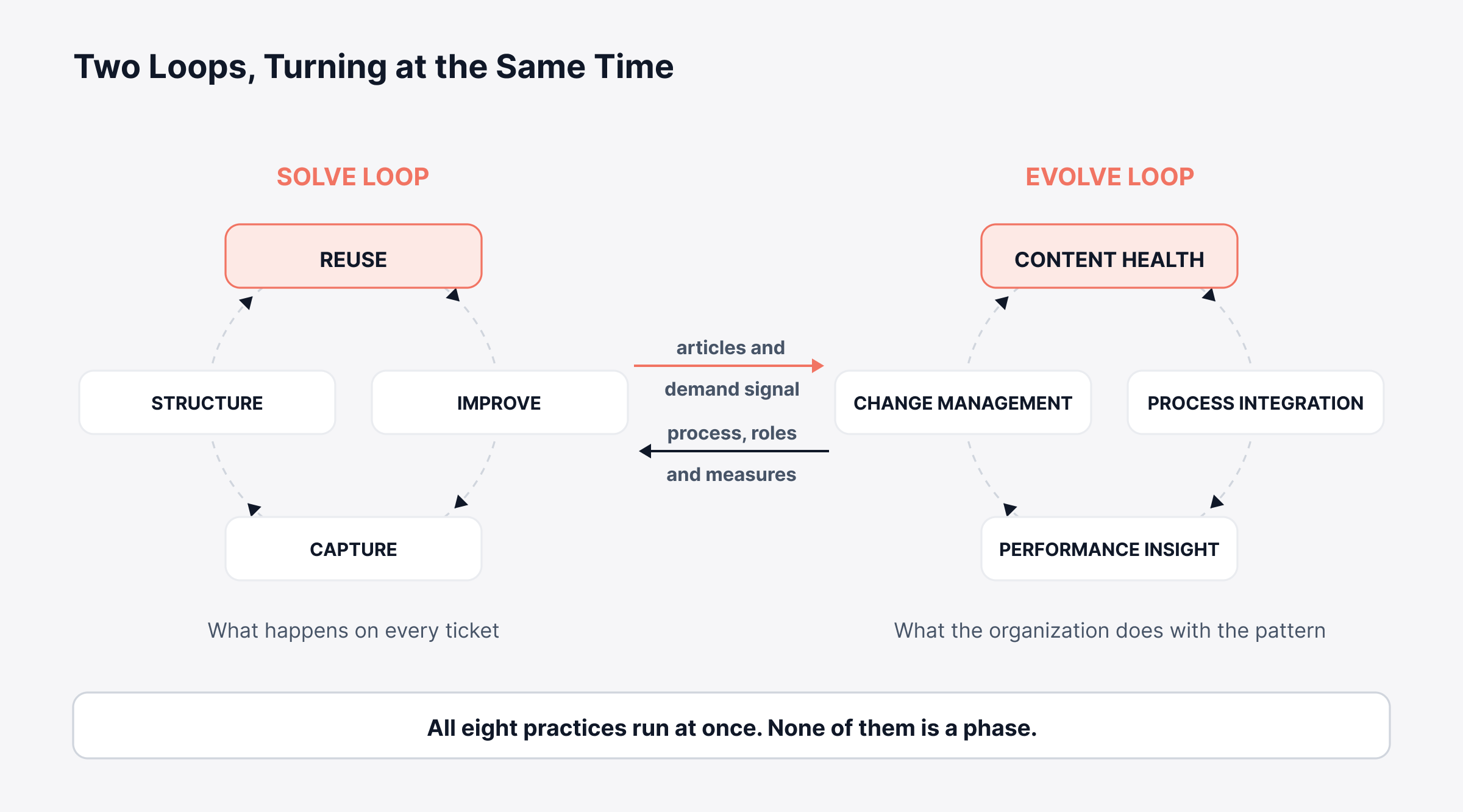
The KCS methodology works through two loops that run at the same time. The Solve Loop covers every ticket. The Evolve Loop covers what the organization does with the pattern those tickets create.
Eight practices sit across the two, four in each.
The Solve Loop
The Solve Loop covers the four things an engineer does while resolving a single issue. The current guide describes them starting from Reuse, since reusing what already exists dominates the day in a working KCS system.
Practice | What it means in a ticket |
Reuse | Search before you solve, and link the article you used to the ticket |
Improve | Fix what is wrong or missing in that article at the moment you notice it |
Capture | Record the issue in the requester's words while you are still in the conversation |
Structure | Put the content into a standard shape so people and machines can read it |
Teams get Capture wrong more often than any other practice. It means capturing context during the interaction, and a new article only gets created when no existing one covers the issue.
The Evolve Loop
The Evolve Loop handles the organizational half. It looks across many tickets and many articles, then changes the system that produced them.
Practice | What the organization does |
Content Health | Keep articles accurate, findable and worth keeping, and archive what is not |
Process Integration | Build knowledge work into the workflow, the roles and the coaching |
Performance Insight | Measure the individual, the program and the benefit to the business |
Change Management | Start from motivation, then keep interest and understanding alive |
Content Health gained a technique called Knowledge Optimization in the current guide. It covers acting on what the system tells you, including when to archive and who should be involved.
Why the Two Loops Depend on Each Other
Run the Solve Loop alone and you get a growing pile of articles with no one maintaining them. Run the Evolve Loop alone and you get governance over content that nobody is creating.
The loops correct each other. The Solve Loop supplies the raw material and the demand signal, and the Evolve Loop decides what that signal means and changes the process accordingly.
All eight practices run concurrently. Teams that treat them as eight sequential phases stall somewhere around practice three.
The diagram below shows both loops turning together, and what each one hands the other.
What Changed From KCS v6?
KCS v6 shipped in April 2016 and remains the version most published material describes. The Consortium has since released an updated methodology under the Success name, and several practice names moved with it.
This table matters when you compare guidance written at different times.
KCS v6 | Current | What actually changed |
Solve Loop: Capture, Structure, Reuse, Improve | Solve Loop: Reuse, Improve, Capture, Structure | Same four practices, described clockwise from Reuse |
Performance Assessment | Performance Insight | Renamed, and widened to cover program and business benefit |
Leadership and Communication | Change Management | Renamed, and now starts from motivation |
Licensing model | Proficiency model | Renamed to stop the confusion with software licenses |
Strategic framework | Impact map | Renamed to tie activity to business outcomes |
The double loop itself survives intact, and the Consortium is explicit that all the practices still run at the same time.
On certification, What's New in Knowledge-Centered Success confirms that existing v6 training and certification remains fully valid, with updated offerings due in April 2027. Nobody needs to wait.
What Are the Benefits of KCS?
The benefits of KCS fall into three groups, and they arrive in a specific order rather than all at once.
Operational efficiency first: Reuse cuts the time spent re-solving known issues, and that return shows up fastest.
Self-service and automation second: Articles written in the requester's words and kept current are what make a portal deflect tickets instead of frustrating people.
Organizational learning last: Patterns in the knowledge base show which product or process defects keep generating work, which is where the largest savings sit.
That order also sets the honest sequence for expectations. Teams see resolution times move within a quarter, while the product-defect insight takes a year of clean data to become credible.
The link to AI arrived more recently and deserves naming. Assistants and agents answer from the content you give them, so an unmaintained knowledge base produces confident wrong answers at scale.
Why Is KCS Hard to Adopt?
KCS is hard to adopt because it asks people to change how they work, and almost none of the difficulty sits in the software.
Four failure patterns come up repeatedly.
Treating it as a documentation project: A team assigns article writing to two people and calls it KCS. The loop never closes, because the people solving tickets are not the people writing.
Measuring article count: Counting articles created rewards volume and produces duplicates. Reuse and content health carry the signal that matters.
Demanding polish before publishing: A heavyweight approval gate on every draft kills capture. Quality comes from use and improvement over time, not from a reviewer at the start.
Skipping coaching: The current guide moves coaching inside Process Integration for a reason. Behavior changes through conversations in the workflow, not through a training day.
We have watched the second one sink more rollouts than any tooling gap. A dashboard counting new articles will get you new articles, and very little else.
How Do You Start With KCS?
Start with a small group and the Solve Loop, and leave the Evolve Loop until there is something to evolve.
Pick one team and one queue: A single support group working a defined set of issues gives you a clean signal and a short feedback cycle.
Agree the article shape before anyone writes: Decide the fields, the audience and the wording standard, so Structure is a habit rather than a cleanup job later.
Make search the first step on every ticket: Reuse only becomes normal when the tool puts search in front of the engineer without being asked.
Let the people solving tickets publish: Use a light review path, and reserve approval gates for content that carries real risk.
Coach in the workflow: Give a few people the coach role and let them review real tickets with real engineers each week.
Measure reuse and content health: Track how often articles get linked to resolutions, and how much of the base has gone stale.
Open the Evolve Loop once patterns appear: When the same article keeps resolving the same issue, you have found a problem worth fixing upstream.
The surrounding ITSM knowledge management practices matter as much as the loop itself. KCS sits inside a wider service management process rather than replacing it.
What Should Your Service Desk Tool Do to Support KCS?
A tool cannot deliver KCS, and it can make every practice either easy or impossible. Judge a platform on whether the eight practices fit inside the workflow it gives your engineers.
The practices map to capabilities you can check for in a demo.
Practice | What the tool needs to do |
Reuse | Suggest articles during ticket creation and link the one used to the resolution |
Improve | Allow in-place edits with edit history, an audit trail and rollback |
Capture | Convert a problem resolution or change outcome into an article without rekeying |
Structure | Provide folders, subfolders, tags and categories, plus a consistent editor |
Content Health | Carry expiry dates, helpful and not helpful feedback, and content performance data |
Process Integration | Connect knowledge to incident, problem, change, release, asset and CMDB records |
Performance Insight | Report usage analytics and search analytics, not just article counts |
Change Management | Nothing. This one is yours, and no product will do it for you |
Motadata ServiceOps covers the first seven rows natively. Knowledge sits on the same platform as incident, problem, change and asset records. Converting a resolution into an article becomes a step in the workflow rather than a separate task.
We would rather you tested the last row honestly than bought around it. The knowledge management capability handles the mechanics, and the behavior change is still a management job.
Where KCS Fits Alongside Self-Service
KCS and self-service get sold together, and they are not the same project. KCS produces the content, and the portal delivers it through one channel.
The order matters. A self-service portal launched over a thin knowledge base teaches users that searching is a waste of time, and that lesson is expensive to undo.
Running both on a unified observability and ITSM platform helps here. The same articles then serve the portal, the agent console and any assistant you point at them.
Turn Every Ticket Into an Article Someone Reuses
KCS works by removing the gap between solving a problem and recording the solution. That single change is what makes every other benefit possible.
It also runs slower than a vendor demo suggests. The hard part is getting engineers to search before they solve, and to fix an article while they are still in it. No platform supplies that habit.
Teams that stay with it stop re-solving the same issues within a quarter. The service desk knowledge base turns into the thing people check first rather than the thing nobody trusts. The larger payoff lands later, when patterns in that base start naming the defects worth fixing upstream.
FAQs
Is KCS the same as ITIL knowledge management?
No, the two work at different levels. ITIL defines knowledge management as a practice and says what good looks like. KCS supplies the loops and techniques to run it, so most teams use both.
How long does a KCS adoption take?
Plan on a quarter for one team to make the Solve Loop habitual. Evolve Loop data takes about a year before it supports decisions about product defects. Teams that rush the Evolve Loop usually end up with measures nobody trusts.
Does KCS require a certification to use?
No, and the methodology is published openly and free to apply. Certification exists for people who want formal training. Existing v6 certification stays valid, with updated offerings due in April 2027.
Who writes the articles under KCS?
The person solving the ticket writes them, which is exactly the point. Dedicated writers can support structure and content health, and pulling authorship away from the engineers breaks the loop.
Can ServiceOps support KCS practices?
Yes, across seven of the eight practices. ServiceOps provides article suggestions during incident creation, in-place editing with an audit trail, and resolution-to-article conversion. It also carries folder structure, expiry dates, article feedback and search analytics.
Author
Ramya Shah
Technical Writer
Ramya Shah is a technical content writer with a computer engineering background and roots in automotive journalism. He covers IT Service Management, observability, IT operations, and AI-driven automation. An early adopter of AI-assisted writing workflows, he turns complex IT processes into clear, engaging content optimized for search and answer engines (AEO), lifting content output and organic visibility.