How a Change Advisory Board Works and When to Skip It
Why does a low-risk configuration update wait nine days for a signature while the change that took down payments went through on a verbal approval? Most change governance handles that badly, and it costs the business twice: projects miss their dates, and the changes that should have been examined cause outages.
The change advisory board was designed to solve exactly this. It gives an organization a place where the people who understand the systems, the customers, and the regulatory exposure look at a proposed change together before it reaches production. The trouble starts when every change is routed there by default.
A board that works through forty items in an hour approves most of them without discussion, so the review exists on paper and changes nothing. This guide covers the CAB process as it actually runs inside an IT service management function. In this blog, you will see who belongs on the board, which change types need its approval, how a CAB meeting should be structured, how an emergency change advisory board takes over, and the conditions under which skipping the board is the correct call.
What Is a Change Advisory Board?
A change advisory board is a cross-functional group that reviews proposed IT changes, assesses their risk and business impact, and advises the change manager on whether each one should proceed. CAB is the common abbreviation for change advisory board. The CAB meaning used by most organizations comes from ITIL, which gives the board its advisory role and leaves the final decision with the change manager.
That split between advice and authority matters in practice. The board brings knowledge the change manager does not have: how the network fits together, how the application behaves, where the security exposure is, and when the business can absorb disruption. One named person still answers for the decision, and some organizations call the same group a change management board or a change control board without changing how it works.
What the board is responsible for:
Risk assessment: Judging what could fail and how far the failure would spread
Business alignment: Confirming the change lands outside protected operational windows
Dependency review: Surfacing conflicts with other scheduled work
Compliance check: Verifying the change meets regulatory and internal control requirements
Scheduling advice: Recommending sequence and timing across competing changes
A CAB carries no delivery responsibility. It does not build, test, or implement anything, and treating it as a technical design review is the fastest way to make the meeting run long. Board time is also expensive, because every seat in the room is a senior person spending an hour, which is reason enough to keep the agenda short.
Why Does a Change Advisory Board Matter to the Business?
A change advisory board matters commercially because it controls the trade between shipping quickly and avoiding outages. Each review costs delivery time, and each problem caught saves an outage, so the board's rules show up in both the delivery plan and the incident count. The purpose of a change advisory board is to spend expert judgment on the small share of changes that can actually hurt the business.
Outage cost avoided: Finding a dependency conflict in a meeting costs an hour, and finding it after release costs lost sales and a surge of support tickets
Audit readiness: A decision trail that already exists turns a regulatory review into a file lookup
Delivery predictability: A published route and cadence lets delivery leads commit to dates instead of waiting on an approval of unknown length
Cross-team visibility: Two teams planning work in the same window find out before both changes go live
Who Belongs on a Change Advisory Board?
Change advisory board members should represent every function that would be called if the change failed. Three to seven voting members is the practical range, because a larger room takes longer to agree than an hour allows.
Core seats:
Change manager: Chairs the meeting, sets the agenda, records the decision, holds final approval
Infrastructure or operations lead: Speaks to platform stability, capacity, and recovery
Application owner: Speaks to behavior of the service being changed and its integrations
Security or compliance representative: Flags regulatory exposure and control gaps
Service desk representative: Speaks to support readiness and expected ticket volume
Rotating specialist seats work better than permanent ones for database, network, and vendor expertise, because those people are needed for a subset of changes and their time is expensive. Keep the service desk seat filled, because that team absorbs the support calls that follow every change the room approves.
Business representatives should attend for changes to customer-facing services. Without them, a change that is technically correct often gets scheduled at a time the business cannot absorb. Once the seats are settled, the next question is which changes deserve that group's time.
Which Types of Changes Actually Need CAB Approval?
Only changes whose failure would affect multiple business services or carry regulatory consequences need CAB approval. The types of changes in change management differ by how much judgment each one needs, and sorting them by type before the meeting is what keeps the agenda short.
An ITIL standard change is pre-approved, repeatable, and carries a documented procedure and a known rollback. Password resets, routine certificate renewals, and adding a monitored node to an existing group fall here, and none of them belongs on a CAB agenda. Each one sent to the board takes review time away from a change that needed it.
How the four change types route:
Change type | What it looks like | Who approves | Reaches the CAB |
Standard | Pre-approved, repeatable, documented rollback | Automatic on submission | No |
Normal, low risk | Contained to one service, reversible within minutes | Peer technical review plus change manager | No |
Normal, high risk | Multiple services, slow or partial rollback | Full board review | Yes |
Emergency | Restoring service or closing active exposure | Emergency change advisory board | ECAB only |
The boundary between low-risk and high-risk normal changes is where most governance arguments happen, and a written scoring model settles it better than a discussion does. Running change impact analysis against a maintained CMDB turns that boundary from opinion into something two people can check independently. Routing decides which changes reach the board, and the process built around it decides how quickly each one gets through.
How Does the CAB Process Work From Request to Review?
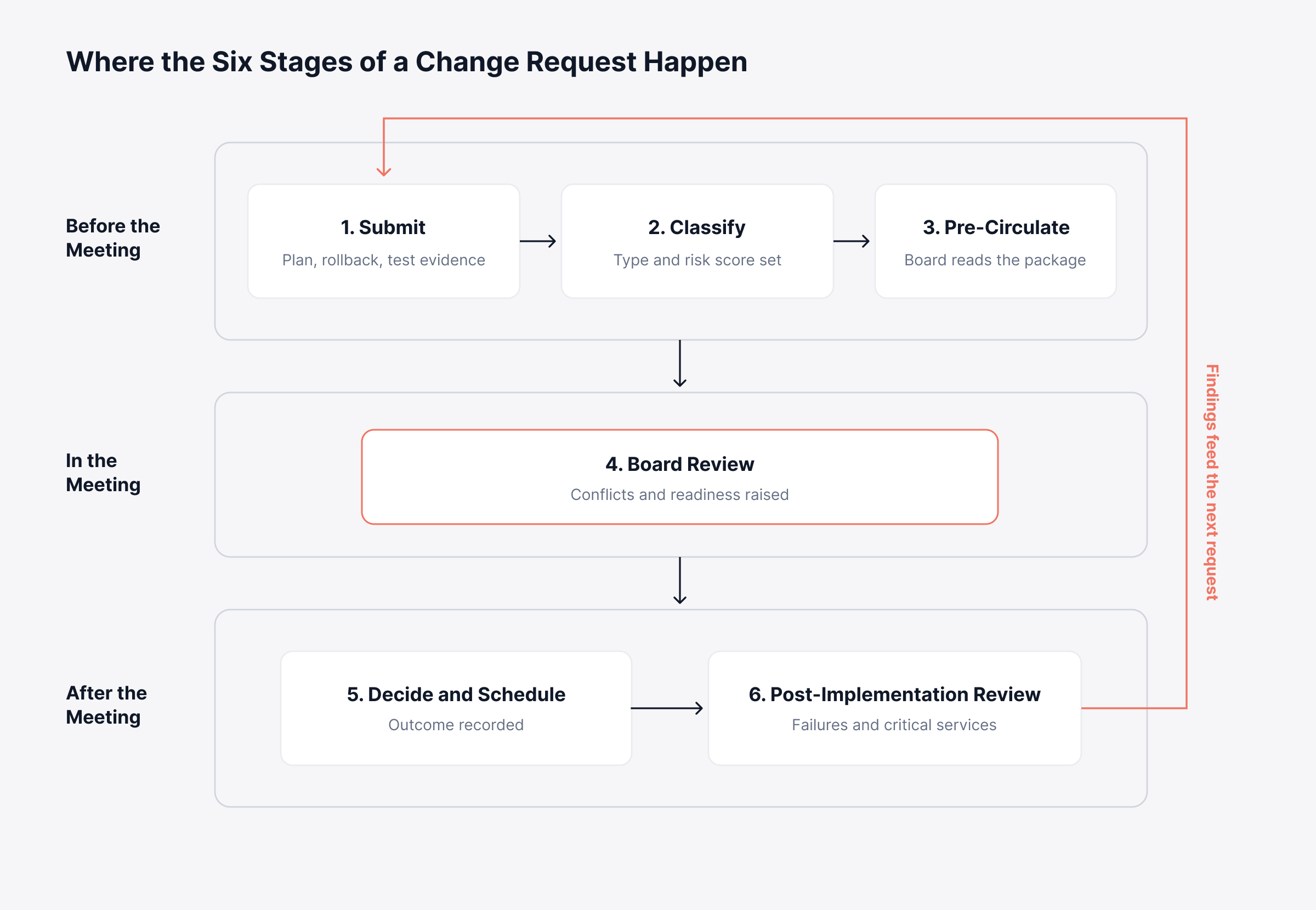
The CAB process moves a change through six stages, and only one of them happens in the meeting itself. Work done before the meeting determines whether the meeting is short.
Request submission: The requester files the change through the IT ticketing system with scope, justification, implementation plan, backout plan, and test evidence
Classification: The change manager assigns a type and a risk score, which decides the route
Pre-circulation: The board receives the full change package with enough lead time to read it
Board review: Members raise conflicts, dependencies, and readiness gaps against the pre-read
Decision and scheduling: The change manager records the outcome and places the change in the forward schedule
Post-implementation review: Failed changes and changes touching critical services return to the board with findings
Stage three is where most CABs break down. A board reading the change package for the first time in the meeting cannot do anything except defer or wave it through, and both outcomes damage the board's credibility.
Treat the meeting as one stage among six instead of the whole process, and the agenda shortens on its own. The diagram below groups the stages by where they happen, and shows how review findings return to the front of the next request.
What Happens in a CAB Meeting?
A CAB meeting reviews the changes queued since the last session, resolves scheduling conflicts between them, and issues a decision on each one. It runs to a fixed agenda and a fixed length, because an open-ended meeting attracts material that belongs elsewhere.
Weekly works for most organizations at a normal delivery pace. Teams shipping continuously move to shorter sessions held two or three times a week, which keeps the queue small enough that nothing waits long for a slot.
A Standing Agenda That Fits One Hour
The most useful change advisory board template is a time-boxed agenda that every member can predict. Sixty minutes divides well across four segments.
Review of the last cycle (5 minutes): Changes implemented, changes that failed, changes still open
Emergency changes already executed (10 minutes): Retrospective approval and documentation check
New change requests (40 minutes): The queue, worked in risk order
Forward schedule (5 minutes): Conflicts, freeze periods, and next-cycle sequencing
Put the largest block against new requests and work them in risk order, so that if the session overruns, it overruns on the items that matter least.
The Five Decisions a Change Advisory Board Can Issue
Giving the board a fixed set of outcomes stops one change from coming back for review twice more. Each decision names an owner and a next step.
Approved: Proceeds as submitted, into the forward schedule
Approved with conditions: Proceeds once named conditions are met, verified by the change manager without returning to the board
Deferred: Returns to a future session with specific missing information named in the record
Rejected: Does not proceed in its current form, with the reason recorded
Reclassified as standard: Recurs often enough and carries a known rollback, so it moves into the pre-approved catalog and never returns
Consider a retailer that routes every price-display update through the weekly board. The change has never failed, the rollback is a single revert, and the review adds five days to work the merchandising team needs inside the same week. Reclassifying it as standard gives that time back to both sides.
The fifth outcome is the one that shrinks the board's workload over time. A board that never reclassifies anything will see its agenda grow every quarter. All five outcomes assume the change arrived carrying a risk rating the room trusts, which is what the scoring model provides.
How Do You Score Change Risk to Decide the Approval Route?
Scoring change risk on a few fixed factors means the route comes from a number instead of an argument. Score four factors from one to three each and the total runs from four to twelve, which is quick to work out and still separates a routine change from a risky one.
The four factors:
Blast radius: How many business services the change touches, from one contained service to a shared platform
Reversibility: How quickly the change can be backed out, from minutes to a restore from backup
Change history: Whether this change type has failed before in this environment
Timing: Whether the window overlaps a protected business period such as month-end close
How the total routes:
Score | Route | Approver |
4 to 5 | Standard change | Automatic on submission |
6 to 8 | Normal, peer review | Technical peer plus change manager |
9 to 12 | Normal, full board | Change advisory board |
Any score during an active outage or open security exposure | Emergency | ECAB |
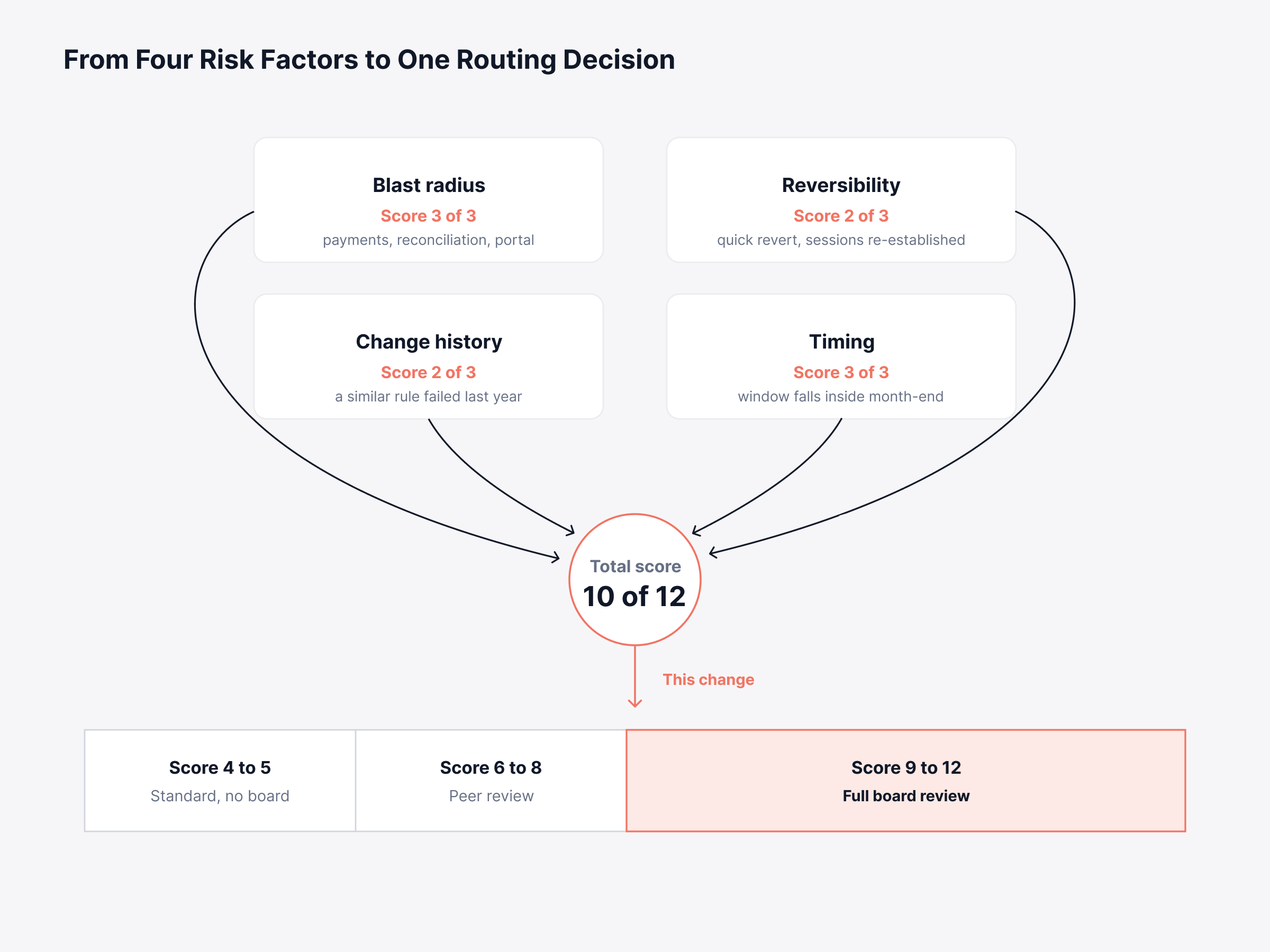
Take a firewall rule change on a payment gateway as a worked example. Blast radius scores three because payments, reconciliation, and the customer portal all depend on it, reversibility scores two because the rule reverts quickly but sessions have to be re-established, history scores two because a similar rule caused an outage last year, and timing scores three because the window falls inside month-end. A total score of ten falls inside the nine to twelve band, which routes the change to the full board without anyone needing to argue the case.
Publish the scoring model so requesters can predict their own route before they submit, which removes most of the back-and-forth at intake. The walkthrough below carries the firewall example through to the band its total lands in.
A scoring model also gives the board something to calibrate against over time. When a change scored six causes an incident, the scoring gets adjusted, so the model gets more accurate every time it is wrong. A process based only on discussion leaves nothing to correct, which is why scoring turns change governance into IT risk management.
When Should an Emergency Change Advisory Board Take Over?
An emergency change advisory board takes over when service restoration or an active security exposure cannot wait for the next scheduled session. The ECAB in ITIL 4 is a smaller standing subset of the full board, convened on demand, with authority to approve immediately and document afterward.
The role of the emergency change advisory board is to make sure someone can approve a change immediately, without waiting for the next scheduled session. Membership is deliberately thin, and three people, typically the change manager or a delegated deputy, the owner of the affected service, and a security representative, can reach a decision in the time a full board takes to assemble.
What an ECAB decision requires:
Quorum of two: Including the change manager or a named delegate, so an unreachable chair never blocks a restoration
A stated rollback: Even under time pressure, the path back has to be named before approval
A time-boxed decision: A short fixed window, after which the service owner proceeds under recorded personal authority
Retrospective documentation: Full change record completed within one working day
Every emergency change returns to the next full CAB meeting for retrospective review. That review is where the organization learns whether the change was genuinely an emergency or whether it was normal work that missed a deadline. A rising share of emergency changes usually means the normal route has become too slow and teams are using the emergency path to get around it, which shows up in incident management data first.
What Should the Change Record Contain for Audit?
A change record has to let someone reconstruct the decision months later without talking to anyone who was in the room. Auditors and incident reviewers both work from that written record, and a missing field costs far more to explain during an audit than it costs to fill in during the meeting.
Fields the record must carry:
Requester and service owner: Named individuals, not team aliases
Business justification: What the change achieves, in terms a non-technical reviewer follows
Risk score and factor breakdown: The number and the reasoning behind each factor
Implementation and backout plans: Both, with the backout plan tested where practical
Attendance and decision: Who was present, what was decided, which of the five outcomes applied
Conditions attached: Named conditions, their owner, and evidence they were met
Implementation result: Success, partial, or failed, with linked incidents where applicable
Systems that maintain an audit log automatically remove most of the effort here, because the decision trail builds itself as the change moves through its states. Manual minute-taking reliably loses the conditions attached to conditional approvals, which is the field auditors ask about most. A complete record is also what lets an organization defend the opposite decision, which is sending a change through without board review at all.
When Should You Skip the Change Advisory Board Entirely?
Skip the board when the change carries a documented rollback, affects one service, and has run successfully enough times that its failure mode is known. Governance is meant to be proportionate, and applying board review to work that has never failed produces delay without reducing risk.
Conditions under which board review adds nothing:
Catalog work: The change exists in the standard change catalog with a tested procedure
Single-service scope: Failure is contained and visible to one owner
Automated rollback: The deployment pipeline reverts without human intervention
Established history: The change type has a clean record across a meaningful number of executions
No regulatory trigger: Nothing in the change touches a control an auditor tests
Organizations running continuous delivery often replace board review for the low and middle bands with automated policy checks and named peer approvers, keeping the board for the high band only. That model works when the release management pipeline has real test gates. Without them, the automated checks approve changes nobody has examined.
CAB change management stays worth running for changes that cross service boundaries, changes inside regulated systems, and changes whose rollback depends on a restore. Highly regulated environments may have no discretion here at all, because the review itself is the control an auditor tests. Whichever balance an organization lands on, the numbers below show whether it is the right one.
Which Metrics Show Whether a Change Advisory Board Is Working?
Five metrics separate a board that manages risk from one that records approvals. Each one should be reviewed against its own trend instead of an industry figure, because the starting point varies enormously by sector. Together they answer the question an executive sponsor asks, which is whether the time spent on governance is preventing anything.
Change failure rate: Share of implemented changes causing an incident or requiring rollback, tracked separately for board-reviewed and non-reviewed changes
Emergency change ratio: Share of all changes routed through the ECAB, where a rising trend points at a normal route that has become too slow
Approval lead time: Elapsed time from submission to decision, measured separately for each route
Standard change ratio: Share of total changes handled by the pre-approved catalog, which should rise as the board reclassifies recurring work
Deferral rate: Share of agenda items returned for missing information, where a high figure points at intake quality instead of at the board
The most telling comparison is the first one. If board-reviewed changes fail at roughly the same rate as changes that skipped the board, the review is not doing what it was set up to do, and the scoring model or the pre-read discipline needs attention. Read these next to your incident management metrics to see how many incidents start as changes, and the wider set of change management practices covers the habits behind each number.
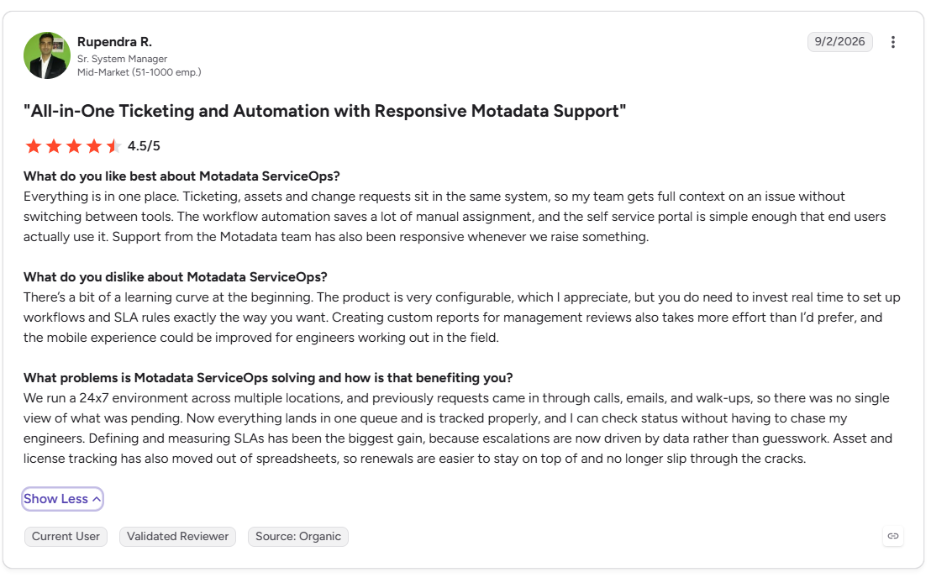
This is what one of our clients says about Motadata ServiceOps on G2.
Where Motadata ServiceOps Fits Into CAB Operations
Motadata ServiceOps handles change management inside the same platform that carries incidents, problems, releases, and the configuration record, so the board reviews a change against current dependency data instead of a form someone filled in days earlier.
What that means in practice:
Multi-level approvals: Approval chains configured per change type, with pending, approved, rejected, and ignored states recorded against each step
Impact analysis on the CMDB: Simulate a change against a configuration item to see every affected CI and business service before the board meets, which feeds the blast radius score directly
Workflow automation: Route by change type and risk without manual triage at intake, so standard changes clear automatically and high-risk changes reach the board
Delegated approval authority: Reassign approval rights during leave, so quorum survives absence
Audit trails and role-based access: Every state transition recorded against a named user
Custom reports and dashboards: Track change failure rate, emergency ratio, and lead time without exporting to a spreadsheet
Linking change to incident and problem records in one system also shortens post-implementation review, because the incident raised after a failed change is already attached to it. The same ITSM workflows carry the release and the change, which removes the reconciliation step between two tools.
Send Only High-Risk Changes to the Board with Motadata ServiceOps
No change process removes risk from production, and any organization that routes enough work around its board will eventually approve something it should have questioned. What a well-run CAB does is concentrate scrutiny where failure would be expensive and get out of the way everywhere else.
That shift depends on a written scoring model that decides the route, a standing agenda that keeps the board inside an hour, and a change record complete enough to survive an audit. Motadata ServiceOps supplies the routing, the dependency data, and the decision trail in one platform, so the board spends its hour on the changes that warrant it. The organizations that get the most from change governance keep shrinking the board's agenda on purpose, moving proven work into the standard catalog cycle after cycle.
FAQs
What is a change advisory board in simple terms?
A change advisory board is a group of people from across IT and the business who review proposed changes before they go live. They assess risk, flag conflicts, and advise the change manager, who makes the final approval decision.
What is the role of the emergency change advisory board?
The emergency change advisory board approves urgent changes that restore service or close an active security exposure, using a small membership convened on demand. It differs from a standard CAB, which meets on a fixed schedule, because the full documentation is completed after the change instead of before approval.
How often should a CAB meeting be held?
Weekly suits most organizations working at a normal delivery pace. Teams releasing continuously often meet two or three times a week with shorter sessions, which keeps the queue small and stops changes waiting several days for a review slot.
Does a standard change need CAB approval?
No. A standard change is pre-approved because it is repeatable, low risk, and carries a documented rollback. Platforms such as Motadata ServiceOps hold these in a pre-approved catalog so they clear on submission, keeping board time for the changes that carry higher exposure.
Can change advisory board approvals be automated?
Approval routing can be automated by change type and risk score, which is how platforms like Motadata ServiceOps clear low-risk work without a meeting. The judgment on high-risk changes stays with people, since that is the part a board exists to provide.
Author
Poonam Lalani
Content Strategist
Poonam Lalani is a B2B content strategist and writer with a background in computer engineering and experience across enterprise technology domains, including AI, cloud, DevOps, data engineering, and IT operations. She specializes in creating research-driven content that simplifies complex ideas and supports product education, thought leadership, and business growth.