10 Top DNS Monitoring Tools for Faster Outage Detection and Internal Zone Coverage
Which layer gets checked first when an application stops loading for half your users and every server reports healthy? DNS is usually the last place anyone looks, and often the place the fault lives.
A resolution failure looks identical to an application outage from the service desk. Tickets stack up against the application owners, the application owners find nothing wrong, and the first half hour goes to proving which layer actually broke. The checkout page, the VPN login and the internal file share are all down for the same reason, and nobody has connected them yet.
The expensive part is rarely the outage. It is the time spent locating it, the service credits that follow, and the customers who tried once and went elsewhere. Persistent network downtime traced back to name resolution is one of the more avoidable line items on that list, because a check running every sixty seconds can name the failing name server before the first ticket arrives.
That is what a DNS monitoring tool buys you: a shorter path from symptom to cause on the layer everything else depends on.
The problem: Resolution failures read as application outages
What we compare: Record coverage, DNSSEC validation, check locations, alert routing
Deployment: Hosted checks against internal and Active Directory zone visibility
Verified pricing: Every figure read from the vendor's own live table
The free question: Where a no-cost monitor is genuinely enough
Ten tools, scored on what each one can see, where it can run, and what it costs at working scale.
Our Top Three Picks at a Glance
Three DNS monitoring tools cover most buying situations, and which one fits depends on whether your zones are public, private or both.
Best for consolidating DNS with the infrastructure behind it: Motadata ObserveOps. DNS checks, resolver host health and network path all report into one observability platform, and an alert can open a ticket instead of an email
Best for dedicated DNS depth: Site24x7. Record validation, DNSSEC checks and a large location network, priced for mid-market budgets
Best free starting point: HetrixTools. Nameserver change detection and domain expiry monitoring at no cost, with one-minute checks on the free plan
Those three sit in different parts of the category, so it helps to know what separates them before comparing prices.
What Are DNS Monitoring Tools?
DNS monitoring tools query your domain's name servers on a schedule and alert you when resolution fails, slows down or returns an answer you did not publish. They watch the layer that turns a hostname into an address, which every other service depends on. That places DNS firmly inside the same observability remit as your servers, applications and network paths.
DNS monitoring software splits into four groups, and the split matters more than any feature list. Understanding where a tool comes from tells you what it will miss.
Hosted synthetic checkers: A DNS monitoring service that queries your domains from distributed vantage points on the public internet. Strong on record validation, DNSSEC and propagation, and they report resolution latency per location. Blind to anything behind your firewall
Uptime platforms with a DNS check type: Add DNS to an existing website and SSL monitoring subscription. Fast to configure and cheap. Shallow on record types and diagnostics
Internet performance platforms: Trace the full resolution path and correlate it with routing and network conditions. Built for large network operations groups and priced accordingly
Infrastructure monitoring platforms: Treat DNS as one service check among many, alongside servers, interfaces and the other network protocols already being watched. Weaker as a standalone DNS product, stronger at telling you which component broke
Most buyers arrive believing they need the first group. A good proportion of them are running internal Active Directory zones that a hosted checker cannot reach, which puts them in the fourth. Reading the network monitoring basics first helps clarify which situation applies.
How Does DNS Monitoring Work?
DNS monitoring works by sending scheduled queries to your name servers and comparing what comes back against what you expect to see.
Query: The tool asks a name server to resolve a hostname, from one location or many
Compare: The answer is checked against the record values you published, so a changed answer registers as an event
Time: Response time is recorded per location, which is how regional slowdowns become visible
Alert: A failure, a slow answer or an unexpected record triggers a notification through your chosen channels
Every tool in this comparison performs those four steps. What separates them is which records they can ask about, where they are allowed to ask from, and what happens once the alert fires.
Why Does DNS Monitoring Matter to the Business?
DNS monitoring matters commercially because name resolution is the single dependency shared by revenue systems, staff productivity tools and customer-facing applications alike.
Three costs sit behind that dependency, and none of them appear on a technical dashboard.
Revenue interruption: When a storefront, booking engine or payment endpoint stops resolving, the transaction does not fail gracefully. It never starts, and the customer usually goes to a competitor instead of retrying
Contractual exposure: Availability commitments rarely carve out name resolution. A resolution outage counts against the same uptime number your customers hold you to, and an SLA penalty follows the shortfall regardless of which layer caused it
Engineering hours: The most expensive part of a DNS incident is the search. Several people from several groups spend the first stretch of the outage proving the fault is not theirs, and that time is billed to the business whether or not anything gets fixed
Those three costs are why DNS belongs inside the observability picture instead of standing alone as a checkbox, and why the importance of network monitoring is usually argued in commercial terms before technical ones.
How We Evaluated These DNS Monitoring Tools
We scored every DNS monitoring tool on five factors, weighted toward the ones that change what an outage costs you.
Record and DNSSEC coverage (25%): Which record types the tool queries, and whether DNSSEC monitoring validates the full signing chain or only alerts on changes to DNSSEC-related records
Check frequency and location count (20%): How fast a failure surfaces, and whether DNS performance monitoring can separate a global outage from a regional propagation problem
Public and internal zone reach (25%): Whether the tool can query private or Active Directory zones, and what deployment options make that possible. Coverage gaps here are what stop an organization reaching five nines uptime on paper and in practice
Alert routing and escalation (15%): Where the alert lands, which channels are supported, and whether the tool can hand off into an incident or ticketing workflow. Routing is what turns a low MTTD into a short outage
Total cost at realistic scale (15%): What the bill looks like at a working configuration instead of at the entry tier
Weighting detection alongside response is deliberate, since the split between monitoring and alerting decides whether a fast check produces a fast fix.
What we did not test: We did not run each platform against a production zone for a full quarter, and we did not measure detection latency under controlled failure conditions. Pricing changes often, so confirm current rates on the vendor's own page before you commit to anything. Where a vendor publishes no rate card, we say so instead of estimating. Those five factors produce the shortlist below.
Quick-Glance Comparison of DNS Monitoring Tools
The table below compares all ten DNS monitoring tools on what they check, where they run and what they cost at the entry tier.
Tool | Best for | What it checks | Where it runs | Entry pricing | G2 |
Motadata ObserveOps | DNS alongside servers, network and services in one platform | DNS, domain, SSL, ping, port, URL, NTP, FTP, email, plus full infrastructure | On-premises, cloud or hybrid | Quote based | 4.7/5 |
Site24x7 | Dedicated DNS depth on a mid-market budget | DNS records, DNSSEC, propagation, uptime, servers | SaaS | $9 per month billed annually | 4.6/5 |
Dotcom-Monitor | Authoritative-path DNS diagnostics | DNS, DNSBL, SSL, ports, ICMP, FTP, SIP | SaaS, with private agents | $40 per month | 4.5/5 |
UptimeRobot | Adding DNS to existing uptime monitoring | DNS, HTTP, port, ping, keyword, API, SSL, domain expiry | SaaS | Free, paid from $12 per month annually | 4.7/5 |
ThousandEyes | Correlating DNS with internet and routing conditions | DNS server, DNS trace, DNSSEC, BGP, network path, HTTP | SaaS, with enterprise agents | Quote based | 4.5/5 |
Paessler PRTG | Internal and Active Directory DNS zones | DNS sensor, plus network, server and application sensors | On-premises or hosted | Free to 100 sensors, paid from $200 per month annually | 4.7/5 |
Datadog | DNS inside an existing observability deployment | Synthetic DNS tests, network DNS metrics, full stack | SaaS | Free to 5 hosts, Pro from $15 per host monthly annually | 4.4/5 |
SolarWinds Observability | Server-side DNS service health | DNS service status, server and application health | SaaS | From $8 per node per month | 4.3/5 |
Nagios XI | Self-managed DNS checks with an open-source path | DNS via check plugins, plus host and service checks | On-premises | Free to 7 nodes, paid from $2,595 perpetual | 4.5/5 |
HetrixTools | Free nameserver change and expiry monitoring | Nameserver changes, domain expiry, SSL, uptime | SaaS | Free for life, paid from $9.95 per month | Not available |
The rows differ most in the deployment column, which is usually the constraint that decides the purchase.
Top 10 DNS Monitoring Tools Compared
Each DNS monitoring tool below is reviewed on what it covers, what it costs and where it stops being the right fit.
1. Motadata ObserveOps
Best for: Organizations that want DNS resolution watched alongside the servers, interfaces and services behind it
Rating:
G2 - 4.7/5
Gartner Peer Insights - 4.6/5
Capterra - 4.7/5
This is our own platform, so read the considerations below with that in mind. ObserveOps handles DNS as one of ten service check types, alongside domain, SSL certificate, ping, port, URL, NTP, RADIUS, FTP and email checks.
What separates it from a dedicated DNS checker is what happens after the check fails. The same platform is already watching the resolver host, the interface it connects through and the network path in between, so the alert arrives with the surrounding context attached.
It deploys on-premises, in the cloud or across both, which means internal and Active Directory zones are visible to the same monitoring layer that watches your public domains. Correlation groups related alerts before anyone gets paged.
Pros
- One platform covers DNS, servers, network devices, cloud resources and applications
- Alerts can become tickets automatically instead of stopping at an email
- Deployment choice suits regulated environments where data cannot leave the premises
- OpenTelemetry-native ingestion, so existing instrumentation carries across
Cons
- Pricing is quote based, so budgeting needs a scoping conversation up front
- Strongest where DNS is one of several layers being consolidated, and less differentiated for a single-domain buyer
- Deployment mode is a decision to make at the start, since on-premises and cloud are both offered
- Buyers who only want DNS checks will find more capability here than the use case calls for
Pricing:
Licensing: Quote based, scoped to the environment and the deployment mode
Trial: A 30-day free trial is available
2. Site24x7
Best for: Mid-market IT operations groups that want dedicated DNS monitoring depth without an enterprise contract
Rating:
G2 - 4.6/5
Gartner Peer Insights - 4.5/5
Capterra - 4.7/5
Site24x7 built its DNS monitoring around record validation and a large network of check locations. It queries name servers directly, compares the answers against what you expect to see, and validates the DNSSEC chain instead of only watching for record changes.
The platform integrates with managed DNS providers including Route 53, Azure DNS and Google Cloud DNS, which matters when your zones live with a cloud provider. Root cause analysis runs on failures automatically.
One caution worth knowing before you buy: A banner on the vendor's site confirms that Site24x7 Observability has become OpManager Nexus, with website and digital experience monitoring continuing under the Site24x7 name.
Pros
- Genuine DNS depth at a price most mid-market budgets absorb
- Large check location network makes regional propagation problems visible
- Free forever plan covers uptime monitoring for up to 50 resources
- Annual billing takes roughly ten percent off the monthly rate
Cons
- Anomaly detection, forecasting and event correlation are gated to the Enterprise tier
- The OpManager Nexus rebrand makes it harder to confirm which product a quote covers
- Monitor allocations are split across basic, host and advanced types, which complicates sizing
- Private and internal zones need workarounds that hosted checks handle poorly
Pricing:
Lite: $10 per month, or $9 paid annually, covering two servers and five websites
Professional: $49 per month, or $42 paid annually, covering five servers, one application and 20 websites
Enterprise: From $625 per month paid annually
Free forever: Uptime monitoring for up to 50 resources
Trial: 30 days
Billing basis: Per plan by monitor type and allocation, with add-ons for host monitors, network components and synthetic runs
3. Dotcom-Monitor
Best for: Teams that need authoritative name server queries and detailed DNS diagnostics
Rating:
G2 - 4.5/5
Capterra - 4.5/5
Dotcom-Monitor queries authoritative name servers directly, so what you see is what the servers are publishing at that moment, ahead of any resolver cache. That distinction matters for DNS propagation monitoring, since cached answers can hide a bad change for hours.
DNS monitoring lives inside the Internet Infrastructure platform, alongside port, SSL, ICMP, FTP and SIP checks. DNS blacklist monitoring is a separate product for teams protecting email deliverability.
Private Agents let you run checks from inside your own network, which extends coverage to internal zones that hosted checkers cannot reach. Pricing is fixed per configuration, so the monthly bill does not move with check volume.
Pros
- Authoritative queries surface problems that cache-based checks miss
- Fixed pricing makes the monthly cost predictable at any check frequency
- Private Agents extend the same platform to internal zones
- Free forever plan covers up to 25 targets at five-minute checks
Cons
- Check frequency is the dominant cost factor, and one-minute checks multiply the bill sharply
- The five-platform structure means DNS buyers may need more than one subscription
- Free plan is limited to two check locations and seven days of retention
- Premium Locations and other add-ons are charged as a percentage of the package price, which complicates budgeting
Pricing:
Internet Infrastructure (ServerView): From $40.00 per month for 5 targets at 15-minute checks
Same 5 targets at one-minute checks: $175.00 per month
100 targets at 15-minute checks: $139.99 per month
Free forever: 25 targets, five-minute checks, two locations, seven-day retention
Trial: 30 days, no card required
Billing basis: Fixed monthly rate set by platform, target count and check frequency. Premium Locations add 25 percent
4. UptimeRobot
Best for: Teams already running uptime and SSL monitoring who want DNS added to the same dashboard
Rating:
G2 - 4.7/5
Gartner Peer Insights - 4.7/5
Capterra - 4.8/5
UptimeRobot treats DNS uptime monitoring as one monitor type among many, next to HTTP, port, ping, keyword, API and SSL checks. Setup takes minutes, and DNS record change monitoring fires alerts independently of resolution failures.
The free plan is the reason most people find it. Fifty monitors at five-minute intervals, with DNS, SSL and domain expiry checks included and no card required, covers a surprising amount of ground for small deployments.
Paid tiers buy check frequency more than monitor count. The entry paid plan actually includes fewer monitors than the free one, since what you are paying for is the drop from five minutes to sixty seconds.
Pros
- One of the strongest free tiers in the category, with DNS checks included
- Simple enough to configure without reading documentation
- Check intervals reach 15 seconds on the top self-serve tier
- Machine-readable pricing published, which makes budgeting straightforward
Cons
- No DNSSEC chain validation, only alerts on DNSSEC-related record changes
- Login seats bill separately at $15 to $19 per person per month
- No free trial on paid plans, though a 14-day money-back guarantee applies
- Hosted checks only, so internal zones stay invisible
Pricing:
Free: 50 monitors at five-minute intervals, no card required
Solo: $13 per month, or $12 per month billed annually, 10 monitors at 60-second intervals
Team: $46 per month, or $39 per month billed annually, 100 monitors at 30-second intervals, three seats
Scale: $98 per month, or $79 per month billed annually, 200 monitors at 15-second intervals, five seats
Trial: No trial. A 14-day money-back guarantee applies to new subscriptions
Billing basis: Per plan by monitor count and check interval, with seats charged separately
5. ThousandEyes
Best for: Large network operations groups correlating DNS behavior with internet routing and path conditions
Rating:
G2 - 4.5/5
Capterra - 4.6/5
ThousandEyes approaches DNS as one signal inside a broader picture of internet performance. Its DNS server and DNS trace tests run alongside BGP route monitoring and network path visualization, which lets you see whether a resolution problem originates with your provider, an upstream network or your own configuration.
DNSSEC validation and multi-protocol testing across HTTP, FTP, SIP and RTP come as part of the platform. Cloud Agents cover public vantage points and Enterprise Agents run inside your own network.
The commercial model is the barrier for smaller buyers. Licensing runs on a consumption pool of test units, where test type, agent type and frequency all draw down the same pool.
Pros
- The strongest correlation between DNS behavior and internet routing conditions available
- Enterprise Agents bring internal resolvers into the same view as public checks
- Endpoint coverage answers whether a DNS problem is local to one office
- Multi-protocol testing removes the need for separate synthetic tools
Cons
- No published rate card, so cost visibility requires a sales conversation
- Unit consumption makes spend hard to forecast as test frequency rises
- A minimum annual commitment puts it out of reach for small deployments
- More platform than a team monitoring a handful of public domains needs
Pricing:
Licensing: Annual subscription priced on a consumption pool of test units. Unit draw varies by test type, agent type and check frequency
Cloud Agent tests consume roughly twice the units of the equivalent Enterprise Agent test
Endpoint Agents license per agent instance instead of drawing on units
No public rate card is published. Every configuration is quoted
6. Paessler PRTG
Best for: Organizations monitoring internal, private or Active Directory DNS zones on their own hardware
Rating:
G2 - 4.7/5
Gartner Peer Insights - 4.5/5
Capterra - 4.6/5
PRTG runs on your own infrastructure, which solves the problem hosted checkers cannot. Its DNS sensor queries internal resolvers directly and reports response time and answer validity for zones that never touch the public internet.
The sensor model is what makes PRTG both flexible and awkward to price. Every check consumes a sensor, and a DNS sensor counts the same as a bandwidth sensor or a disk sensor.
That works well when DNS is one item on a long monitoring list. It works poorly if DNS is the only thing you need, since you pay for sensor capacity you will not use.
Pros
- Internal and Active Directory zones are visible without workarounds
- Freeware tier permanently covers 100 sensors, enough for a small deployment
- One tool covers DNS alongside the rest of the network infrastructure
- Trial runs 30 days with no sensor limit
Cons
- Sensor counting makes cost planning harder as the deployment grows
- Licenses cannot be combined on a single server, which complicates scaling
- Licensing moved from perpetual to subscription, so older cost assumptions no longer apply
- No DNSSEC chain validation in the standard DNS sensor
Pricing:
PRTG 500: $200 per month paid annually, 500 sensors or roughly 50 devices
PRTG 1000: $358 per month paid annually, roughly 100 devices
PRTG 2500: $742 per month paid annually, roughly 250 devices
PRTG 5000: $1,300 per month paid annually, roughly 500 devices
Freeware: 100 sensors, permanent
Trial: 30 days, no sensor limit
Billing basis: Per sensor bundle, billed annually
7. Datadog
Best for: Engineering organizations already running Datadog who want DNS folded into existing dashboards
Rating:
G2 - 4.4/5
Gartner Peer Insights - 4.7/5
Capterra - 4.6/5
If Datadog is already deployed, adding DNS visibility means turning on synthetic DNS tests and DNS metrics inside network monitoring. Resolution data lands in the same dashboards as your traces, logs and infrastructure metrics.
The correlation is the argument. A DNS resolution spike shows up next to the service latency it caused, which shortens the path from symptom to cause considerably.
Cost is the counter-argument. Every Datadog product meters separately, and synthetic tests bill on their own meter on top of per-host infrastructure charges. Our breakdown of Datadog pricing covers how those meters stack.
Pros
- Strongest correlation between DNS problems and downstream application impact
- Private locations extend synthetic tests inside the network perimeter
- Free tier covers up to five hosts for evaluation
- Enormous integration catalog covers most of what you already run
Cons
- Each product meters separately, so the bill assembles from several lines
- Synthetic test volume becomes a meaningful cost at high check frequency
- Poor fit for a buyer who wants DNS monitoring alone
- Custom metrics and containers beyond the per-host allotment bill on top
Pricing:
Free: Up to 5 hosts with one-day metric retention
Pro: From $15 per host per month billed annually, $18 on-demand
Enterprise: From $23 per host per month billed annually, $27 on-demand
Synthetic monitoring: Metered separately from infrastructure hosts
Billing basis: Per host per month for infrastructure, with separate meters for synthetics, logs and custom metrics
8. SolarWinds Observability
Best for: Windows-centric environments watching DNS as a server-side service alongside application health
Rating:
G2 - 4.3/5
Gartner Peer Insights - 4.3/5
SolarWinds approaches DNS server monitoring from the inside. Instead of querying your domains externally, it watches the DNS service running on your own infrastructure and reports its health, resource consumption and response behavior.
That framing suits organizations running their own DNS on Windows Server, where the question is usually whether the service itself is degraded. It reports alongside the rest of the application and server stack.
Buyers should know that SolarWinds has consolidated several legacy products into the Observability platform, and older DNS monitoring documentation points at the previous Server and Application Monitor product.
Pros
- Well-suited to environments running self-managed DNS on Windows Server
- Node-based pricing is simpler to forecast than consumption models
- Fully functional 30-day trial with no feature gating
- Consolidated platform covers infrastructure, applications and logs
Cons
- Server-side focus means external resolution and propagation go unwatched
- No DNSSEC validation as part of the standard DNS coverage
- Multi-year contracts are the norm, with annual billing and subscription only
- Product consolidation makes older documentation unreliable
Pricing:
Essentials: From $8 per node per month
Advanced: From $14 per node per month
Premier: From $17.50 per node per month
Contract terms: Multi-year contracts, billed annually, subscription only
Trial: 30 days, fully functional
Billing basis: Per node per month, with value-based node counting at Premier only
9. Nagios XI
Best for: Teams comfortable running their own monitoring who want DNS checks with an open-source path underneath
Rating:
G2 - 4.5/5
Gartner Peer Insights - 4.3/5
Capterra - 4.5/5
Nagios handles DNS through check plugins, which is both its strength and its cost. The DNS check queries a resolver, validates the answer against an expected value and reports the response time, and you can extend it with anything you can write.
Nagios XI adds a web interface, dashboards, reporting and configuration wizards over the open-source engine. Nagios Core remains free for teams willing to configure everything in text files.
Licensing is perpetual and priced per node, with annual maintenance after the first year. That model appeals to organizations that would prefer a capital purchase over a subscription.
Pros
- Perpetual licensing suits budgets that prefer capital purchases
- Plugin architecture means almost any check can be built
- Runs entirely on your own infrastructure, so internal zones are reachable
- Large community with plugins for most scenarios already written
Cons
- Configuration and maintenance consume meaningful engineering time
- The interface feels dated next to modern SaaS platforms
- Log Server, Network Analyzer and Fusion are separate products with separate licenses
- No DNSSEC validation without building it yourself
Pricing:
Standard: Perpetual from $2,595 for 100 nodes, rising to $14,995 for 1,000 nodes
Enterprise: Perpetual from $4,690 for 100 nodes, $17,090 for 1,000 nodes
Free: 7 nodes or 100 services
Trial: 30 days
Billing basis: Perpetual per node, where a node is any unique IP or URL. Maintenance renewed annually after year one
10. HetrixTools
Best for: Small deployments that need nameserver change alerts and domain expiry monitoring at no cost
HetrixTools solves one specific DNS problem well and charges nothing for it. Nameserver change detection alerts you when your domain's name servers change, which is the signal that matters most when a domain or its DNS configuration has been hijacked.
Domain expiry monitoring and SSL authenticity checks come with it, on every tier including the free one. Checks run at one-minute frequency even on the free plan, which is unusual in this category.
The scope is narrow and the vendor makes no claim otherwise. This is not record-by-record DNS query monitoring, and there is no DNSSEC validation.
Pros
- Free for life with 15 uptime monitors and 15 server monitors
- Nameserver hijack detection at no cost, which few free tools offer
- One-minute checks and unlimited uptime report history on the free plan
- Paid tiers are inexpensive by any comparison in this category
Cons
- No per-record DNS query monitoring or DNSSEC validation
- Free accounts require a login at least once every 90 days to stay active
- Four check locations on the free tier, rising to 12 at the top plan
- Hosted only, so internal zones are out of scope
Pricing:
Free: 15 uptime monitors, 15 server monitors, one-minute checks, four locations, free for life
Professional: $9.95 per month, 30 monitors, six locations
Business: $19.95 per month, 60 monitors, nine locations
Enterprise: $49.95 per month, 200 monitors, 12 locations
Annual billing: Two months free
Billing basis: Per plan by monitor count and location count. Server monitoring included at no extra cost
Ten tools is a wide field, and for a fair number of organizations the right answer is none of them.
Do You Really Need a Dedicated DNS Monitoring Tool?
Many organizations do not need a dedicated DNS monitoring tool, and plenty of buyers who start by searching for a DNS monitoring tool free of charge are right to.
If you run a handful of public domains on a managed provider, Route 53 or Cloudflare health checks plus a free uptime monitor cover the common failure modes. With no compliance obligations attached, that combination costs nothing and is enough.
Three situations change the calculation.
1. Internal and Active Directory zones: Internal DNS monitoring is the gap a hosted checker cannot fill, since it queries from the public internet.
What breaks: Authentication, file shares and internal applications, with no external alert raised
Why it goes unseen: It joins the other causes of downtime that surface late
2. DNSSEC chain validation: Watching DNSSEC records tells you something changed, and validating the chain tells you whether signed responses still verify.
What to check: The full path from the parent DS record through DNSKEY to RRSIG
Who needs it: Any organization running signed zones
3. Correlation with the infrastructure behind it: A failed check confirms resolution stopped and says nothing about the resolver host, the interface or the upstream route.
What context adds: The failing component named alongside the alert
What it saves: Diagnosis time, where most of the cost of downtime accumulates
If none of those apply, keep the free tools and spend the budget on the wider set of monitoring challenges instead. For everyone else, the questions below decide which tool survives a procurement review.
What Should You Look for in a DNS Monitoring Tool?
Six questions separate a DNS monitoring tool that will work in your environment from one that will only work in the demo.
Which record types does it query? Confirm coverage for A, AAAA, CNAME, MX, NS, SOA, TXT and SRV at minimum. Ask specifically about DS, DNSKEY and RRSIG if you run signed zones
Does it validate the DNSSEC chain or watch DNSSEC records? These are different capabilities, and vendor marketing frequently uses the same words for both
Can it query private zones? Ask how, specifically. Private agents, on-premises collectors and self-hosted deployment are the three answers that work
What is the fastest check interval on the plan you would actually buy? Entry tiers often quote a headline frequency that only applies at higher tiers
Where does the alert go? Email is a starting point, and unrouted notifications become alert noise within a week. Escalation policies, maintenance windows and a route into your incident or ticketing workflow determine whether anyone acts on it out of hours
What does the bill look like at three times your current scale? Consumption and per-check models look cheap at the entry configuration and change character quickly
Answering those six narrows the field. How you configure whichever tool you pick decides whether it earns the license fee.
What Are DNS Monitoring Best Practices?
Six DNS monitoring best practices separate a setup that catches problems from one that generates noise.
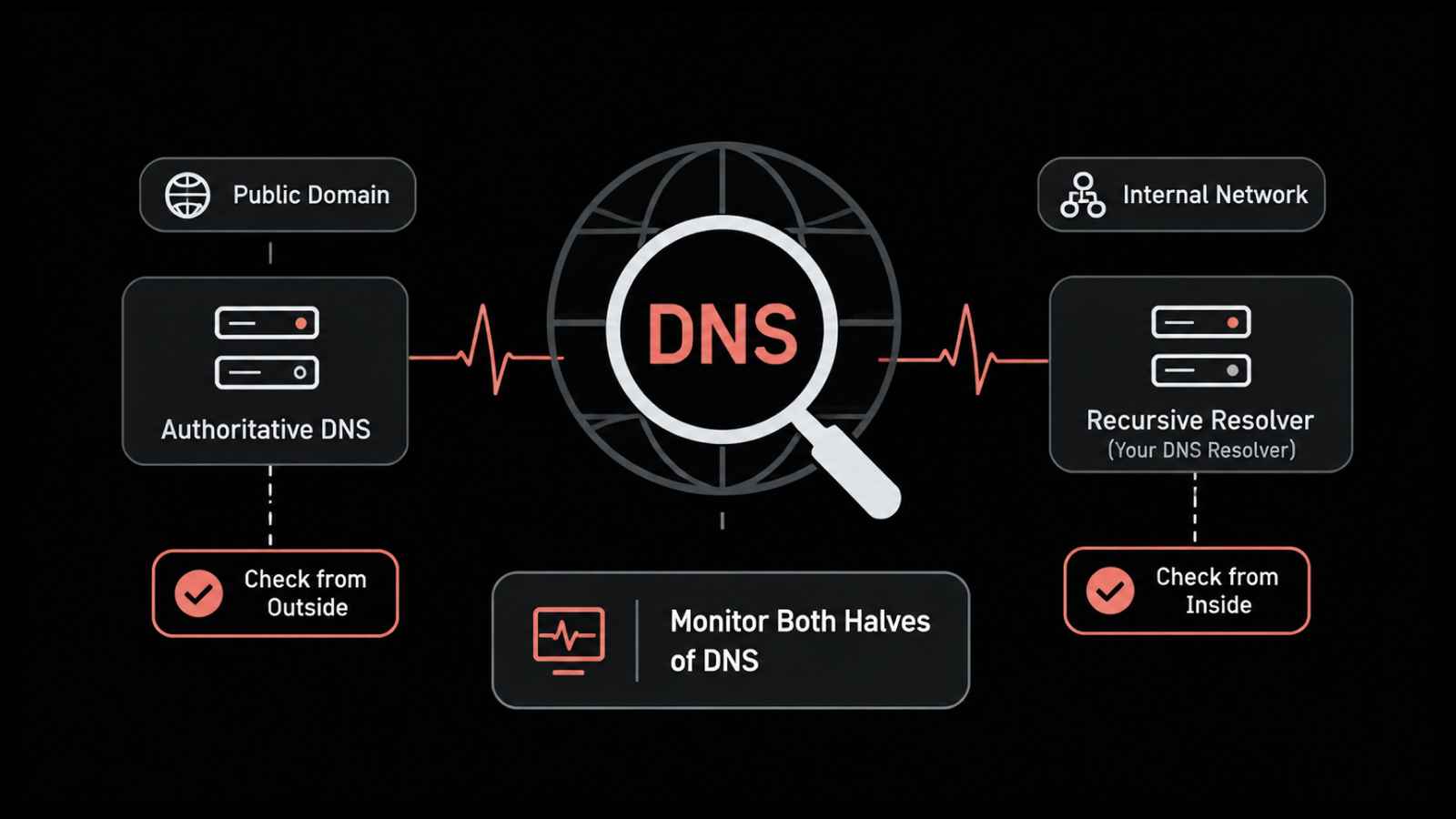
1. Monitor the Authoritative and Recursive Paths Separately
A public resolver tells you what the cache holds, and your authoritative name servers tell you what you are actually publishing.
Configure one check against a public resolver and one against each authoritative server
Alert on any mismatch between the two answers, since that gap is where propagation problems live
Keep the authoritative check running during change windows, when knowing which answer is current decides how fast the rollback happens
2. Alert on Record Changes as Well as Resolution Failures
DNS monitoring security starts here, because resolution failures are loud while an unauthorized record change routes traffic away quietly for hours.
Baseline every record that carries production traffic, including MX and TXT
Alert on any deviation, including changes made by your own people through approved channels
Review change alerts weekly so the expected ones stop looking like incidents
3. Watch TTL and Propagation Through Every Change Window
Planned DNS changes cause more outages than DNS attacks do, and the TTL decides how long a mistake lasts.
Lower the TTL well before a cutover so the old answer expires quickly
Check from several geographic locations during the change instead of assuming propagation completed
Restore the original TTL once the change has settled, to keep query volume and cost down
4. Validate the Full DNSSEC Chain End to End
Signed zones fail in ways unsigned zones never do, and an unvalidating test query will not show it.
Validate the chain from the parent DS record through DNSKEY to the RRSIG on each monitored record
Alert on signature expiry with enough lead time to re-sign before anything breaks
Confirm your monitoring tool validates the chain, since watching DNSSEC records is a different capability
5. Route DNS Alerts Into the Incident Workflow
A DNS alert landing in a shared mailbox overnight achieves nothing without an owner attached.
Send DNS failures through the same escalation path as any other production incident
Attach an on-call rotation and acknowledgement tracking so someone owns the clock
Apply the same monitoring best practices across DNS and everything else to keep response predictable
6. Keep an Internal Vantage Point for Private Zones
External checks confirm the internet can reach you and say nothing about whether your employees can resolve internal hostnames.
Run at least one monitoring agent inside each segment that depends on private DNS
Treat internal resolution failures at the same severity as public ones
Include Active Directory DNS in the same coverage, since authentication fails with it
With the practices settled, the remaining question is which platform to run them on.
How Do You Choose the Right DNS Monitoring Tool?
Choosing a DNS monitoring tool comes down to where your zones live, whether they are signed, and where you want the alert to end up.
1. If your zones are all public and hosted with a managed provider: Site24x7 and Dotcom-Monitor are the two picks worth shortlisting, with Motadata ObserveOps if the same buying decision covers your servers and network. Site24x7 gives you DNSSEC validation and a large location network at mid-market pricing. Dotcom-Monitor gives you authoritative queries and predictable fixed costs.
2. If you run internal or Active Directory zones: Motadata ObserveOps and Paessler PRTG both deploy where the zones live. ObserveOps covers public and private zones in one platform with correlation to the hosts underneath. PRTG works well where DNS is one line item on a long list of on-premises checks.
3. If you already run a monitoring platform: Datadog and ThousandEyes both add DNS to something you have already bought. The question is whether the incremental metering cost is lower than a dedicated tool, which it often is not. Our wider comparison of network monitoring software covers the same trade-off across the broader category.
4. If budget is the constraint: HetrixTools covers nameserver changes and expiry for nothing, and UptimeRobot's free tier adds resolution checks across 50 monitors. Together they cover more than most small deployments need.
Two evaluation criteria are worth adding to whichever shortlist you land on, because both change what a tool is worth once it is live.
5. Where the alert ends: Detection speed gets scored everywhere. What happens after detection rarely does. A tool that finds a resolution failure in 30 seconds and emails an unmonitored alias produces a worse outcome than one that finds it in two minutes and opens a ticket with an owner attached. Motadata built ObserveOps alongside an ITSM product for this reason, so a DNS failure can become an assigned ticket automatically.
6. Whether it can deploy where the data must live: Hosted checkers are structurally incapable of watching a zone that never leaves your network, and they are unsuitable where monitoring data cannot cross a border. Ask every vendor whether the product can run on your own infrastructure, and treat an evasive answer as a no.
Score those two alongside record coverage and check frequency, and the shortlist usually shifts. Treating network availability as a business outcome instead of a dashboard metric makes the reason clearer.
Watch Public and Internal DNS in One Place with Motadata ObserveOps
The right DNS monitoring tool depends less on feature counts than on two questions: which zones you need watched, and who acts when a check fails. Both are business questions before they are technical ones. Public domains on managed DNS are well served by the dedicated hosted checkers in this comparison, and if your environment is entirely public with no signed zones and no compliance constraints, a free tier plus your provider's health checks may be all you ever need.
That situation rarely stays static. Internal zones appear, DNSSEC gets adopted, an auditor asks where the monitoring data is stored, and the DNS alert that used to reach one engineer now needs an owner and an audit trail. Motadata ObserveOps covers DNS resolution alongside the resolver hosts, network paths and services behind it, deploys on-premises or in the cloud, and hands the alert into a ticketing workflow instead of leaving it in an inbox.
FAQs
What is the best DNS monitoring tool?
There is no single best DNS monitoring tool, because the answer depends on where your zones live. Site24x7 leads for dedicated depth on public domains, and Motadata ObserveOps fits better when internal zones and the infrastructure behind them need the same coverage.
Is there a free DNS monitoring tool that is good enough?
Yes, for small public deployments. HetrixTools covers nameserver change detection and domain expiry free for life, and UptimeRobot's free plan includes DNS checks across 50 monitors. Neither validates the DNSSEC chain or reaches internal zones, so signed or private zones need a paid option.
How does Motadata ObserveOps compare with Site24x7 for DNS monitoring?
It depends on your environment. Site24x7 offers more depth as a dedicated DNS product, with DNSSEC chain validation and a larger check location network. Motadata ObserveOps fits better when DNS is one layer among servers, network devices and applications, and when the alert needs to become a tracked ticket.
What should I check before buying a DNS monitoring tool?
Confirm which record types it queries, whether it validates the DNSSEC chain or only watches DNSSEC records, and whether it can reach private zones. Then check the fastest interval on the plan you would buy, where alerts are routed, and what the bill looks like at three times current scale.
Can DNS monitoring detect a DNS hijack?
Yes, if it watches for record and nameserver changes instead of only checking resolution. A hijacked domain often resolves perfectly well, just to the wrong address, so availability checks alone will miss it. Baseline your records and alert on any deviation from the expected values.
Author
Poonam Lalani
Content Strategist
Poonam Lalani is a B2B content strategist and writer with a background in computer engineering and experience across enterprise technology domains, including AI, cloud, DevOps, data engineering, and IT operations. She specializes in creating research-driven content that simplifies complex ideas and supports product education, thought leadership, and business growth.