10 Best AI Agent Orchestration Platforms in 2026
One AI agent can handle a simple request on its own. Give it a bigger job, and it starts to drop things. Now it has ten steps, data in three systems, and a handoff to another agent midway.
AI agent orchestration platforms fix that. These platforms range widely. Some are open-source frameworks that engineers build on.
Others are ready-made agents you switch on for one business function, like customer support, sales, or IT service management.
We have compared 10 platforms in detail so you can match one to your team instead of guessing.
In this guide, you will find:
A side-by-side comparison table of all 10 platforms, with category, hosting, and pricing model.
An honest overview of each tool, including the cons vendors leave off their own pages.
The platforms grouped by category and use case, so you can see which type fits your work.
A short decision guide that points you to the right kind of platform for your situation.
By the end you will have a shortlist you can put in front of your team.
What Is AI Agent Orchestration?
AI agent orchestration is the coordination of several AI agents so they work toward one goal instead of alone.
The platform handles the parts that get hard at scale. It decides the order agents run in and keeps shared state and memory as work moves.
Agents pass tasks to each other through defined handoffs. When the stakes are high, the platform pauses for a human to approve a step.
So one agent can break a job into pieces, send each piece to a specialist, and keep the run on track. For the mechanics behind it, see our AI agent orchestration guide.
The 10 Best AI Agent Orchestration Platforms Compared
Here is how the 10 platforms compare at a glance.
# | Platform | Category | Best For | Hosting | Pricing Model |
1 | Motadata ServiceOps | Domain (ITSM and IT ops) | Agentic IT service management, from ticket triage to self-healing resolution | SaaS and on-prem | Quote-based |
2 | LangGraph | Developer framework | Complex, stateful, custom multi-agent workflows | Open source plus managed platform | Free core; platform usage-based |
3 | CrewAI | Developer framework | Role-based collaborative agent teams | Open source plus enterprise | Free core; enterprise quote |
4 | OpenAI Agents SDK | Developer framework | GPT-native agents with clean handoffs | Open-source SDK (uses model API) | Free SDK; pay API usage |
5 | AWS Bedrock Agents | Cloud platform | AWS-native enterprise agents | AWS cloud | Usage-based |
6 | Google Vertex AI Agent Builder | Cloud platform | Google Cloud and Gemini-native agents | Google Cloud | Usage-based |
7 | UiPath Agentic Automation | RPA and agent hybrid | Process automation with robots, agents, and people | Cloud and self-host | Quote and consumption |
8 | Zapier Agents | No-code automation | Cross-app automation for business teams | SaaS | Freemium plus tiers |
9 | Salesforce Agentforce | Domain (CRM) | Sales, service, and CRM agents | SaaS | Consumption plus per-user |
10 | Aisera | Domain (IT and employee support) | AI service desk and employee support automation | SaaS | Quote-based |
Now, let’s take a look at these tools in detail.
The 10 Best AI Agent Orchestration Platforms in 2026
The list starts with platforms you can switch on for one business function. It ends with frameworks you build on yourself.
1. Motadata ServiceOps Agentic AI and Orchestration
Ratings: G2 4.6/5, Gartner Peer Insights 4.2/5
Best for: IT and NOC teams that want agentic AI applied to service management and operations, from ticket triage through to resolution, especially in hybrid, on-prem, and regulated environments.
Pricing: Quote-based, licensed as part of ServiceOps, with modular options and a free 30-day trial.
Motadata ServiceOps is an AI-enabled ITSM platform. Its Agentic AI and Orchestration module is where the agents live.
The focus is narrow by design: agents that run IT service and operations work with less manual effort. In AI Studio, you build agents from a catalog and give each one a role, knowledge, and tools.
You can also run teams of agents, with a manager agent handing out the work. All of this sits inside ServiceOps, so the agents act on your tickets, assets, CMDB, and patch workflows directly.
Every automation carries audit trails, approvals, and role-based access control before it goes live.
Here’s what one of our customers had to say about Motadata ServiceOps.
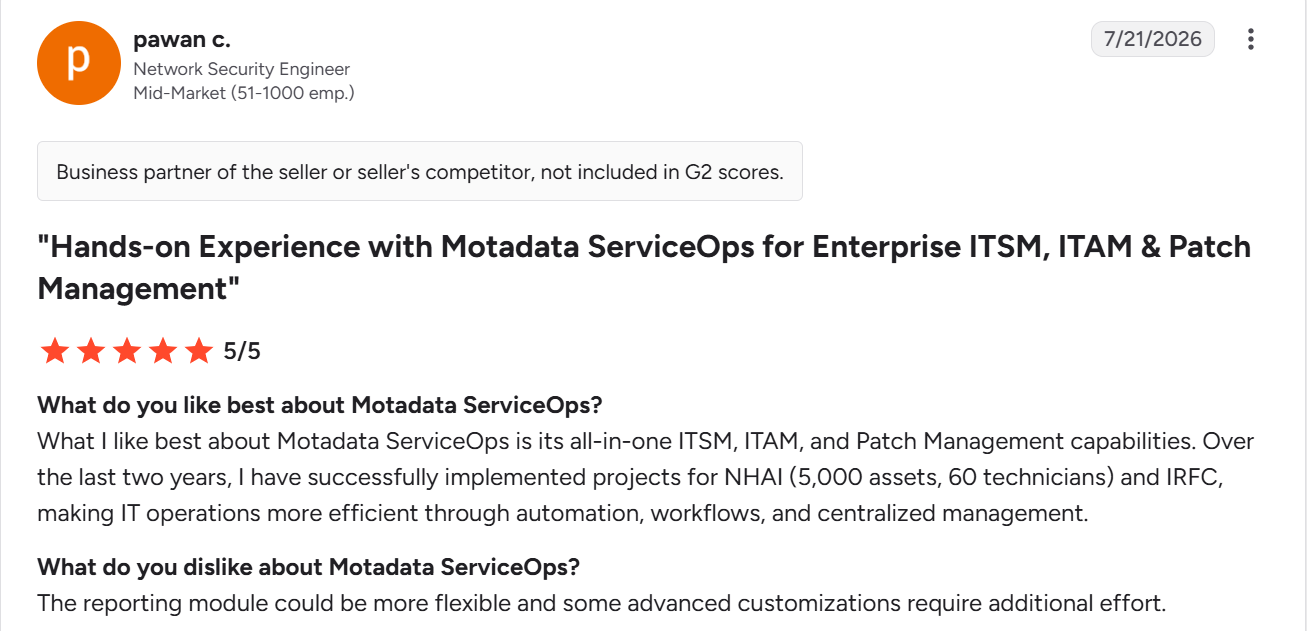
Read more of our G2 reviews here.
Pros
- Purpose-built for ITSM and ITOM, so agents work on real service data instead of a bolt-on integration layer.
- Governance and an on-prem option fit BFSI, government, telecom, and other regulated estates.
- Motadata reports strong outcomes: 60% faster ticket triage, 40% less manual workload, 90% accuracy in priority prediction and categorization, and 50% faster onboarding.
Cons
- It is built for IT service and operations. A team building general-purpose LLM agents outside IT will want a developer framework instead.
- It is a newer module, with a thinner public review footprint than long-established platforms.
- Pricing is quote-based, with no public per-seat number, so you need a sales conversation to size it.
- The reported outcome numbers are Motadata figures, not independently audited benchmarks.
2. LangGraph
Ratings: No dedicated G2 or Gartner Peer Insights listing yet (open-source framework).
Best for: Engineering teams building stateful, long-running, production multi-agent systems that need fine control over the flow.
Pricing: Free open-source core. The managed platform adds paid tiers (Plus from about $39 per seat per month); model tokens are separate.
LangGraph comes from the team behind LangChain. It models an agent workflow as a graph: nodes for steps, edges for the flow, all sharing one state object.
That gives you explicit control over branching, loops, and retries. You do not have to hope the model routes itself. Its real edge is durability.
LangGraph checkpoints the full graph state after every step. So a run can resume after a crash, rewind for a replay, or wait for a human to sign off.
3. CrewAI
Ratings: G2 4.5/5. Not listed on Gartner Peer Insights.
Best for: Teams that want to stand up role-based multi-agent crews quickly without hand-wiring an execution graph.
Pricing: Free open-source framework. The managed platform starts around $25 per month; model tokens are separate.
CrewAI is an independent Python framework, written from scratch rather than on top of LangChain. Its core idea is the crew: a team of role-playing agents that work a task together.
Each agent gets a role, a goal, and a backstory. CrewAI also offers Flows, for when you need a precise, deterministic pipeline instead.
Used together, crews and Flows let you move from open teamwork to tightly controlled steps in one project.
Pros
- Fast, intuitive onboarding; the crew model gets a working multi-agent app running with little code.
- Crews plus Flows cover a useful range from autonomous to deterministic.
- Lightweight and independent, with a large tool ecosystem.
Cons
- Advanced memory and knowledge features can be finicky and need tuning to work reliably.
- The higher-level abstraction gives less fine control than a graph framework for complex custom logic.
- Durability and deeper observability lean on the managed platform, and its limits can push cost up in production.
4. OpenAI Agents SDK
Ratings: G2 4.3/5. Not listed on Gartner Peer Insights.
Best for: Teams that want a lightweight, minimal way to ship multi-agent apps fast with clean agent-to-agent handoffs.
Pricing: Free open-source SDK. You pay only for model tokens and any hosted tools you use.
The OpenAI Agents SDK is small on purpose. It is the production-ready successor to OpenAI's experimental Swarm.
It leans on a few primitives: agents, handoffs that pass control from one agent to another, guardrails for input and output checks, and sessions for memory.
A runner drives the loop, and tracing is on from the start. The name undersells one thing. The SDK is model-agnostic and runs over 100 models through LiteLLM, so you are not chained to OpenAI.
Pros
- The lowest learning curve here; a working agent takes minutes and little boilerplate.
- A clean handoff model and default tracing make multi-agent debugging straightforward.
- Free, open-source, and genuinely model-agnostic despite the branding.
Cons
- Minimal abstractions mean less support for complex, long-running orchestration. There is no native equivalent to LangGraph checkpointing.
- Native persistence is thin, so resilient state usually needs external infrastructure.
- The best-integrated experience and hosted tools pull toward the OpenAI ecosystem.
5. AWS Bedrock Agents
Ratings: G2 4.3/5, Gartner Peer Insights 4.5/5 (Amazon Bedrock platform).
Best for: Teams already standardized on AWS that need to move agents from prototype to secure production without rebuilding infrastructure.
Pricing: Consumption-based, no upfront fee. Metered across runtime, memory, and more, plus model inference, so totals track your workload.
Amazon Bedrock, now extended by AgentCore, is AWS's managed way to build, connect, and run agents on its model catalog. It stays agnostic about frameworks and models.
So agents written in LangGraph or CrewAI run here too, alongside AWS-native ones. The pull is the AWS integration.
You get a serverless runtime, managed identity, memory, and enterprise guardrails, and you pick them up piece by piece.
Pros
- Framework- and model-agnostic, so you are not tied to one agent SDK or one model.
- Enterprise-grade security, identity, and isolation native to AWS.
- Modular, so you adopt only the components you need.
Cons
- Cost is hard to forecast across many separately metered components plus model inference.
- Real AWS lock-in; the value assumes you already run on AWS.
- Wiring the components together correctly carries a learning curve and operational overhead.
- Overlap between older Bedrock Agents and newer AgentCore creates some migration confusion.
6. Google Vertex AI Agent Builder
Ratings: G2 4.3/5, Gartner Peer Insights 4.4/5 (Vertex AI platform).
Best for: Google Cloud and Gemini-oriented teams that want an open framework backed by a managed, serverless runtime.
Pricing: Pay-as-you-go across runtime, memory, and search, plus Gemini model charges. The Agent Development Kit is free and open source.
Google's platform, built around Vertex AI, lets you build, scale, and govern enterprise agents.
Here, you write the logic in the open-source Agent Development Kit first. Then, you deploy it onto the managed Agent Engine runtime.
Its edge is data gravity. Agents get native access to Gemini and to Google Cloud stores like BigQuery and Vertex AI Search. The framework still supports plenty of non-Google models.
Pros
- The open-source kit avoids framework lock-in and can run outside Google if needed.
- Strong grounding on enterprise data through native Vertex AI Search and BigQuery.
- The serverless runtime removes infrastructure management when scaling.
Cons
- Usage pricing across several meters makes costs hard to predict.
- Full value assumes committing to Google Cloud and Gemini.
- Frequent product renaming creates documentation and naming confusion.
- Production setup with Terraform and IAM has a real learning curve for teams new to Google Cloud.
7. UiPath Agentic Automation
Ratings: G2 4.6/5, Gartner Peer Insights 4.6/5
Best for: Large enterprises with existing RPA estates that need to orchestrate agents, robots, and people across long-running, compliance-heavy processes.
Pricing: Platform license plus consumption, quote-based through sales. A free platform trial is available.
UiPath extended its RPA platform into agent orchestration, with Maestro as the control layer. Maestro is vendor-agnostic and built on BPMN process modeling.
It coordinates UiPath agents, third-party agents, robots, APIs, and people in one governed workflow. The point of difference is coverage.
Bots, AI agents, and human approvals sit under a single governance, audit, and observability layer, above the tools you already run.
Pros
- Truly vendor-agnostic orchestration that unifies robots, any-provider agents, and people.
- Enterprise-grade governance and human oversight built into the orchestration layer.
- Bridges mature RPA with agentic AI, protecting existing automation investments.
Cons
- Licensing is expensive and opaque, layered on top of existing platform costs.
- Full value assumes you are already a UiPath customer; it is less compelling greenfield.
- A heavier, more complex stack than a lightweight code-first SDK.
- The newest agentic components are recent and still maturing.
8. Zapier Agents
Ratings: G2 4.5/5, Gartner Peer Insights 4.5/5.
Best for: Operations, marketing, and RevOps teams that want no-code AI agents wired into their existing app stack without engineering help.
Pricing: Freemium, with paid tiers above a free plan. Agents meter on activities, so cost climbs at volume.
Zapier Agents is Zapier's AI-agent product, grown out of its earlier agent work. You describe an agent in plain language, and it acts across Zapier's connectors.
The agents ride the same integration layer as classic Zaps. So they can read data, decide, and fire multi-step workflows across your apps.
The headline advantage is reach. Agents plug into thousands of app integrations, far more than any CRM- or ITSM-native rival here.
Pros
- Unmatched integration breadth, so agents plug into almost any existing tool instantly.
- Genuinely no-code and fast to stand up for non-technical users.
- Flexible enough to span simple automations and multi-app agent workflows.
Cons
- Activity-based billing gets expensive fast at high volume, a common user complaint.
- Multi-step and frequent workflows burn through usage quickly, making cost hard to predict.
- Shallower reasoning and less deep customization than purpose-built enterprise platforms.
- Agents depend on connected apps for data, with limited native governance below the top tier.
9. Salesforce Agentforce
Ratings: G2 4.3/5, Gartner Peer Insights 4.4/5.
Best for: Salesforce-centric enterprises that want autonomous service, sales, and CRM agents grounded in their own customer data.
Pricing: A mix of consumption and per-user pricing that has changed often. Confirm the current model, since costs vary widely.
Agentforce is Salesforce's platform for autonomous agents across service, sales, marketing, and commerce. You assemble them in a low-code builder.
They reason through the Atlas Reasoning Engine, grounded in Salesforce Data Cloud and CRM records.
That grounding is the whole pitch. Agents act on trusted Salesforce data and workflows directly, with no bolt-on integration in between.
Pros
- Deep grounding for orgs already on Salesforce, with trusted data and native action on records.
- Strong enterprise governance through guardrails, testing, and observability.
- Rapid deployment via prebuilt agents for common service and sales cases.
Cons
- Cost is high and hard to forecast, and the billing models can produce surprises at scale.
- Heavy Salesforce lock-in; value drops sharply outside that stack.
- Frequent pricing-model changes make budgeting difficult.
- Real accuracy depends on clean, well-structured Data Cloud and org data.
10. Aisera
Ratings: G2 4.4/5, Gartner Peer Insights 4.4/5.
Best for: Large enterprises automating IT, HR, and customer-service desks with domain-specific agentic AI.
Pricing: Subscription and quote-based, with no public list price. Request a custom quote.
Aisera is an enterprise agentic-AI platform. It automates employee and customer support across IT, HR, finance, and customer service. Its agents work in layers.
A universal agent routes the request; domain agents add context, and task agents do the work in systems like ServiceNow and Workday.
Aisera ships more than 100 prebuilt agents.
The draw is depth in one area: IT and employee service, with contextual checks that cut down on wrong answers.
Pros
- Strong domain depth in IT and employee service, with many ready-to-deploy agents.
- Fast time to value, marketed at around 90 days, versus longer build-your-own projects.
- Real agentic AIOps that predicts and remediates incidents autonomously, beyond simple question deflection.
Cons
- Fully quote-only pricing makes evaluation and budgeting hard.
- Enterprise focus and setup complexity make it heavy for small teams.
- Tuning needs meaningful vendor involvement and clean knowledge sources.
- A narrower fit outside IT, HR, and service support than horizontal, connector-first platforms.
AI Agent Orchestration Platforms by Category and Use Case
The 10 platforms sort into five categories. Which one you want comes down to a single fork. Do you buy agents built for a job, or build your own?
Here is how the groups break down and who each one suits:
1. Domain and Vertical Enterprise Agents
Platforms: Motadata ServiceOps (ITSM and IT ops), Salesforce Agentforce (CRM), Aisera (IT and employee support).
What they do: Ship agents built for one business function, so you configure rather than code. Motadata ServiceOps, for example, runs agents for ticket triage, self-healing workflows, and runbook automation across IT operations management.
Best for: Teams that want fast time to value in one domain, plus regulated industries like BFSI, telecom, healthcare, and government where governance and data control matter most.
2. RPA and Agent Hybrids
Platform: UiPath Agentic Automation.
What it does: Joins traditional robotic process automation with AI agents and human approval.
Best for: Operations and shared-services teams in large enterprises that already run RPA and need to orchestrate bots, agents, and people across long, exception-heavy processes.
3. No-Code and Low-Code Automation
Platform: Zapier Agents.
What it does: Lets business teams build agent workflows across apps with no engineering support, on a very large connector library.
Best for: Smaller teams that want quick automations across many tools and can trade some depth for speed.
4. Cloud and Hyperscaler Platforms
Platforms: AWS Bedrock Agents, Google Vertex AI Agent Builder.
What they do: Managed platforms for building custom agents on the cloud you already run.
Best for: Cloud-native engineering teams on AWS or Google Cloud that want managed scaling and native access to their own data.
5. Developer and Code-First Frameworks
Platforms: LangGraph, CrewAI, OpenAI Agents SDK.
What they do: Give engineers the building blocks to code custom multi-agent systems with full control.
Best for: AI and software teams that want to design their own state, memory, and coordination instead of adopting a packaged product.
What to Look for in an AI Agent Orchestration Platform
Use these criteria to weigh platforms against your own needs. Each one maps to a real decision you will make during a trial.
Multi-agent coordination and handoffs: Check how the platform passes work between agents and whether it supports patterns like delegation and supervision.
State and memory management: Look at how it holds context within a run and across sessions, and whether state survives a crash.
Workflow control and human-in-the-loop: Confirm you can add branching, approvals, and human checkpoints where the work is sensitive.
Tool and system integrations: Count the connectors and APIs that matter to you, and test how easily agents call your own systems.
Governance, guardrails, and audit trails: For regulated work, require role-based access, approvals, and a record of what each agent did.
Build model: Decide whether a no-code builder, a low-code studio, or a code-first framework fits your team's skills.
Deployment and data residency: Match the hosting options, SaaS, cloud, or on-prem, to your compliance and data rules.
Pricing predictability: Model the bill as usage grows, since consumption and per-activity pricing can climb fast.
How to Choose the Right AI Agent Orchestration Platform for Your Team
Start from your situation, not from a brand name. This table points you to the category that tends to fit. From there, shortlist two or three tools and trial them.
Your Situation | Start With | Why |
Running an IT service desk or IT ops and want agents that triage and resolve tickets | Motadata ServiceOps Agentic AI and Orchestration | Purpose-built for ITSM and ITOM, with governance, RBAC, and an on-prem option |
Automating sales, service, or CRM interactions | A CRM-native agent platform | Agents grounded in your customer data |
Automating an IT or employee helpdesk at scale | A domain IT and employee-support platform | Prebuilt IT and HR agent workflows |
Automating multi-step processes with bots and humans | An RPA and agent hybrid platform | Combines RPA, agents, and human-in-the-loop |
A non-technical team wanting quick cross-app automations | A no-code or low-code platform | Fast to build, with many connectors |
Already standardized on AWS or Google Cloud | Your hyperscaler's agent platform | Native integration and managed scaling |
An engineering team building bespoke multi-agent systems | An open-source developer framework | Full control over state, memory, and coordination |
Choose the Right AI Agent Orchestration Platform for Your Business
The right AI agent orchestration platform comes down to one question. Do you want to buy agents built for a job, or build your own from a framework?
Engineering teams building custom systems will get the most from LangGraph, CrewAI, or the OpenAI Agents SDK. Cloud-native teams will lean on their hyperscaler.
IT and NOC teams have a clearer pick. If you want agentic AI for service management and operations, with governance and an on-prem option, Motadata ServiceOps is the closest fit.
Pick two or three, trial them against the criteria above, and let your own workflows settle it.
FAQs
What is the difference between single-agent and multi-agent orchestration?
A single agent handles a task alone. That works until the task gets complex or spans many systems. Multi-agent orchestration splits the work across specialist agents that plan, fetch data, and act in parallel. You gain speed and resilience, with more coordination to manage.
Do you need to be a developer to use an AI agent orchestration platform?
Not always. No-code and low-code platforms let business and IT teams build agents with little coding. Domain platforms like Motadata ServiceOps ship prebuilt agents you configure rather than program. Only code-first frameworks need real engineering. Pick the build model that matches your team's skills.
Can AI agent orchestration platforms be used for IT operations and service management?
Yes, and some are built for it. Motadata ServiceOps runs agents on your tickets, assets, and CMDB, handling triage, routing, and self-healing workflows. Domain platforms like this ship prebuilt IT agents, integrations, and governance controls, so teams get value faster than building on a general framework.
How is AI agent orchestration different from RPA and traditional workflow automation?
Traditional RPA follows fixed rules, so it repeats the same steps and breaks when a process changes. AI agents reason, adapt, and decide within guardrails, which suits work that varies or needs judgment. Many enterprises now combine both under one governance layer.
Author
Ramya Shah
Technical Writer
Ramya Shah is a technical content writer with a computer engineering background and roots in automotive journalism. He covers IT Service Management, observability, IT operations, and AI-driven automation. An early adopter of AI-assisted writing workflows, he turns complex IT processes into clear, engaging content optimized for search and answer engines (AEO), lifting content output and organic visibility.