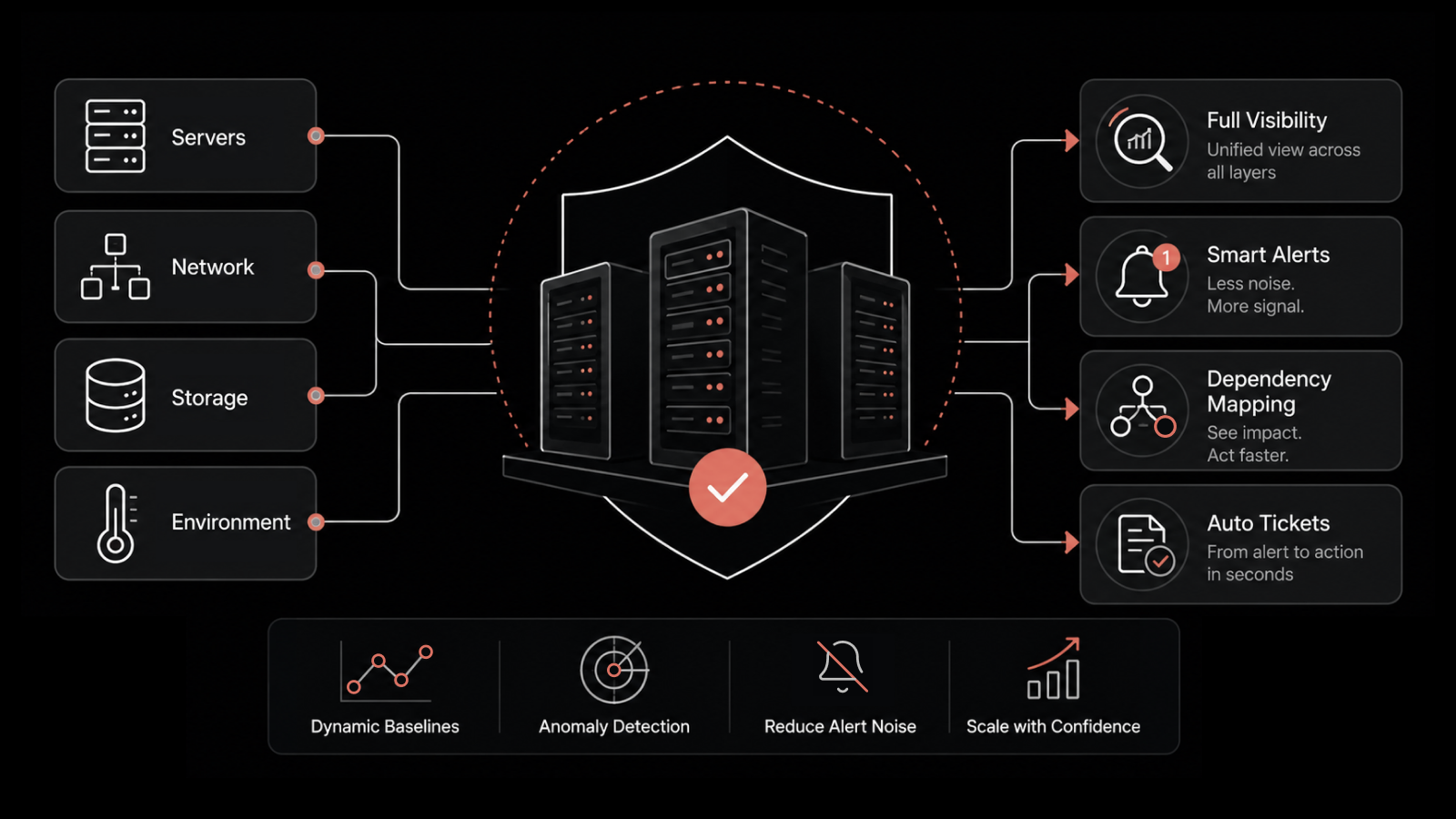
Why Siloed Monitoring Increases Your MTTR and How to Resolve It
Are you spending more time figuring out whose problem it is than actually fixing it?
If that feels familiar, you are not alone. Many IT teams start their day with multiple dashboards and tools, yet still struggle to understand what is wrong when something breaks.
Everything may look fine in one view, and fine in another, but the customer impact tells a different story. Incidents end up taking longer to resolve than they should.
This is not about effort or capability. It comes down to how monitoring is structured. When every team works from its own tools and its own view, no one sees the full system clearly. Each part looks correct in isolation, but the bigger picture gets lost.
The result is slower resolution, repeated handoffs, and unclear ownership during incidents. Over time, it also adds unnecessary operational cost without improving control or visibility.
This guide explores how this happens, what it costs, how to recognize it early, and how teams can move toward a more unified observability approach.
How Monitoring Silos Form (And Why They Feel Necessary at First)
No one sets out to build a siloed monitoring setup. It usually grows over time, for practical reasons that make sense in the moment, which is exactly why it becomes hard to unwind later.
1. The Logic That Made Specialized Tools Work
If you look back at earlier enterprise environments, things were much more segmented. You had network teams using SNMP-based monitoring tools, application teams using APM (Application Performance Monitoring) platforms, and database teams depending on vendor-specific performance tools.
Each of these tools did its job well. At that time, that level of separation worked.
A network issue stayed within the network layer. An application issue stayed within the application layer. The system boundaries were clearer, and problems rarely needed cross-team correlation to understand.
Specialization was not a weakness then. It matched the architecture that existed.
Then Modern Infrastructure Changed the Shape of Systems
Hybrid cloud, microservices, serverless components, and API-driven systems changed how everything connects.
Today, a single user request can pass through load balancers, gateways, multiple services, queues, databases, and external SaaS platforms, often spread across on-prem and multiple cloud environments.
When something slows down or fails, the cause can sit anywhere in that chain. Each tool still shows only its own slice. Network tools show traffic, APM tools show code paths, and cloud tools show resource usage within their boundary.
The system evolved. The monitoring tools stayed fragmented.
The Swim Lane Problem
This is where the swim lane effect appears. Each team works within its own boundary, using its own dashboards, alerts, and escalation paths.
When an incident spans multiple layers, resolution depends on bringing all these teams together and manually correlating information across different systems.
It works, but it is slow by design. And as systems grow more complex, it does not scale well.
Why Teams Hold on to Their Tools
This is also where things become harder to change, because teams are not being irrational.
A network engineer trusts the tools they have used for years. They know exactly how to interpret the data, and switching means losing that familiarity and productivity, at least for a while.
Over time, tools also become part of how teams work, communicate, and operate day to day.
There is also the budget structure. When each team owns its own tooling decisions, there is little incentive to consolidate.
Each group optimizes for its own stability and efficiency, even if the overall system becomes more fragmented.
Individually, these decisions make sense. Together, they create a system that is harder to operate than anyone intended.
What is the Business Cost Of Siloed Monitoring?
This is where the problem stops being theoretical and starts showing up in your day-to-day operations. The impact is not hidden. You can see it in incident timelines, cloud spending, engineering effort, and even compliance work.
1. Extended MTTR Through Escalation Delays
The most immediate cost you face is higher Mean Time to Resolution.
It usually starts with a simple alert in one of your monitoring tools. You investigate and find nothing unusual in your area, so you escalate. The next team does the same. Then it moves again.
After a few handoffs, you end up in a bridge call where everyone tries to piece together what happened by comparing dashboards and timestamps across different systems. Eventually, someone connects the dots, but only after significant time has passed.
In many cases, each escalation adds 15 to 30 minutes of delay. A problem that could be understood in minutes with unified telemetry often stretches to an hour or more in a fragmented setup.
When you multiply this across recurring P1 and P2 incidents, the cost becomes very real in your operational metrics.
2. Alert Fatigue From Redundant Noise
When different tools monitor overlapping parts of your infrastructure without coordination, they often alert on the same issue in different ways.
A single root cause, such as database connection pressure, can trigger multiple alerts across network, application, database, and infrastructure layers. From your perspective, it looks like several separate problems. In reality, it is just one.
This creates unnecessary noise for your on-call teams. Over time, they start ignoring alerts because many of them are duplicates or low value.
That is how alert fatigue builds, not from lack of attention, but from repeated overload.
The risk is that when a truly critical and unfamiliar issue appears, it gets lost in that noise.
3. Wasted Optimization Spend
Another cost shows up in how you try to improve performance.
Without a unified view, each team optimizes what they can see. You might spend engineering time tuning application code, while the real issue sits in infrastructure configuration.
Or you might scale infrastructure to handle latency that is actually caused by inefficient database queries.
From the outside, it looks like progress because work is happening. But in reality, effort is being spent on symptoms instead of root causes.
That means both engineering time and cloud spend get used inefficiently, without solving the actual problem.
4. Compliance And Audit Risk
As regulatory expectations grow, frameworks like DORA, SOX, and HIPAA require clear visibility into system behavior, incident response, and monitoring coverage.
When your data is spread across multiple tools with different retention rules and access models, it becomes harder to prove consistency during audits. You end up manually collecting evidence from multiple places just to show what should already be visible.
This does not only increase audit risk. It also turns compliance into a repeated operational effort every time requirements change.
5. The Human Cost Nobody Talks About Enough
There is also a cost that rarely shows up in dashboards.
When you are on call in a fragmented environment, incidents often turn into long sessions of switching between tools, joining coordination calls, and trying to figure out where the issue actually lives. Post-incident reviews often end with suggestions like improving communication between teams.
But communication is not the real problem here. The structure forces manual coordination in the first place.
Over time, this leads to fatigue and frustration. And it is important to recognize that this is not about people working poorly. It is about systems that make their work harder than it needs to be.
The 5 Warning Signs Your Organization Has a Siloed Monitoring Problem
Some teams already know they are dealing with fragmented monitoring. Others feel it, but do not have a clear way to confirm it. These five signs make it easier to recognize what is actually happening.
1. Incidents Are Only Resolved After A Cross-Team Meeting
If every meaningful incident ends up requiring a bridge call with multiple teams, you are not dealing with a coordination issue; you are dealing with a visibility problem.
In a well-connected observability setup, you should be able to follow the chain from symptom to root cause without needing to bring everyone into a live discussion.
When resolution depends on meetings instead of data, it means no single view of the system exists. Each call is a signal that information is still fragmented.
2. Every Team’s First Response Is “Not Us”
When something breaks, each team checks its own systems, finds nothing unusual, and moves the responsibility elsewhere.
That reaction is often misunderstood as defensiveness, but it is usually just a limitation of visibility. Each team can only see what their tools are exposed to.
So, when they say, “not us,” they are not avoiding responsibility. They describe the boundaries of their view. The real issue is that those boundaries exist in the first place.
3. You Run Multiple Monitoring Tools Without A Shared View
If you look across your organization and see separate tools for monitoring, logging, APM, and alerting, but no unified layer connecting them, you already have fragmentation.
The problem is not the number of tools on its own. It is the lack of correlation across them.
Without a shared view, each tool tells only part of the story. During an incident, that gap becomes the reason teams spend time stitching information together instead of solving the issue directly.
4. MTTR Is High But No Single Tool Explains Why
You know your Mean Time to Resolution is higher than it should be, but when you inspect individual tools, none of them clearly explain the delay.
That is because the delay does not exist inside any single system. It happens in between them.
It shows up in escalations, in context switching, and in the manual effort needed to correlate data across platforms. Each tool looks clean on its own, which is exactly why the real problem is hard to spot.
5. Your Industry Has Already Moved Ahead
Research from EMA indicates that most organizations are already moving toward full-stack observability approaches, with widespread adoption across modern infrastructure teams.
If you are still operating with isolated, domain-specific tools and no clear consolidation strategy, the gap is no longer theoretical. It becomes visible during every incident, where more unified teams resolve issues faster with less effort.
Over time, that difference compounds into both operational and competitive disadvantages.
From Silos to Unified Observability: The Consolidation Roadmap
Moving from fragmented monitoring to unified observability is not a single switch. It is a structured transition that starts with visibility, then moves into alignment, and finally into consolidation across teams and tools.
Step 1: Inventory All Current Monitoring Tools and Their Owners
Start by getting a clear picture of what you actually have in place.
List every tool used for monitoring, logging, alerting, tracing, and dashboards.
For each one, note who owns it, what it monitors, what it costs annually including licensing and maintenance effort, and which teams depend on it during incidents or planning.
This step often reveals more overlap than expected. You will likely find multiple tools covering the same systems without coordination between them.
That redundancy is important. It is usually the first place where you can identify cost savings and simplification opportunities, even before making any changes.
Step 2: Map Telemetry Gaps And Overlaps
Next, build a simple coverage matrix.
On one axis, list your key services and infrastructure components. On the other hand, map your telemetry types, including metrics, logs, traces, and events. Then identify which tools cover which areas.
This exercise typically exposes two patterns.
Overlaps show where multiple tools are generating signals for the same issue. These are sources of noise and duplicated effort. Gaps show where no tool provides visibility. These are blind spots, and they are often where the next major incident will surface.
Both are critical inputs for your consolidation plan.
Step 3: Define A Single Pane Of Glass Strategy
At this stage, the goal is not to replace everything at once. It is to establish a unified view that brings data from all existing tools into one correlated layer.
This allows your teams to continue using their current systems while you build a shared source of visibility across them.
OpenTelemetry has become the standard approach for vendor-neutral instrumentation. By adopting it for new services and gradually extending it to existing systems, you create a consistent telemetry pipeline that can feed into a single observability platform over time.
This approach protects your existing investment while keeping your future options open.
Step 4: Integrate CMDB And Service Dependency Data
Connecting your observability system with your Configuration Management Database or service catalog changes how incidents are understood.
Instead of looking at isolated metrics, you start seeing relationships between services, infrastructure, and dependencies.
When something degrades, you can immediately see what depends on it. You can also correlate performance issues with recent changes and automatically route incidents to the right owners based on service mapping.
At this point, your observability setup moves beyond monitoring and starts supporting actual service reliability.
Step 5: Enable Cross-Team Collaboration Workflows
Technology alone will not remove silos. You also need to adjust how teams work together.
Create shared dashboards that combine infrastructure, application, and business metrics in one place. Replace isolated runbooks with service-level runbooks that reflect how systems actually behave end to end.
You also need to adjust how post-incident reviews are framed. Instead of focusing on which team was responsible, shift the focus to where visibility broke down and why the issue was not detected or resolved faster.
That change in perspective is what starts aligning teams around the system instead of their individual tools.
Step 6: Add AI Correlation for Root Cause Identification
Once your telemetry is unified and dependencies are mapped, you can apply AI-driven correlation to identify patterns across the entire stack.
This is where the difference between traditional monitoring and unified observability becomes clear.
Instead of only telling you that something is wrong, the system can help you understand what caused it, where it started, and what other services may be affected. In some cases, it can surface this information before teams even begin an investigation.
That shift from reacting to diagnosing is what makes consolidation meaningful, because it directly reduces time to resolution and improves decision making during incidents.
What Factors To Check When Finding A Unified Observability Platform
Choosing a unified observability platform is not just a tooling decision. It is a long-term architectural commitment. If you get it wrong, you do not just replace a tool, you end up recreating silos in a different form or locking yourself into a new constraint. These are the key areas you should evaluate before making a decision.
1. Support For All Four Telemetry Types
You should first check whether the platform treats metrics, logs, traces, and events as equal, native data types.
The real value of unified observability only appears when all telemetry types are ingested, stored, and queried in the same environment. If a platform handles metrics and logs well but treats traces as secondary or optional, you will still end up with fragmented visibility, just inside one product instead of several.
That is a limitation that often becomes expensive later, because you end up rebuilding correlation layers that should have been available by default.
2. OpenTelemetry-Native Ingestion
You should ensure that the platform fully supports OpenTelemetry as a primary ingestion method.
This matters because it protects your instrumentation strategy. When your telemetry is built on OpenTelemetry, you are not tied to a single vendor format or SDKs.
If you ever decide to change platforms, you should be able to move without rewriting your instrumentation layer. Without this, switching costs become so high that you are effectively locked into your first choice.
Instrument-level neutrality is not optional in modern architectures. It is what keeps your system flexible over time.
3. AI-Powered Correlation and Anomaly Detection
You should look beyond basic alerting and evaluate how the platform uses AI for analysis.
The real advantage of unified observability appears when the system can automatically correlate signals across metrics, logs, traces, and topology data.
During an incident, especially at high severity, no one has time to manually connect all the dots. An effective platform should surface likely root causes and relationships between signals without requiring manual investigation across tools.
This is where AI becomes more than a feature. It becomes a way to reduce resolution time under pressure.
4. Customizable Service Topology Views
You should check whether the platform provides an accurate and continuously updated view of your service architecture.
Modern systems change frequently. Static diagrams or manually maintained maps quickly become outdated and misleading.
A useful platform should automatically discover services and dependencies and reflect those changes in real time. This helps you understand how issues spread across your system instead of relying on assumptions or outdated documentation.
If the topology is not accurate, it reduces trust in every insight built on top of it.
5. Pricing That Does Not Punish Data Volume
You should also carefully evaluate the pricing model, because it directly influences how much visibility you can afford.
If costs increase sharply with every log line or metric collected, you will eventually be forced to reduce instrumentation just to control spend. That leads to blind spots, which defeat the purpose of observability.
A better model is one that scales predictably with infrastructure size or usage commitments, not with raw telemetry volume. Your visibility should grow with your system, not be limited by cost per data point.
The ROI Of Breaking Down Monitoring Silos
The business case for moving away from siloed monitoring is no longer theoretical. The impact is measurable, and it shows up in three clear areas that reinforce each other over time.
1. Operational Efficiency Gains
When you consolidate monitoring into a unified observability platform, you reduce a significant amount of manual effort that is otherwise spent on correlating data across tools.
According to Gartner’s 2024 IT Operations Benchmark Report, organizations that move to unified observability see a 20 to 30 percent reduction in network and infrastructure administration effort.
Most of this improvement comes from removing the need to manually stitch together information during incidents. Instead of switching between tools and comparing outputs, your teams work from a single correlated view.
2. MTTR Improvement
Mean Time to Resolution is one of the most direct indicators of value.
Research from EMA shows that 64 percent of organizations report at least a 25 percent improvement in MTTR after adopting full-stack observability practices.
In environments where monitoring is heavily fragmented, the improvement is often even higher because the starting point is already inefficient. A large portion of incident time is spent just understanding where the issue is, not fixing it.
Once visibility is unified, that delay reduces significantly, which directly improves resolution speed.
3. Financial Return
Unified observability also delivers a clear financial return.
On average, organizations see around a 100 percent return on investment, with typical gains close to $500,000 depending on scale and complexity.
These returns come from a combination of reduced tool overlap, lower incident duration costs, and improved engineering productivity. When teams are no longer spending time manually correlating data, they can focus more on resolution and prevention of work.
Why These Benefits Increase Over Time
The impact of consolidation does not stay flat. It compounds.
As your teams start trusting the unified platform, they naturally improve their instrumentation. Better instrumentation produces better data. Better data enables more accurate correlation. More accurate correlation reduces incident resolution time even further.
Each improvement reinforces the next one, which is why the return continues to grow instead of stabilizing.
What You Should Do Next: Assess Your Monitoring Fragmentation
If the challenges in this guide feel familiar, the cost of delay is already showing up in your incident patterns.
A good starting point is a simple consolidation assessment. List your current tools, identify gaps in visibility, and measure how much time your teams spend correlating information during incidents.
These numbers are usually enough to make the problem clear without additional explanation.
You do not need to solve everything at once. Start with one meaningful use case where your current setup fails to provide a clear answer. Use that to validate improvement over a focused period, such as 90 days.
Once you see measurable improvement, expansion becomes a natural next step.
The real cost of siloed monitoring is not always obvious at first. But once you measure it clearly, it becomes much harder to justify leaving it as it is.
Frequently Asked Questions
What is siloed monitoring and why does it cause problems?
Siloed monitoring is when different IT teams each use separate, disconnected tools to monitor their own domain, with no shared view across layers. It causes problems because modern incidents rarely stay within one domain. When teams cannot see each other's data, they cannot identify root causes without manual coordination, which inflates MTTR and increases error rates.
What is the difference between observability and monitoring?
Monitoring tells you when something is wrong by checking predefined thresholds. Observability tells you why it is wrong by correlating signals across your entire system, including metrics, logs, traces, and events, and mapping relationships between services. Monitoring is reactive. Observability is investigative. You can read more about observability vs monitoring in this blog post.
How many monitoring tools are too many?
There is no universal number, but four or more disconnected tools with no unified correlation layer is a reliable indicator of a fragmentation problem. The issue is not the tool count. It is whether those tools share data in a way that allows any single responder to trace an incident from symptom to root cause without switching contexts.
How long does it take to consolidate monitoring tools?
A focused consolidation initiative with a clear lighthouse use case typically shows measurable MTTR improvement within 60 to 90 days. Full unification across all teams, with governance, AI correlation, and workflow integration, usually takes three to six months. The timeline depends more on organizational alignment than on technical complexity.
What is OpenTelemetry and why does it matter for consolidation?
OpenTelemetry is a vendor-neutral, open-source framework for generating and collecting telemetry data including metrics, logs, and traces. Standardizing on OpenTelemetry means your instrumentation is portable across observability platforms, so your investment is not tied to any single vendor. It is an architectural foundation that makes long-term consolidation feasible.
Does consolidating monitoring tools mean replacing everything at once?
No. The recommended approach is to implement a unified telemetry layer that ingests data from existing tools while you progressively reduce the tool count. This lets teams migrate at their own pace, reduces transition risk, and allows you to demonstrate ROI from the unified platform before decommissioning legacy tools.
Author
Jagdish Sajnani
Senior Content Strategist
Jagdish Sajnani is a B2B SaaS content strategist and writer. He has experience across different B2B verticals, including enterprise technology domains such as IT Service Management, AI-driven automation, observability, and IT operations. He specializes in translating complex technical systems into structured, engaging, and search-optimized content. His work improves product understanding, strengthens organic visibility, and supports B2B demand generation.