How to Execute Change and Release Management Together: A Practical Guide
Change and release management are two complementary ITIL practices -- change management controls the risk of modifications to IT services, while release management governs how updates and new capabilities are built, tested, and deployed into production.
Your team just approved a batch of infrastructure changes. Separately, a major application release is scheduled for the same maintenance window. Neither team checked the other's calendar. The result: conflicting deployments, a production incident at 2 AM, and a postmortem that could have been avoided.
This scenario plays out in organizations that treat change management and release management as independent processes. They aren't. When executed together, these practices reduce deployment risk, shorten recovery times, and give your IT operations team the predictability they need to deliver reliably.
What Is Change Management?
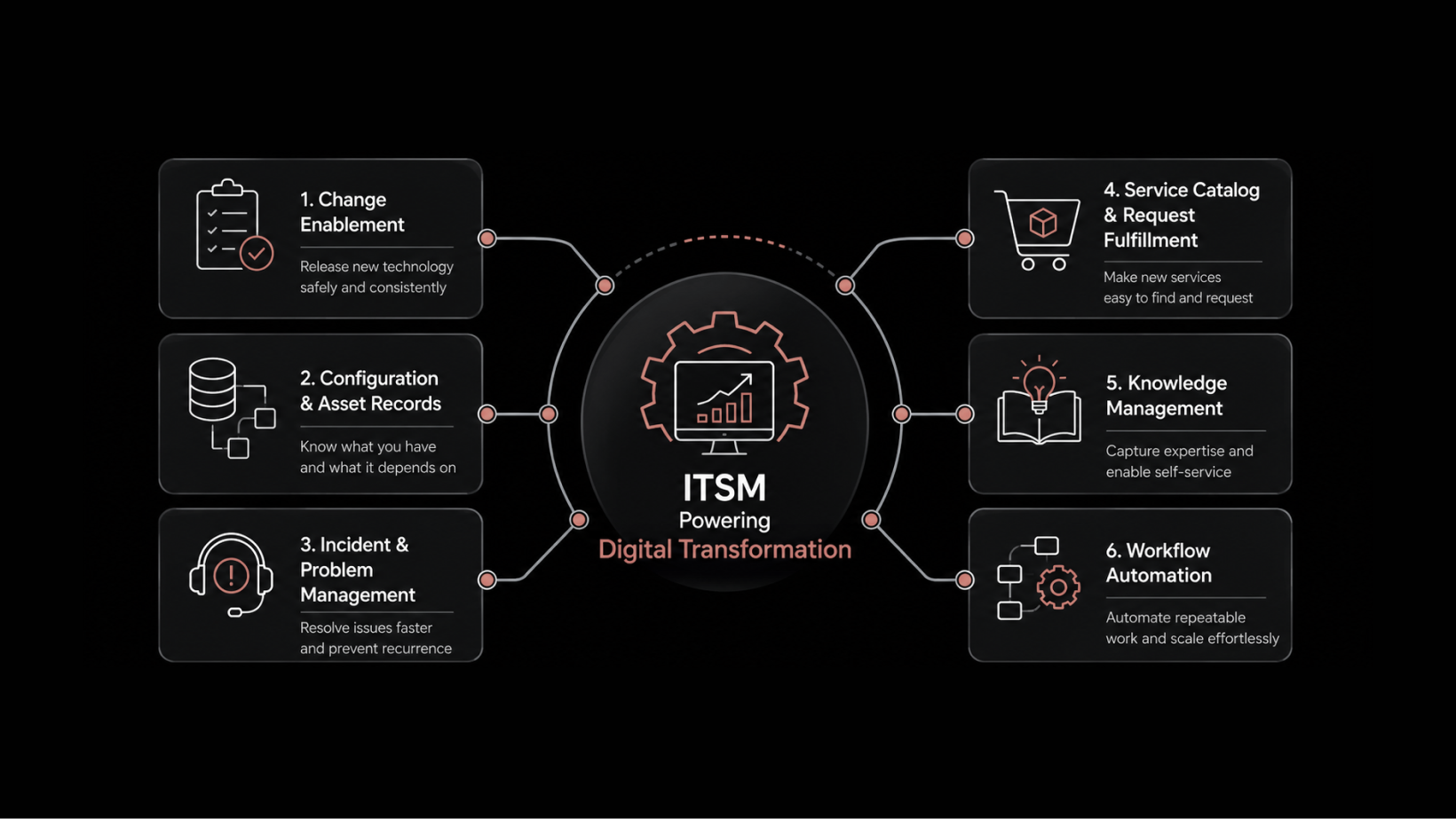
Change management is the ITIL practice of controlling modifications to IT infrastructure, services, and configurations. Its primary purpose is risk mitigation -- making sure that every change, whether it's a firewall rule update or a database schema migration, follows a structured workflow that minimizes disruption.
In ITIL 4, this practice is called change enablement, reflecting a shift from gatekeeping to facilitating safe change at speed. The goal isn't to slow things down. It's to make sure changes succeed on the first attempt.
The Change Management Lifecycle
Change identification: A technician, developer, or automated system raises a change request describing what needs to happen and why.
Assessment and planning: The change is evaluated for risk, impact, and resource requirements. An execution plan with rollback procedures is documented.
Approval and scheduling: Depending on the change type (standard, normal, or emergency), the request goes through appropriate approval -- from automated approval for pre-authorized standard changes to full CAB review for high-risk changes.
Implementation: The change is executed according to plan, with checks at each stage to verify expected outcomes.
Review and closure: After implementation, the change is reviewed for success or failure, lessons are documented, and the request is closed.
Types of Changes
Change Type | Approval | Example |
|---|---|---|
Standard | Pre-authorized; no CAB review | Password reset, user provisioning |
Normal | CAB review required | Server migration, network reconfiguration |
Emergency | Expedited approval; post-implementation review | Security patch for active exploit |
What Is Release Management?
Release management governs the end-to-end process of planning, building, testing, and deploying new or updated services into production. While change management asks "should we do this safely?", release management asks "how do we build, validate, and ship this effectively?"
A release can contain multiple changes bundled together into a single deployment package. This bundling is intentional -- it reduces the number of production touches and allows for coordinated testing across related changes.
The Release Management Lifecycle
Submission and planning: A release request is submitted with scope, timeline, phased rollout strategy, and contingency plans.
Build and configuration: The release engineering team assembles the release package, configures environments, and establishes the KPIs for validation.
Testing and quality assurance: QA teams validate the release against predefined acceptance criteria. This includes functional testing, performance testing, and regression testing.
Deployment: The release is deployed in phases to limit blast radius. Canary deployments or blue-green strategies help isolate risk.
Review and closure: Post-deployment review assesses whether the release met its KPIs, identifies issues, and captures lessons for future releases.
Change Management vs. Release Management: Key Differences
Understanding where these practices differ -- and where they overlap -- is essential for executing them together.
Dimension | Change Management | Release Management |
|---|---|---|
Primary focus | Risk mitigation and disruption prevention | Building, testing, and deploying releases |
Operational level | Strategic -- controls what changes happen and when | Operational -- manages how releases are delivered |
Scope | Individual changes (may or may not trigger a release) | Release packages (typically contain multiple changes) |
Post-execution | Impact assessment and change review | Version control and release validation |
Scheduling | Change calendar with maintenance windows | Release windows aligned to development sprints |
Key stakeholder | Change Advisory Board (CAB) | Release manager and engineering teams |
The critical insight: every release involves changes, but not every change requires a release. A firewall rule update is a change that doesn't need a release process. A new application version is a release that contains dozens of changes. When organizations treat these as completely separate workflows, things fall through the cracks.
How to Execute Change and Release Management Together
Aligning these practices isn't about merging them into one process. It's about creating clear integration points so both teams operate with shared context and coordinated timing.
Unify Your Change and Release Calendars
The single most impactful step is integrating your change schedule with your release schedule. When both calendars are visible in one place, you eliminate conflicts -- like scheduling a network change during a major application release window.
Use your ITSM platform to maintain a unified calendar that shows all planned changes and releases. Set up conflict detection rules that flag overlapping activities automatically.
Include Release Stakeholders in the CAB
Your Change Advisory Board should include representation from release management. When the CAB evaluates a change request, they need to know whether it conflicts with an upcoming release, whether the release team has dependencies on the same infrastructure, and whether bundling the change into an existing release makes more sense than executing it independently.
This cross-functional visibility reduces surprises and improves decision quality.
Define Scope and Impact Together
Before a release is planned, both teams should align on scope. Which changes are included in the release? Which are handled independently? What's the combined impact on production systems?
A comprehensive scope document should include:
All changes bundled into the release
Infrastructure dependencies shared across change and release activities
Combined risk assessment covering both individual changes and the release as a whole
Unified rollback plan that accounts for partial deployment scenarios
Build a Shared Communication Plan
When changes and releases are coordinated, communication must be coordinated too. Stakeholders need to know:
What's changing and when
Why the change or release is happening
Who's responsible for each phase
What the rollback plan is if something goes wrong
How success will be measured
A single communication plan covering both change and release activities prevents the confusion that comes from separate, sometimes contradictory announcements.
Track Unified KPIs
Measuring change and release performance separately gives you an incomplete picture. Track KPIs that span both processes:
KPI | What It Measures |
|---|---|
Change success rate | Percentage of changes implemented without incidents |
Release deployment frequency | How often releases reach production |
Failed change rate | Changes that required rollback or caused incidents |
Mean time to recovery (MTTR) | Time to restore service after a failed change or release |
Change lead time | Time from change request to production implementation |
Release defect rate | Issues discovered post-deployment |
Review these KPIs together in post-implementation reviews. Patterns in the data -- like failed changes correlating with specific release types -- drive continuous improvement across both practices.
Automating Change and Release Workflows
Manual coordination between change and release management introduces human error, delays, and inconsistency. Modern ITSM platforms automate the integration points:
Automated conflict detection flags when a change request overlaps with a scheduled release window.
Workflow automation routes change requests through the correct approval chain based on type and risk level.
Automated notifications keep all stakeholders informed as changes and releases move through their lifecycles.
Audit trails provide a complete record of who approved what, when, and why -- essential for compliance.
Integration with CI/CD pipelines connects release management workflows directly to development pipelines, enabling faster and more consistent deployments.
Automation doesn't replace judgment. It eliminates the manual steps where things get dropped and gives your team more time for the risk assessment and planning work that actually requires human expertise.
ITIL 4 and Modern Change Enablement
ITIL 4 renamed "change management" to "change enablement" for a reason. The emphasis shifted from controlling change to enabling it -- making it easier for teams to deploy changes safely and frequently rather than creating bureaucratic barriers that slow everything down.
This mindset shift aligns naturally with DevOps and agile practices. Standard, low-risk changes can be pre-authorized and deployed automatically through CI/CD pipelines. Normal changes follow a streamlined CAB process. Emergency changes have an expedited path with mandatory post-implementation review.
The result is faster deployments with appropriate risk controls at each level.
How Motadata ServiceOps Streamlines Change and Release Management
Managing change and release workflows across spreadsheets and email chains creates exactly the kind of gaps that lead to deployment failures. Motadata ServiceOps provides a unified ITSM platform where change requests, release plans, and approval workflows live in one place.
With automated routing, conflict detection, and built-in audit trails, your team spends less time on manual coordination and more time on the risk assessment and planning that prevents incidents. ServiceOps integrates change and release calendars so your CAB always has complete visibility into what's planned, what's in progress, and what's at risk.
Explore Motadata ServiceOps to see how unified ITSM brings change and release management together.
FAQs
What is the difference between change management and release management?
Change management controls the risk of individual modifications to IT services and infrastructure. Release management governs how multiple changes are bundled, built, tested, and deployed as a release package. Change management is strategic (deciding what changes are safe to make), while release management is operational (delivering the changes to production).
Why should change and release management be executed together?
Because releases contain changes, and poorly coordinated changes can disrupt releases. When both processes share calendars, stakeholders, and KPIs, organizations see fewer deployment failures, faster recovery from incidents, and more predictable delivery cadence.
What is a Change Advisory Board (CAB)?
A CAB is a cross-functional group that reviews and approves change requests based on risk, impact, and business priority. In organizations that coordinate change and release management, the CAB includes release management stakeholders to ensure complete context for approval decisions.
How does ITIL 4 handle change management differently?
ITIL 4 renamed the practice to "change enablement" and shifted the focus from gatekeeping to facilitation. Standard changes can be pre-authorized and automated. Normal changes follow a streamlined review process. The goal is enabling safe change at speed, not creating bureaucratic delays.
What KPIs should I track for change and release management?
Track change success rate, failed change rate, release deployment frequency, mean time to recovery (MTTR), change lead time, and release defect rate. Reviewing these together in post-implementation reviews reveals patterns that drive improvement across both practices.