SBOM vs CBOM: Software and Cryptographic Bills of Materials Explained
How confident are you that you know every component inside your software, and every algorithm guarding it? In practice, the answer is usually scattered across build tools, ticketing systems, and spreadsheets that stopped being accurate months ago.
A modern application draws on hundreds of open-source parts, and the encryption underneath them is harder still to trace. That visibility gap is what keeps the "SBOM vs CBOM" question alive in security and compliance reviews.
An SBOM records everything your software is built from. A CBOM records the cryptography that protects it, meaning the algorithms, keys, and certificates that keep data private. Both are inventories.
They differ on a single point: what each one actually counts. Settle that, and the question of which to build first mostly answers itself. What follows covers what goes into each inventory, how CBOM and SBOM compare, where they overlap, and how security and DevSecOps teams use them together.
What is an SBOM (Software Bill of Materials)?
An SBOM, or software bill of materials, is a machine-readable record of every component inside an application. Think of the ingredient panel on a food label, but for software.
It captures the parts a team selected on purpose, along with the ones those components introduced indirectly:
Supplier and component name
Version, down to the exact number
Dependencies, including transitive ones (parts pulled in by other parts, which you never picked yourself)
License terms, which surface legal risk early
A cryptographic hash for each part, which confirms nothing has been altered
Those fields align with the NTIA minimum elements, the baseline the US National Telecommunications and Information Administration set for what an SBOM must contain.
CycloneDX, from OWASP, came out of the security world and reflects that focus.
Because both are machine-readable, the tool that writes the file and the tool that reads it never need a translator in between.
An SBOM shows its value most clearly during a live security incident. When Log4Shell surfaced in December 2021, teams holding a current SBOM identified their exposed applications in minutes. Everyone else worked through nested build files by hand for days.
One limitation deserves attention. An SBOM tells you a component is in the build. Whether the vulnerable code ever runs is a separate question, and it isn't one the SBOM can answer. Closing that gap takes reachability analysis and VEX (Vulnerability Exploitability eXchange), and both come up further down.
What is a CBOM (Cryptographic Bill of Materials)?
A CBOM, short for cryptographic bill of materials, records the cryptographic components used in your software. It answers a sharper question than an SBOM does. What guards our data, and does that guard still hold?
A full CBOM tracks:
Encryption algorithms such as AES (used to protect data) and RSA (used to exchange keys and sign data), each with its key size
Keys and secrets, listed by their properties, never the raw key
Digital certificates, with their issuer and expiry date
Protocols such as TLS, SSH, and IPsec, down to the cipher suites a connection agrees on (the mix of algorithms it settles on)
Cryptographic libraries like OpenSSL that the code depends on directly
A CBOM extends the CycloneDX standard. Version 1.6 was the turning point. From there on, CycloneDX models every algorithm, key, certificate, and protocol as an asset in its own right, tied back to the software that uses it.
An entry can carry both a classical strength rating and a NIST quantum-security level. That second field is what makes a CBOM a practical planning tool for the shift to post-quantum cryptography. For most of the past decade, almost no one built one.
The situation changed for two reasons. Regulators now expect proof of an organization's cryptographic posture, and quantum computing has placed a firm deadline on the algorithms in common use. Both are covered next.
SBOM vs CBOM: The Core Differences
The difference between an SBOM and a CBOM comes down to scope. An SBOM enumerates every software component in a build. A CBOM enumerates only the cryptography those components rely on, and it describes that cryptography in far greater technical depth.
Dimension | SBOM | CBOM |
Scope | All software components | Cryptographic assets only |
Records | Packages, versions, licenses, dependencies, hashes | Algorithms, key sizes, certificates, protocols, cipher suites |
Core question | What is the software built from? | What cryptography does it use, and is it sound? |
Main owners | AppSec, DevSecOps, developers | Security architects, PKI and compliance teams |
Standard | SPDX, CycloneDX | CycloneDX 1.6+ (extends the SBOM) |
Maturity | Established tooling and mandates | Emerging, discovery tooling still maturing |
Main driver | Supply-chain security, licensing | Post-quantum migration, crypto compliance |
An SBOM gives you breadth across the whole software supply chain, while a CBOM gives you depth on the one layer most SBOMs pass over.
The two also serve different owners.
Ask what the software is built from and you're in SBOM territory, the day-to-day of developers, DevSecOps, and application-security teams.
Ask what cryptography that software runs, and whether any of it is weak, and you've moved into CBOM territory, where security architects and the PKI (public key infrastructure) and compliance teams work.
SBOM tooling and mandates are already well established. CBOM tooling is still maturing. Because a CBOM lives inside the same CycloneDX standard, most organizations under both supply-chain and quantum pressure end up keeping both.
How an SBOM and a CBOM Work Together
A CBOM is built to live inside a CycloneDX SBOM. Its cryptographic assets attach to the same list of components, so a single file can describe both what the software contains and what protects it.
The clearest payoff comes mid-incident. A new flaw lands in a cryptographic library that's deployed everywhere:
Your SBOM confirms the library is present in your product.
Your CBOM shows whether your code invokes the affected algorithm at all.
If it never touches the vulnerable path, you can publish a VEX statement, a short, evidence-backed note declaring that the flaw does not affect you.
A certificate problem or a broken algorithm then becomes a routine lookup.
A CBOM also fits within a wider family of inventories:
SBOM for software components
CBOM for the cryptography guarding them
HBOM for the physical hardware underneath
SaaSBOM and ML-BOM for cloud services and machine-learning models
Read together, these records are sometimes called a cybersecurity bill of materials.
Why an SBOM and a CBOM Both Matter
Both inventories exist to remove blind spots, the kind attackers and auditors each look for, and the pressure behind each comes from a different direction.
Why an SBOM Matters
A string of supply-chain attacks pushed the SBOM from optional to expected:
SolarWinds, in 2020, slipped malicious code into one trusted update and reached somewhere near 18,000 organizations.
Log4Shell struck the year after, catching a huge slice of the Java ecosystem in a single stroke.
Each time, defenders were left with the same deceptively small question. Where does this live in our environment? An SBOM answers that, and it answers it quickly.
Regulation caught up soon after:
Executive Order 14028 (May 2021) made an SBOM mandatory for any software sold to US federal agencies.
The NTIA defined the minimum elements every SBOM must include.
OMB memo M-22-18 layered on supplier self-attestation.
CISA followed with a maturity model built to ratchet expectations upward over time.
According to Gartner, organizations mandating SBOMs for critical-infrastructure software were projected to rise from below 20 percent in 2022 to 60 percent by 2025. For the teams running the software day to day, one SBOM feeds vulnerability management, asset management, and license checks from a single source.
Why a CBOM Matters
The CBOM answers to a deadline the whole industry can already see, and that deadline is quantum computing:
Many teams already run a harvest-now-decrypt-later approach: capture encrypted traffic today, store it, and unlock it the day a capable quantum machine arrives.
In August 2024, NIST finalized FIPS 203, 204, and 205 (Federal Information Processing Standards), its first post-quantum standards, which introduce the quantum-safe algorithms ML-KEM, ML-DSA, and SLH-DSA.
NIST IR 8547 sets the clock: public-key mainstays like RSA and ECDSA are marked for deprecation after 2030 and full disallowance after 2035.
PCI DSS 4.0 has required an inventory of cryptographic cipher suites and protocols under Requirement 12.3.3 since March 2025.
None of that migration works without knowing what you run, and a CBOM is the inventory it starts from. The price of skipping this step is not hypothetical. When Heartbleed hit OpenSSL in 2014, teams without a cryptographic inventory spent days tracking down every affected system. Hand them a CBOM and that same hunt collapses into one query.
Common Challenges with an SBOM and a CBOM
Producing a first SBOM or a first CBOM is straightforward. Keeping either one accurate, and turning it into something a team acts on, is where most programs struggle.
For an SBOM:
Transitive dependencies pile up. An application might declare thirty direct components and resolve to several hundred more beneath them, where most unmanaged risk hides.
A listed component may never run. Without reachability analysis to confirm what actually executes, the inventory floods triage queues with false alarms.
Freshness slips. A list rebuilt once a quarter no longer reflects what is shipping.
For a CBOM:
Discovery is the sticking point. Cryptography buries itself in compiled binaries, TLS configuration, keystores, and third-party libraries, so finding it means examining the source code and how it runs, which a simple package scan can't do.
Dedicated tools are emerging, including IBM's CBOMkit and support in the newer CycloneDX versions, though none yet covers a large environment fully.
Ownership is murky. Cryptography spans development, operations, and security, and a routine vulnerability assessment inspects software defects while saying nothing about cryptographic hygiene.
One caution applies to both. Each inventory doubles as a detailed map of your attack surface. Treat it that way: restrict access tightly, and store metadata about your components and cryptography while keeping the keys themselves out of it entirely.
When do you Need an SBOM, a CBOM, or Both?
For most teams the order is simple enough. Start with an SBOM, bring in a CBOM as cryptographic and regulatory pressure builds, and assume you will run both once the environment calls for it.
Choose an SBOM first if you build or buy software, track open-source license exposure, or answer federal procurement and attestation rules.
Choose a CBOM first if you're planning a move to quantum-safe encryption, managing large numbers of certificates and keys, or meeting rules like PCI DSS 4.0.
Run both in banking, healthcare, government, or critical infrastructure, where software risk and cryptographic risk run through the exact same systems.
7 Best Practices for Managing an SBOM and a CBOM
These seven practices separate an inventory people trust from one they ignore.
Generate them in the pipeline: Wire generation into your CI/CD pipeline so the SBOM and CBOM rebuild on every commit, with no one having to remember a manual scan.
Stick to open formats: Stay on SPDX or CycloneDX, and favor CycloneDX when you want software, cryptography, and VEX data in one file.
Capture the full dependency tree: Pull in transitive layers and, where the tooling supports it, reachability, so the record mirrors what truly runs.
Rebuild on every release: Anchor each inventory to a specific build, because last quarter's snapshot misstates what is live today.
Pair the list with VEX: Use exploitability statements to separate genuine exposure from components that are present but never executed, which keeps the remediation queue credible.
Lock the files down: Guard each one as a sensitive map of the attack surface, apply zero-trust access, and store only metadata.
Give it an owner and aim for crypto-agility: Name one accountable person, and treat the inventory as the foundation for swapping algorithms quickly (crypto-agility) when a standard changes or a primitive breaks.
Turn SBOM and CBOM Insights into Action with Motadata ServiceOps
Every point above ends at the same demand: prove it. That's the part Motadata ServiceOps was built for. It doesn't generate SBOMs or CBOMs, and doesn't claim to. It's the system where the obligations those inventories create become owned, deadlined, auditable work on the estate you already run:
A unified CMDB (the central record of every asset and the links between them), kept current by automated agent-based and agentless discovery, so a flagged component maps straight to the live systems running it via IT asset management.
Dependency mapping in the CMDB shows the blast radius, meaning which business services a vulnerable component or weak algorithm actually touches.
Software and license management carries usage tracking and compliance-violation alerts, plus automated end-of-service-life flags, so unsupported components surface before they turn into audit findings.
Patch discovery scans Windows, macOS, Linux, and third-party applications for missing updates, and closed-loop patch and vulnerability workflows carry each fix to completion under defined SLAs.
Every fix leaves a per-endpoint audit trail of deployment history and compliance status, the evidence shape auditors ask for, alongside reporting for PCI DSS, HIPAA, and SOX from the same platform. Our guide to patch compliance covers that discipline in detail.
A native tie-in with Motadata ObserveOps means monitoring alerts can open ServiceOps tickets, closing the loop from detection to resolution.
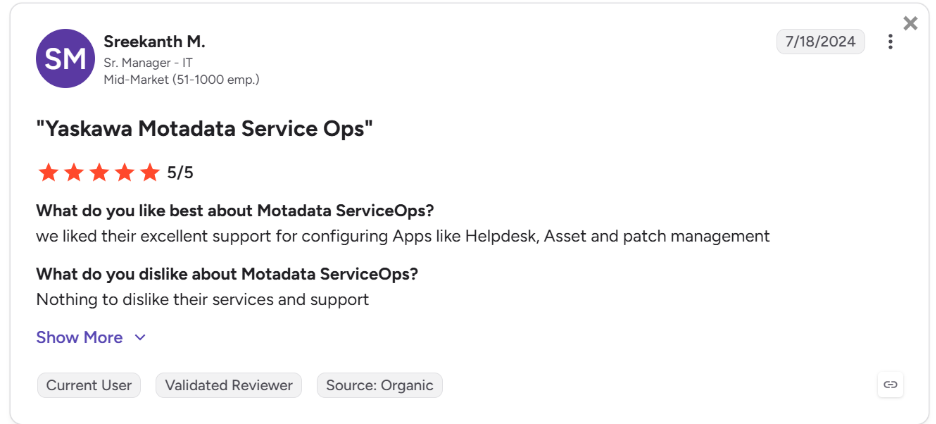
Here's what our customer "Sreekanth" say about Motadata ServiceOps on G2.
An inventory secures nothing by itself. It starts paying off the moment it drives something concrete, a patch, a certificate reissue, a migration plan. The direction across every mandate is the same: know what your software contains, know where it runs, and prove what you did about it. As SBOM mandates widen and the post-quantum deadlines of 2030 and 2035 close in, the teams that wire these pieces together now will meet the next standard with evidence that existed before anyone asked for it.
FAQs
What is the difference between an SBOM and a CBOM?
An SBOM lists every software component in an application, while a CBOM lists only the cryptography, such as algorithms, keys, certificates, and protocols. An SBOM gives you breadth across the software supply chain, and a CBOM gives you depth on the layer that keeps data private.
Is a CBOM part of an SBOM?
Since CycloneDX 1.6, a CBOM extends the SBOM inside the same standard, so cryptographic assets and software components can share one list. A CBOM adds cryptographic detail that a standard SBOM does not capture.
What formats are used for an SBOM and a CBOM?
SBOMs commonly use SPDX or CycloneDX, both open and machine-readable. CBOMs use CycloneDX 1.6 or later, which models algorithms, keys, certificates, and protocols as cryptographic assets.
Do you need both an SBOM and a CBOM?
Most regulated teams benefit from both, since software risk and cryptographic risk run through the same systems. Many teams begin with an SBOM for component visibility and add a CBOM as post-quantum and compliance demands grow. A platform such as Motadata ServiceOps then connects those inventories to asset and patch management, so teams can act on what they reveal.
How does a CBOM support post-quantum readiness?
A CBOM inventories the cryptographic assets used across your software, helping teams identify quantum-vulnerable algorithms, prioritize remediation, and plan migrations before the NIST 2030 and 2035 milestones. Combined with IT asset and patch management, those findings can be tracked through to resolution.
Author
Poonam Lalani
Content Strategist
Poonam Lalani is a B2B content strategist and writer with a background in computer engineering and experience across enterprise technology domains, including AI, cloud, DevOps, data engineering, and IT operations. She specializes in creating research-driven content that simplifies complex ideas and supports product education, thought leadership, and business growth.