Smart City Monitoring: How Network Visibility Keeps Cities Online
What happens when a city's traffic signals freeze at rush hour and nobody in the operations center knows why? For the teams running a connected city, that gap between a failure and its first clue is the worst place to be.
Smart city monitoring closes that gap. It gives operators a live view of every network, device, and service the city runs. A fault gets caught and traced before citizens ever feel it.
Without that visibility, small problems stay hidden until they spread. One congested uplink can drag down cameras, transit displays, and citizen portals at the same time. That is why proactive monitoring matters more as a city grows.
This guide covers what smart city monitoring tracks, the public services that depend on it, the security and privacy stakes, and how to choose a platform that can hold a whole city.
What Is Smart City Network Monitoring?
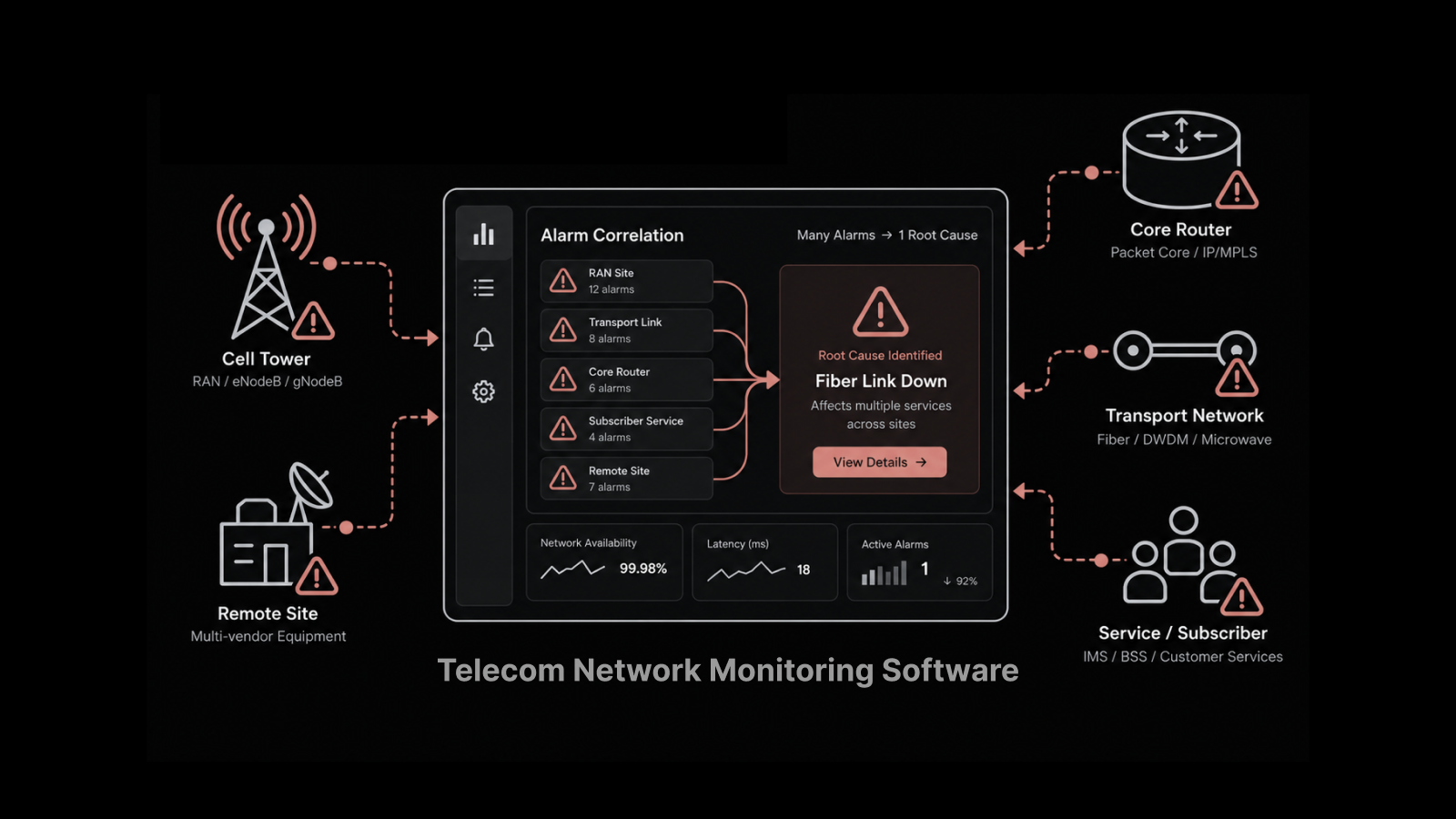
Smart city monitoring means tracking the networks, devices, and services that keep a connected city running. It watches every link, sensor, server, and application across the city. The moment performance slips, it flags the trouble.
A smart city is really a network of networks. Traffic systems, utilities, transit, surveillance, and citizen services each run on their own equipment. All of it shares one backbone, so monitoring has to see across every part at once.
Good monitoring puts all of that in one real-time view. Operators spot an issue and act on it before it disrupts an essential service.
Why Does Network Monitoring Matter for Smart Cities?
Smart cities never really close. Citizens expect traffic signals, transit apps, emergency lines, and water services to work at 2 a.m. as well as 2 p.m. That expectation puts the network under constant load and leaves little room for silent failure.
Network problems are also the most likely thing to break. Uptime Institute reports that network-related issues are the largest single cause of IT service outages. In a city where dozens of services share one backbone, a single unnoticed fault can ripple into downtime across several services at once.
There is a public dimension here too. A failed sensor network can delay an emergency response or hide a water-quality problem, so monitoring protects people, not only uptime. Catching issues early is where real-time monitoring earns its place.
What Runs on a Smart City Network?
A smart city packs many public services onto shared infrastructure, and each one leans on the network underneath it. These are the systems monitoring has to keep an eye on:
Traffic management, from smart signals to congestion sensors that adjust traffic flow in real time
Public transit, including vehicle tracking, passenger apps, and station systems
Video surveillance and CCTV, which support public safety and consume heavy bandwidth
Street lighting and smart poles that report status and energy use
Water, gas, and energy utilities, where a monitoring gap can turn into a public-health issue
Environmental sensors tracking air quality, noise, and weather across districts
Public Wi-Fi and citizen portals that citizens use every day
When these run well, the city feels smooth and almost invisible. When the network under them slips, the failures show up in public, which is why watching the connective layer matters as much as the services on top of it.
What Should Smart City Monitoring Track?
Watching services is not enough on its own. Useful monitoring pulls raw signals from across the estate into a few clear categories:
Network devices and links, from core routers and switches to field gateways at remote sites
IoT sensors and endpoints spread across traffic, metering, and environmental systems
Servers and applications that run civic services, dashboards, and portals
Traffic flow and bandwidth, so operators see congestion and unusual patterns as they build
Video and surveillance streams, which fail quietly when a link degrades
Logs and security events, which reveal both faults and intrusions
Reading these together is what separates real monitoring from a wall of graphs. A dropped camera feed and a saturated uplink often share a root cause, and network performance metrics read side by side reveal it far faster than isolated tools.
How Does Network Monitoring Support Public Safety and Security?
Smart cities widen the attack surface every time they add a device. Thousands of sensors, cameras, and controllers create thousands of entry points, many of them in the field and lightly secured.
The stakes are rising fast. Critical infrastructure accounted for 70% of attacks IBM's X-Force team responded to in 2024, and smart cities rely on exactly that infrastructure. Monitoring helps protect these systems by spotting unusual activity, such as suspicious log patterns or sudden traffic spikes, before an attack causes disruption.
Privacy matters as much as security. Smart city monitoring means watching infrastructure, not citizens, and city teams have to keep that line clear with data governance and access controls. Platforms that support compliance frameworks and can keep data on-premises help cities meet privacy rules while still watching their networks. Strong cyber resilience depends on seeing threats early, which is exactly what continuous monitoring provides.
What Makes Smart City Networks Hard to Monitor?
Scale is the first problem. A city network can span thousands of devices from many vendors, spread across districts, tunnels, poles, and buildings. No single team can watch that by hand.
Distance is the second. Field equipment sits far from the operations center, often on links that are themselves unreliable, so the monitoring has to survive patchy connectivity and still report accurately.
Then there is noise. When every minor blip pages someone, real incidents get lost in the flood and teams start ignoring alerts. That is often why monitoring loses its edge over time, the tooling still runs but no longer earns trust.
The mix of old and new adds to all of it. Cities layer modern IoT on top of legacy utility and traffic systems, and much of that older gear speaks limited protocols, the same challenge seen across IoT and edge networks. Pulling both into one view is harder than any demo suggests.
What Should You Look for in a Smart City Monitoring Platform?
Not every tool holds up at city scale, and picking the wrong one gets expensive fast. Uptime Institute found that 54% of major outages cost more than $100,000, and one in five exceed $1 million. So weigh each option against how a smart city actually behaves: distributed, always on, and full of mixed hardware.
A few capabilities separate a platform that copes from one that buckles:
Unified visibility that brings metrics, logs, and flows into one view instead of separate tools
Auto-discovery and topology mapping, so new field devices appear on the map without manual entry
Multi-site scale, with collectors that poll remote districts and report to a central server
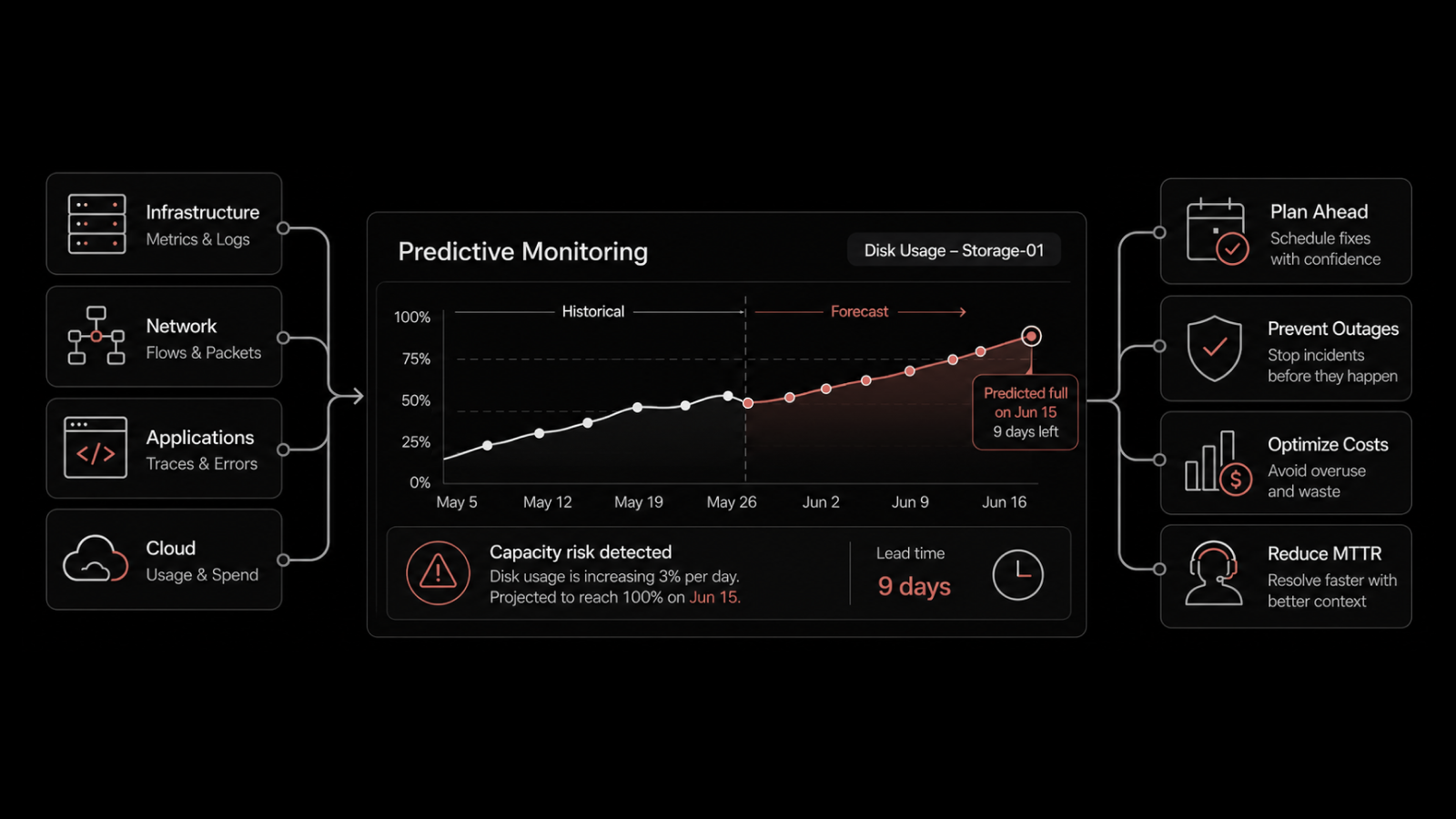
AI-driven anomaly detection that learns normal behavior and cuts alert noise instead of adding to it
Broad protocol support, including SNMP and flow data, to cover mixed and legacy gear
Security and compliance features that watch for threats and support data-privacy rules
Deployment choice across on-premises and cloud, so public data can stay where regulations require
Native ticketing, so a detected fault opens a work item on its own
Match the platform to the city, not the other way around. A tool built for a single data center will struggle the moment it has to watch fifty districts at once, so choosing the right platform comes down mostly to scale and breadth.
How Does Motadata ObserveOps Fit Smart City Monitoring?
We built Motadata ObserveOps for exactly this kind of distributed, always-on estate. It unifies metrics, logs, flows, traces, and topology on one platform, so a city team works from one view instead of stitching together five tools. That is what unified observability looks like in practice.
The design fits a city's geography. ObserveOps runs in a multi-site mode where collectors sit in each district and feed a central server, and it supports high-availability and disaster-recovery setups for services that cannot go dark. For remote field sites, the lightweight MotaAgent keeps reporting even when a link drops, then forwards its stored data once the connection returns.
The AI is built into the platform from the start. Motadata's DFIT deep-learning framework runs anomaly detection, noise reduction, and correlation across every signal, using adaptive AI that does not need weeks of pre-training. When it spots a fault, flow and log analytics triangulate the root cause, and a native tie-in with Motadata ServiceOps can raise and route the ticket automatically.
For public-sector needs, ObserveOps adds configuration and compliance checks against standards like CIS, GDPR, HIPAA, and SOX, and runs on-premises, in private cloud, or public cloud so city data can stay where the rules require. Motadata markets outcomes of 45% less downtime, 95% faster incident resolution, 80% MTTR reduction, and 55% cost optimization with the platform, figures it reports as customer results rather than independently audited benchmarks.
What Are the Best Practices for Smart City Network Monitoring?
Getting monitoring right at city scale comes down to a few habits that hold up over time:
Start with discovery and topology. Map every device and link before adding dashboards, so nothing runs unwatched.
Unify your signals. Keep metrics, logs, and flows on one platform so root cause is one search, not three tools.
Use dynamic baselines. Let AI learn normal behavior instead of setting static thresholds that age badly.
Tune alerts hard. Route only what matters, because intelligent alerting is what keeps teams trusting the system.
Watch security continuously. Treat log anomalies and traffic spikes as early warnings worth acting on.
Plan for scale and remote sites. Choose collectors and agents that survive patchy links and keep reporting.
Review effectiveness regularly. Check that alerts still map to real incidents, and retune them when they drift.
Where Smart City Monitoring Goes From Here
The hard part of smart city monitoring was never the sensors. It is the sprawl, the fact that one city runs dozens of public services on shared infrastructure, and a fault in one can surface anywhere. A tool that watches each district in isolation will always be a step behind.
We treat monitoring as the foundation a smart city sits on, visibility first, because you cannot manage what you cannot see. That approach asks for more upfront work. Unifying metrics, logs, and flows takes more setup than adding another point tool, and the payoff builds over months rather than in a first-week demo.
Still, the cities that get this right spend less time hunting faults and more time improving service for citizens, which is the whole reason monitoring matters. Start with one clear view of the network, and let the rest of the city grow on top of it.
FAQs
What is smart city network monitoring?
Smart city network monitoring is the continuous tracking of the networks, devices, and services that keep a connected city running. It watches links, sensors, servers, and applications in one place and flags faults before they reach citizens.
Why do smart cities need network monitoring?
Smart cities run public services that cannot afford silent downtime, and network issues are the most common cause of IT service outages. Monitoring gives operators an early warning so they can fix a problem before it spreads across traffic, transit, or utility systems.
What does a smart city monitoring system track?
A complete system tracks network devices and links, IoT sensors and endpoints, servers and applications, traffic flow and bandwidth, video streams, and security logs. Watching these together makes it far easier to trace a fault back to its root cause.
What are the biggest challenges in monitoring smart city networks?
The main challenges are scale, distance, noise, and a mix of legacy and IoT gear. A city network spans thousands of mixed-vendor devices across a wide area, and poorly tuned tools flood teams with alerts until the monitoring stops being trusted.
What features should a smart city monitoring platform have?
Look for unified visibility across metrics, logs, and flows, auto-discovery with topology mapping, multi-site scalability, AI-driven anomaly detection, broad protocol support, security and compliance features, and native ticketing. Together these let one platform hold an entire city rather than a single district.
Author
Poonam Lalani
Content Strategist
Poonam Lalani is a B2B content strategist and writer with a background in computer engineering and experience across enterprise technology domains, including AI, cloud, DevOps, data engineering, and IT operations. She specializes in creating research-driven content that simplifies complex ideas and supports product education, thought leadership, and business growth.